
LSA-2299
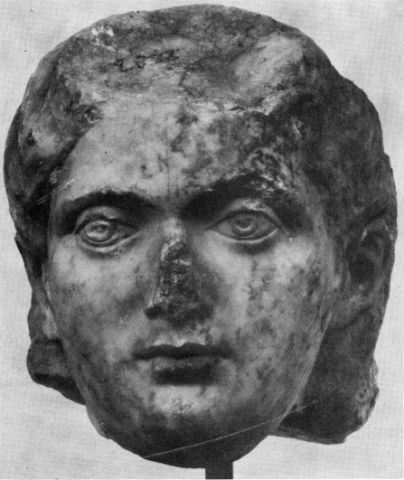
Portrait head of woman. From Athens. Mid to late third century
Record details
Photographs
Bibliography
- Datsoule-Stavride, A., Hysteroromaika Portraita 2ou - 4ou m(eta) Ch(ristou) Aiona sto Ethniko Archaiologiko Mouseio Athenon, Archaiologike Ephemeris 1981, 127-38, Athens 1983, p. 133 no. 2836 pl. 49 a
Discussion
DESCRIPTION (Object)
Portrait head of a young woman, neck broken. Pentelic marble, H 26, W 20.9, D 25.4 cm. The hair above the centre of the brow is broken off. According to Datsoule-Stavride 1981, 133 n. 2, the back side is not finished (the only published image is of the front side). The nose is chipped off and there is a large chip at the (proper) left eyebrow. Minor chips on both eyes; the surface is covered with stains but in a good state of preservation.
Articulation of the hair is not legible from the published photo.
The pupil is circumbscribed by a circular line, the iris drilled into a pelta shape (only visible on the proper left eye, the right is chipped).
PROVENANCE/ LOCATION
There is no published record on the provenance of the head. Today in the store rooms of the National Archaeological Museum in Athens, inv. no. 2836.
DESCRIPTION (Subject)
The portrait head depicts a young woman with a full chin and a small sensuous mouth. Her hair is combed in sinuous lines from the middle of the brow towards the ears and the back. The ears are free. In the back, the hair is combined into a broad central braid wich is looped onto the skull ('Scheitelzopffrisur') (Datsoule-Stavride 1981, 133; this is only rudimentary visible on the published photo). In front of the ears there are little locks hanging.
DATE
Datsoule-Stavride 1981 assessed the hairstyle as being that of the coin portraits of the empresses Ulpia Severina (270-5) and Magnia Urbica (283-5) and dated the head to the last decades of the third century.
The date given by Datsoule-Stavride is not convincing in our view. The hairstyles of Ulpia Severina and Magnia Urbica have been developed from fashion hairstyles with central braid earlier in the 3rd century. The characteristic feature of the late-3rd century hairstyles worn by the two empresses is the length of the braid which reaches up to the brow, and its beeing twisted into a loop. Both these characteristics are not visible from the feature of our head with its break at the decisive part. The central braid, combined with free ears, is a characteristic feature of female portraits of the mid-3rd century and the Gallienian period (Bergmann 1977, 89-101 pl. 26-31). A hairstyle comparable to our head is displayed by the Athenian head National Museum inv. no 451 (Datsoule-Stavride 1985 pp. 80-1 pl. 111-12). In our view, the head belongs to the Gallienian rather than the tetrarchic period.
Discussion references
- Bergmann, M., Studien zum römischen Porträt des 3. Jahrhunderts n. Chr., Bonn 1977
- Datsoule-Stavride, A., Hysteroromaika Portraita 2ou - 4ou m(eta) Ch(ristou) Aiona sto Ethniko Archaiologiko Mouseio Athenon, Archaiologike Ephemeris 1981, 127-38, Athens 1983
Cite: Last Statues of Antiquity, LSA-2299 (Ulrich Gehn).