
LSA-230
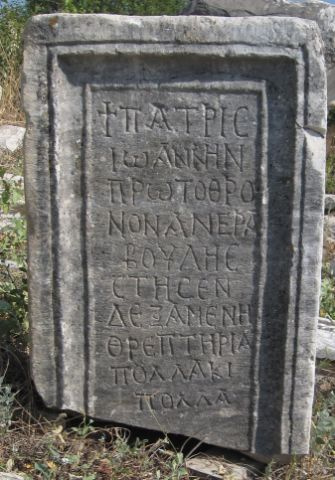
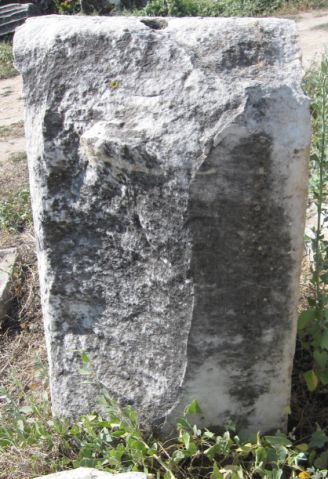
Base for statue of John, civic office holder. Aphrodisias (Caria). Late fifth to sixth century.
Record details
Photographs
Inscription
cross Πατρὶς / Ἰωάννην / πρωτόθρο/νον ἀνέρα /(5) βουλῆς / στῆσεν / δεξαμένη / θρεπτήρια / πολλάκι / (10) πολλά.
Inscription translation
The fatherland set up (this statue of) John, who has the first seat in the Council, having often received from him many repayments for his rearing.
(Trans: C. Roueché)
Bibliography
- Roueché, C., Aphrodisias in Late Antiquity (Journal of Roman Studies Monograph 5), London 1989, no. 73
Discussion
INSCRIPTION
Verse inscription of two hexameters laid out in ten lines:
cross Πατρὶς / Ἰωάννην / πρωτόθρο/νον ἀνέρα /(5) βουλῆς /
στῆσεν / δεξαμένη / θρεπτήρια / πολλάκι /(10) πολλά.
'The fatherland set up (this statue of) John, who has the first seat in the Council, having often received from him many repayments for his rearing.' (Trans: C. Roueché)
Letter height 3-4 cm.
DESCRIPTION
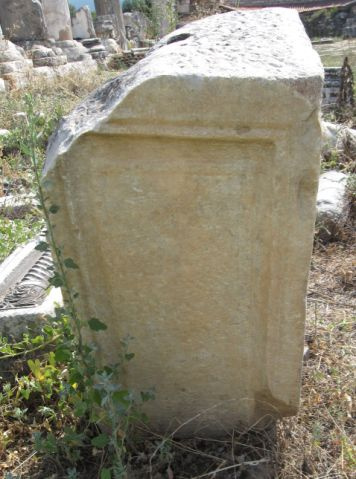
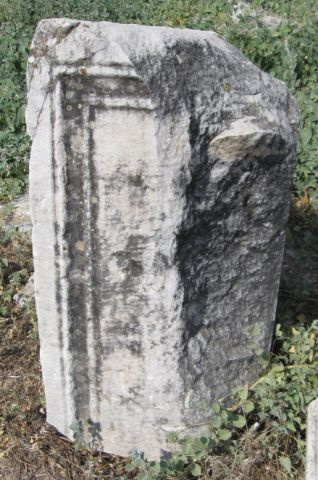
Rectangular shaft broken in two parts below the inscription. Upper part H: 78, W: 49, D: 39 cm. Lower part H: 53, W: 44, D:41 cm. White marble.
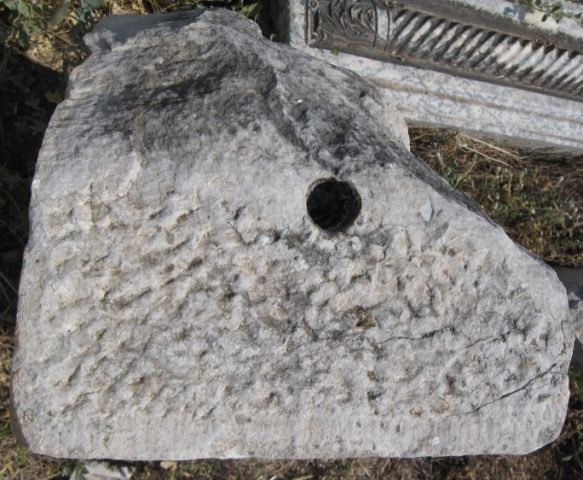
Most of the back proper left side of the base has broken off. The front and sides have the same framing moulding. The well-finished back is without moulding. The upper surface has a round central dowel hole which still preserves lead casing and was used to attach a moulded upper element. The bottom has traces of rectangular cutting, perhaps a lewis hole.
PROVENANCE
The base was excavated in 1965 in the temple of Aphrodite. It was re-used, face-down, as a step in the bema of the church. It was recorded by Roueché 2005 in the temple of Aphrodite, exc. inv. 65-511.
HONORAND, AWARDER AND DATE
The honorand John is a local Aphrodisian who was an important member of the Council. He is honoured by the fatherland and is said specifically to have provided appropriate returns for his rearing. The same expression is used on a base set up by the Council for Menander, an imperial-office holder from Aphrodisias, probably of the late fourth century (LSA-191)
The content provides little clue to the date. The use of hexameter has suggested to Roueché the influence of Nonnus which would place it no earlier than the later fifth century. She believes that the lettering belongs most probably in the sixth century.
Roueché understands this base in the context of a series of honours for locals in the later fifth or early sixth century at Aphrodisias; see also LSA-188, LSA-192 , LSA-194, LSA-226, LSA-232, LSA-233. Her conjectured flourish in prosperity and in the statue habit appears to be supported by the sculptural evidence: see LSA-173, LSA-175 , LSA-177, LSA-179, LSA-219, and an unpublished head excavated in 2011.
Cite: Last Statues of Antiquity, LSA-230 (J. Lenaghan).