
LSA-2300
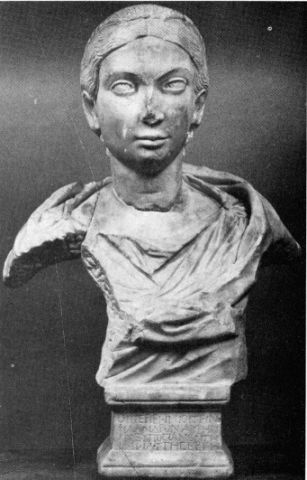
Portrait bust of Aurelia Euposia. From Melos (Insulae). Mid to late third century
Record details
Photographs
Bibliography
- Datsoule-Stavride, A., Hysteroromaika Portraita 2ou - 4ou m(eta) Ch(ristou) Aiona sto Ethniko Archaiologiko Mouseio Athenon, Archaiologike Ephemeris 1981, 127-38, Athens 1983, pp. 133-4 no. 424 pl. 49 d
Discussion
DESCRIPTION (Object)
Portrait bust of a woman on a rectangular base with inscription. Pentelic marble, H (overall) 67, (head) 23.1 , (base) 6; W (bust) 44.5, (head) 18.4, (base) 14 cm. The neck is broken at its base but fits into the breakline; at the (proper) left side a layer of marble is chipped off at the collarbone. Both arms are missing; the right shoulder is broken off but has been re-attached. The lower side of the bust where the arms are missing is roughly finished with a point, probably to prepare the area for a glue, and Datsoule-Stavride 1981, 134 n. 7 observes two dowel holes at the right side; the missing pieces were probably patched already in antiquity. The tip of the nose is chipped off, and the bulge of the himation in front of the breast is chipped at both sides. Datsoule-Stavride 1981, 134 n. 7 observes traces of read colour in the hair.
According to Datsoule-Stavride 1981, 134 the bun is not finished at the left side in the back.
Single strands of hair are articulated by a flat chisel; the hair is separated from the brow by a deep (drilled or chiselled) line.
The eyebrows are marked by short chisel strokes. The iris is circumscribed by an incised circular line, the pupil marked by two small adjacent round drill holes (Datsoule-Stavride 1981, 134). Above the left eyebrow, Datsoule-Stavride l. c. 134 notes an incised line from the sketch of the sculptor.
The eyes are set against the cheeks with a marked caesura, as is the small chin from the lower lip. A short fold runs vertical beside the left ala of the nose; Datsoule -Stavride l. c. 134 observes that the filtrum is indicated by a marked vertical line (not visible on the published image).
The conspicuous horizontal groove at the lower part of the neck is assessed as an individual feature of the portrait by Datsoule-Stavride, hence as deliberately incised by the sculptor.
The bust once included shoulders and breast. The garment is rendered with plasticity, distinguishing the different tissues of chiton and himation.
The foot has the shape of a cloddy base or altar moulded at top and bottom. It bears an inscription (Inscriptiones Graecae XII(3) 1126) laid out in four lines:
Οἱ περιβώμιοι τὴν / φίλανδρον Αὐρήλι-/αν Εὐπόσιαν ἐν τῷ / ἰδίω αὐτῆς ἔργῳ - 'The functionaries of the Asiatic cults (περιβώμιοι) (set this up to) husband-loving Aurelia Euposia in her own house'.
PROVENANCE/ LOCATION
The bust was found 1861 in Melos in an ancient building in the vicinity of the theatre, in the area called 'Treminthia'. The building had a mosaic floor; together with our bust two reliefs with inscriptions and two marble heads were found. In the find report (Filistor II 1862 p. 274; Bullettino dell'Instituto di corrispondenza archeologica 1862, p. 86; Archäologische Zeitung 1861 p. 234* (P. Pervanoglu)) the bust is described as headless. In the catalogues by Heydemann 1874 and Sybel 188 it is documented with head; Heydemann assumed that the head was found later; he does not consider, however, that two heads were found along with the bust. From the state of documentation it remains impossible to decide whether the head now mounted on the bust is one of the two found together with it and was adjusted later, or if it was found at a later date (Wolters, Athenische Mitteilungen 1890, p. 246 n. 1).
The bust is today in the National Archaeological Museum in Athens, inv. no. 424.
DESCRIPTION (Subject)
The portrait depicts a woman with central braid hairstyle ('Scheitelzopffrisur'), dressed in a chiton and a himation. Her hair is of little volume; it is parted above the middle of the brow from where it is led in long wavy strands to the ears and the back of the head. The ears are free. In the back, the hair is combined into a braid which is looped onto the skull. The braid is strikingly flat; on its surface it shows a braiding pattern of rhombic and triangular forms (from Datsoule-Stavride 1981, 134; not discernable on the published photo).
Slight irregularities lend an expression of asymmetry to the face. The right side of the face is broader than the left; the filtrum, the bridge of the nose and the centre parting of the hair are not in an axis; the eyes are irregular in shape and size, and the left eye is set higher than the right.
The chiton is buttoned on both shoulders; it is loosely fitting and has a wide aperture making the collarbones and part of the shoulders visible. The mantle (himation) is loosely draped over the chiton. The slightly 'revealing' drapery contributes to the individualization of the portrayed. Portraits on sarcofagi of the 3rd century occasionally stage the female beauty of the defunct in a similar manner relating it to the husband portrayed on the same sarcophagus at the same time; the connubial relation of our bust is secured by the inscription (and was possibly supported by a counterpiece).
The unusual altar-shape of the tabula is to allude to the religious affiliation of the honorand and thereby again underlines individual properties of the portrayed. There is no indicator, however, of a priestly office held by the portrayed.
An Aurelia Euposia is mentioned in a funerary inscription from Cyzicus (Corpus Inscriptionum Graecarum 3690); the woman in Cyzicus is the wife of Aelius Chrestion.
DATE
Kavvadias 1892, 267 no. 424 assessed the bust (and/ or the head?) as being 'of the later Roman period' ('τέχνης μεταγενεστέρων ῥωμαϊκῶν χρόνων'). Datsoule-Stavride, judging from the hairstyle and the technique, assigned a date as narrow as 283/5 to our bust.
The hairstyle with the central braid reaching up almost to the forehead is the most resilient criterium to date our portrait; it broadly assigns the head to the mid/ late third century (Bergmann 1977, 90). According to a rough rule of thumb the hairstyle starts with the empress Tranquillina (241; Kienast 1996, 197) and the braid extends towards the brow in the course of the century. The narrow date proposed by Datsoule-Stavride 1981 obviously follows the assumption that our head emulates the hairstyle of the empress Magnia Urbica (283-5; Kienast 1996, 262). Coin portraits of that empress do indeed show some similarities to the hairstyle of the bust in the only slightly sinuous hair and the braid lying flat on the skull (Bergmann 1977, Münztafel 5 nos. 7, 8). As many, however, are the differences: the ears of the empress are half covered, and the braid appears to reach the hairline above the central brow. Bergmann 1977, 90, moreover, points out that the length of the braid is not a reliable indicator of date. The portrait head of Tranquillina, Bergmann l. c. pl. 7, 3-4, has a braid with almost the same length as our head; it is, moreover, lying flat on the skull. A certain variability in length, broadth and volume of the braid appears in Gallienic female portraits (Bergmann 1977 pl. 26-31). The 'realistic' asymmetries in our head, in our view, support a date in mid 3rd century (cf. Bergmann 1977, 93); our brief considerations cannot, however, be conclusive. We therefore assign broad outer dates of 240/300 to our head.
Wegner 1976 has described the 2nd quarter of the 3rd century as a period when outstanding creativity and inventiveness was dedicated to the art-form of the bust. Our large bust with its 'individual' drapery would sit comfortably within this general context.
FURTHER DISCUSSION
The translation of the formula 'ἐν τῷ / ἰδίω αὐτῆς ἔργῳ ' has risen some speculation. Hiller v. Gaertringen (Inscriptiones Graecae XII(3) ) assumed that the inscription be funerary and the 'own works' that 'what the woman did when still alive' ('Fortasse sepulcralis est inscriptio et τὸ ἴδιον muliebris ἔργον id, quod ζῶστα fecerat'). Datsoule-Stavride proposed that the woman 'perhaps worked there, or that she liked the place and therefore set up the bust there as a sign of appreciation'. Speculations of this kind do not much enlighten the meaning of the inscription. ἔργον can be used in the sense of 'land; property; possession', and the obvious meaning of ἐν is local. In our view, the phrase ἐν τῷ ἰδίω αὐτῆς ἔργῳ is best understood as answering the question 'where?' and determining the location where the bust was set up, namely in the house of Aurelia Euposia. This would be in perfect accordance with the epithet φίλανδρος of the honorand. Another option is that the building with the large mosaic floor was for the religious practice of the Asiatic cults and was founded by Aurelia Euposia. - A similar dedication is known from Tralles where a statue to a woman of senatorial rank is dedicated ἐν τῷ ἔργῳ τῷ ἰδίω αὐτῆς by the agent of a religious community (Athenische Mitteilungen 21, 1896, 113). The lengthy inscription to Marcus Ulpius Carminius Claudianus in Aphrodisias was set up [ἐν ἰ]δίοις ἔργοις (Corpus Inscriptionum Graecarum 2782).
For the identity of the περιβώμιοι as agents of the Asiatic cults see Liddell & Scott s. v.
Discussion references
- Corpus Inscriptionum Graecarum;
- Inscriptiones Graecae; , XII(3) 1126
- Bergmann, M., Studien zum römischen Porträt des 3. Jahrhunderts n. Chr., Bonn 1977
- Heydemann, H. G. D., Die antiken Marmor-Bildwerke in der sog. Stoa des Hadrian, dem Windthurm des Andronikus, dem Waerterhaeuschen auf der Akiopolis und der Ephorie im Cultusministerium zu Athen., Berlin 1874, p. 281 no. 760
- Kavvadias, P, Glypta tou Ethnikou Mouseiou, Perigraphikos Katalogos, Athens 1890-1892
- Kienast, D., Römische Kaisertabelle. Grundzüge einer römischen Kaiserchronologie, Darmstadt (2)1996
- Sybel, L. von, Katalog der Sculpturen zu Athen, Marburg 1881, p. 115 no. 692
- Wegner, M. ,Bildnisbüsten im 3. Jahrhundert n. Chr., Festschrift für Gerhard Kleiner zu seinem fünfundsechzigsten Geburtstag am 7. Februar 1973, 105-32, Tübingen 1976
Cite: Last Statues of Antiquity, LSA-2300 (Ulrich Gehn).