
LSA-2301
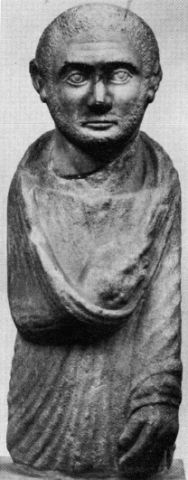
Small statue of bearded man wearing himation. Athens. Earlier fourth century.
Record details
Photographs
Bibliography
- Datsoule-Stavride, A., Hysteroromaika Portraita 2ou - 4ou m(eta) Ch(ristou) Aiona sto Ethniko Archaiologiko Mouseio Athenon, Archaiologike Ephemeris 1981, 127-38, Athens 1983, 135 no. 3382 pl. 50 b
Discussion
DESCRIPTION (Object)
The small scaled statue of Naxian marble is preserved down to the hips; H (total) 70, (of head) 21.4; W (of head) 19.4 cm. The head was broken and is now glued to the torso. A portion of the head is missing at the back. The surface is slightly worn and scattered with chips.
Hair and beard are plastically set off the flesh and are articulated by short thin chisel lines. Hairline and beard line surround the face in an oval that repeats the oval shape of the head.
The eyes are enlarged and protruding; the iris is circumscribed by an incised line. The eyebrows are marked by short diagonal chisel stroke.Tthey are almost horizontal with marked upheavals at the temples; the horizontal accent is taken up by the lips. The lids are bulky and set off the flesh by clear cut lines. The plastic values are reduced to few marked points (temples, cheekbones, chin), while the large areas of the flesh are smooth.
The folds of the garment are rendered as parallel ropes.
The head is oversized for the slim body.
PROVENANCE AND CURRENT LOCATION
There is no published account on the statue’s provenance. It is today in the store rooms of the National Archaeological Museum at Athens, inv. No. 3382.
DESCRIPTION (Subject).
The portrayed is a man of mature age, as indicated by the full beard; however, there are no wrinkles or other indicators of age. The hair is full; it is trimmed to the same length as the beard. The man has a large nose and small lips.
The portrayed is wearing a himation. His left arm hangs down at the body while the right one, wrapped in the garment, is held bent in front of the body, in a gesture well known from the late classical statue of the poet Sophokles.
The choice of costume identifies the portrait as a man of Greek education (paideia).
DATE
The statue was dated to the tetrarchic period by Datsoule Stavride 1981.
Some stylistic features of the head are paralleled by two heads in Athens, probably imperial portraits of the late tetrarchic or early Constantinian period (LSA-128, LSA-129); notably the scarce modelings, the way in which horizontal accents are set, and the way the eyes are worked into their environs. These features distinguish our head from the violently moved faces of the early tetrachic period in Athens (LSA-124, LSA-125, LSA-127).
The hairstyle with the short wavy strands, and the stylistic features of the head indicate a date in the earlier 4th century, in the late tetrarchic or Constantinian period.
FURTHER DISCUSSION
The parallel rope-like folds of the garment resemble the style of Egyptian workshops of the 3rd/ 4th century (LSA-560, LSA-836, LSA-840, LSA-841, LSA-1003, LSA-1004).
Cite: Last Statues of Antiquity, LSA-2301 (Ulrich Gehn).