
LSA-2302
Fragment of plinth inscribed CONSTANTINUS AUG. Rome. 312-337.
Record details
Photographs
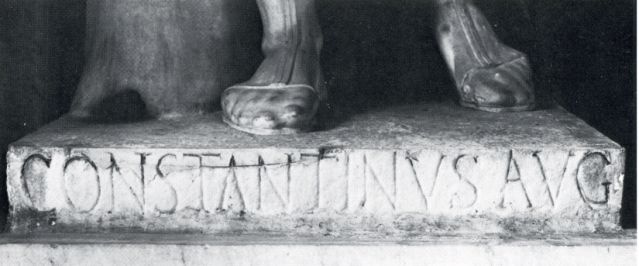
Inscription
Constantinus Aug(ustus)
Inscription translation
Constantine Aug(ustus)
Bibliography
- Corpus Inscriptionum Latinarum; , VI, no. 1148
- Heintze, H. von. 'Statuae quattuor marmoreae pedestres quarum basibus Constantini nomen inscriptum est', Mitteilungen des Deutschen Archäologischen Instituts, Römische Abteilung 86, Mainz 1979, pl. 129.1
Discussion
DESCRIPTION (Object)
Fragmentary inscription. H (of modern plinth): 16 cm. L (of ancient inscription): 124.5 cm. D (of ancient inscription): 3 cm. Lttr H: 11-12 cm. Marble
The ancient inscription has been set into a plinth which is 6 cm shorter than the inscription. Heintze (p. 413) calls this a plaque. The upper edges of the letters from the initial O to the second T have been restored.
PROVENANCE
The inscription was found on the Quirinal Hill in the 15th century with three statues, LSA-555, LSA-556, and LSA-559. It is unclear when this inscription was restored to the statue LSA-556. There are no images of the statue before it was moved to the Lateran in the early 1700s. According to H. von Heintze (pp. 407-408) the statue was restored in 1595 by Ruggiero Bescapè; it was restored again in 1737 when it was moved to the Lateran.
INSCRIPTION
Constantinus Aug(ustus)
Constantine Augustus
DATE
Constantine was Augustus from 309 until his death in 337. It is unlikely however that he would be referred to as Augustus in Rome before 312.
OBJECT
It is unclear what this inscription originally was. Its similarity in nomenclature and declension to LSA-555 and LSA-559 make it seem likely that it was from a plinth. Moreover, a mid-fifteenth century source speaks of four statues which are inscribed with the name of Constantine (see LSA-556). If, however, it were truly a plaque, its connection to a statue would be improbable.
Cite: Last Statues of Antiquity, LSA-2302.