
LSA-2303
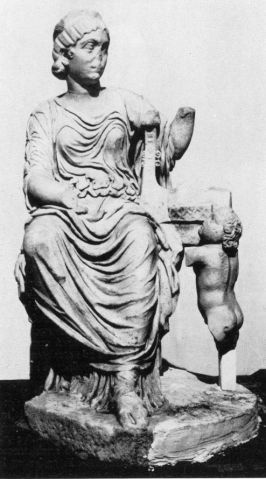
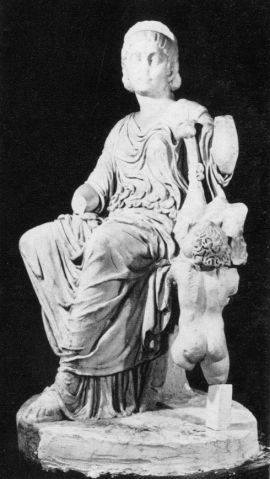
Portrait statue of woman playing lyre. From Tarquinia. Late third century.
Record details
Photographs
Bibliography
- Soprintendenza alle Antichità dell'Etruria Meriodonale. Museo Nazionale di Villa Giulia, Nuove scoperte e acquisizioni nell'Etruria meridonale, Rome 1975, 254-8, no. 7, pls. 76-7 (G. Bordenache Battaglia: late third century)
Discussion
DESCRIPTION (Object)
Over life-size statue group. H: 125, W: c. 76 cm. H (of head): 25, H (from chin to brow): 16, H (of plinth) 4-11, H (of Cupid): 50 cm. Carrara marble.
The group was originally carved with the plinth in one block. It is recomposed of four fragments. (1) statue of seated woman, (2) head of woman, (3) viewer’s left side of lyre, (4) Cupid from the thighs upwards. The left side of the plinth has been restored in cement.
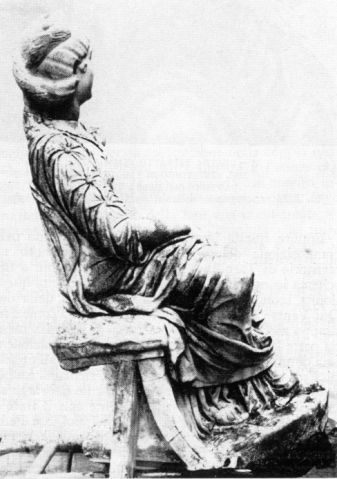
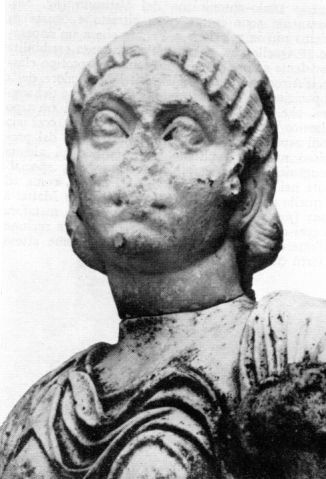
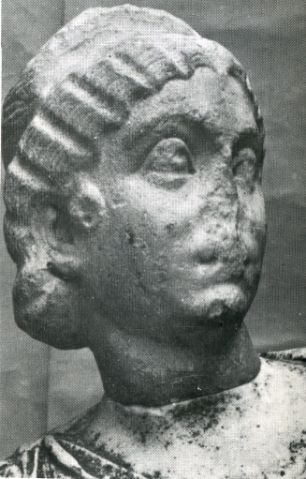
On the woman: both hands, the nose is missing; the lips are abraded. The viewer’s right of the lyre is missing. On the Eros: the arms (though the fingers of the right hand are preserved on the lyre), most of the legs, and the wings (which were separately worked). The chair is missing the back legs. The plinth is restored from fragments.
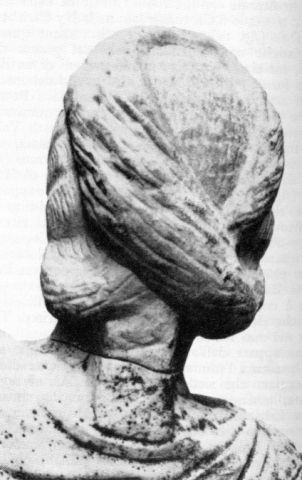
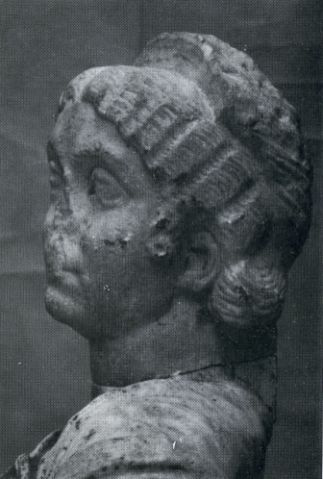
The front of the braid which wraps around the head has been worked for a join. It was to have been completed either in marble or plaster. The neck is supported by roughly picked pillar at the back. The pupils are deeply drilled and large. The inner corners of the eyes are also drilled. There is a drill hole at the centre of the curl in front of each ear.
PROVENANCE
Found in the area of Cazzanello, 10 km north of Tarquinia, in 1962. It was found on the property of Marchese Sacchetti c. 100 m from the sea. Other finds in this area include marble revetment of various colours, mosaics, and column fragments. There are also ancient walls along the edge of the water. All suggest that this was the site of a large Roman villa.
The statue was found upside down just below the surface. The head was found separately nearby.
DESCRIPTION (Subject)
The statue group shows a woman seated on a backless chair. Along her left side she holds a lyre with the aid of an Eros. Her right arm rests in her lap, and her left arm is raised, seemingly above the lyre.
She wears an ample chiton which has buttons along it sleeves and which appears in copious folds around the feet. It has slipped off her left shoulder. Over this she wears a sleeveless garment (peplos) that again falls off the left shoulder and outlines the upper edge of the left breast. It is belted. The belt is not visible but the edge of the overfold (apoptygma) and the blousing (kolpos) over a belt are. On her feet are sandals.
The head looks to her left, to the lyre. Her face is full, with dimpling at the naso-labial folds and around the mouth. The eyes are large with a straight lower lid but a high-arching upper lid. The eyebrows also have a high arch.
The hair leaves most of the tall brow exposed. It is parted in the centre and crimped around the face. It is pulled back around the ears into two large sections which are then wrapped around the head, forming a diadem of hair. In front of each ear is a small curling lock.
DATE
The hairstyle follows a fashion of the late third or early fourth century. The encircling braid style is first depicted in coins of Valeria Galeria in the early Tetrarchy. This is duly noted by Bordenache Battaglia but ignored by Brilliant who places it on the basis of the hair around the face in the mid-third century. The period of transition in fashion from crown braid to encircling braid probably began in the 280s and lasted into the first decades of the fourth century.
LSA-1552 (note especially the back view) wears a similar hairstyle. LSA-1194 and LSA-1298 are early examples of the encircling braid style which however have uncrimped hair around the face. LSA-256 shows a similar arrangement of hair over the brow but still features the crown braid.
INTERPRETATION
The statue uses an Aphrodite model. The drapery slipping off the shoulder and the overfold and blousing around the belt belong to fifth century images of Aphrodite. The cithara, however, indicates that the honorand is intended to be seen in the guise of the Muse.
Discussion references
- Brilliant, R. 'Una statua ritratto femminile dal territorio di Tarquinia', Bollettino d'Arte, Milan 1984, 1-12, figs. 1-5, 21, 23 (240-260)
Cite: Last Statues of Antiquity, LSA-2303.