
LSA-2305
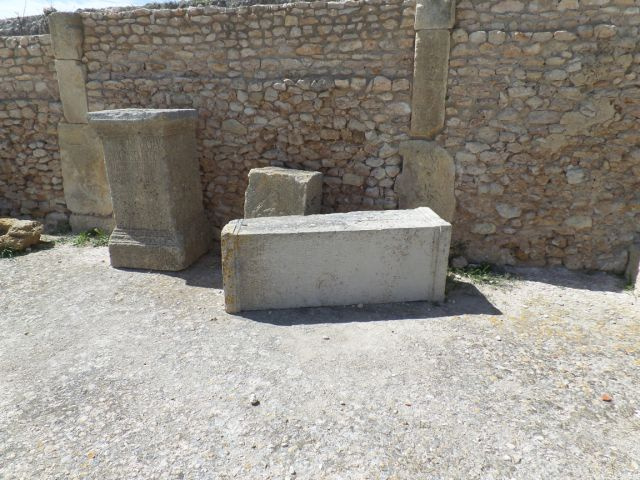
Base for statue of Didius Preiectus, local magistrate and benefactor (together with LSA-1744). Pheradi Maius (Byzacena). Fourth century
Record details
Photographs
Inscription
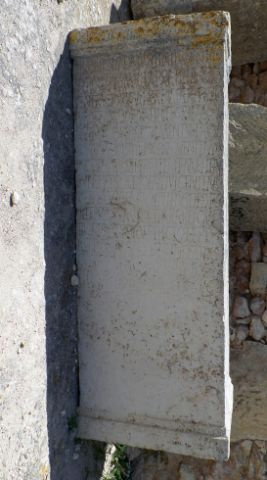
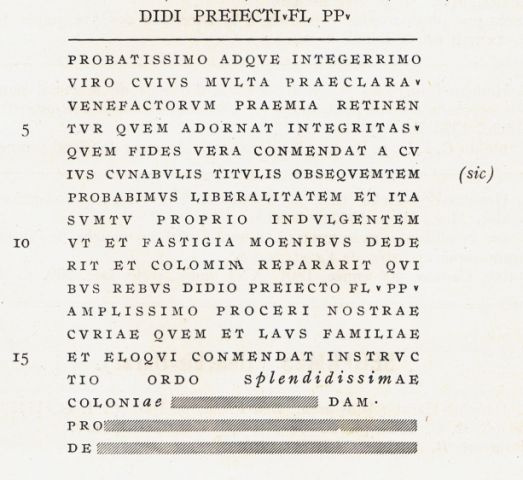
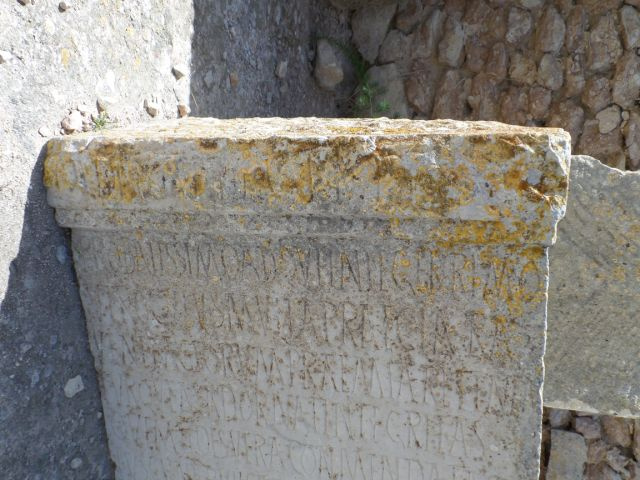
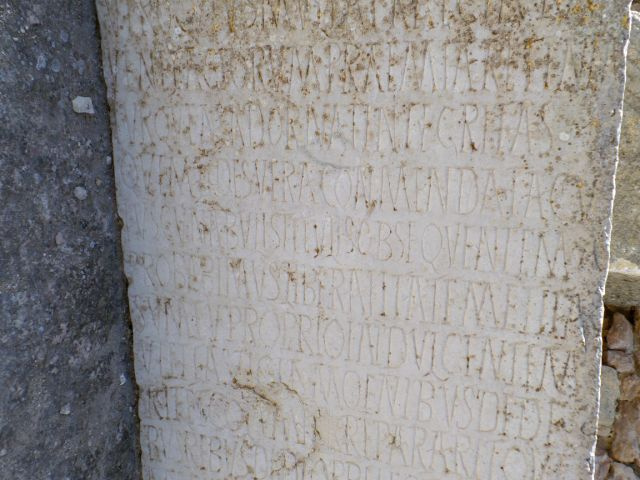
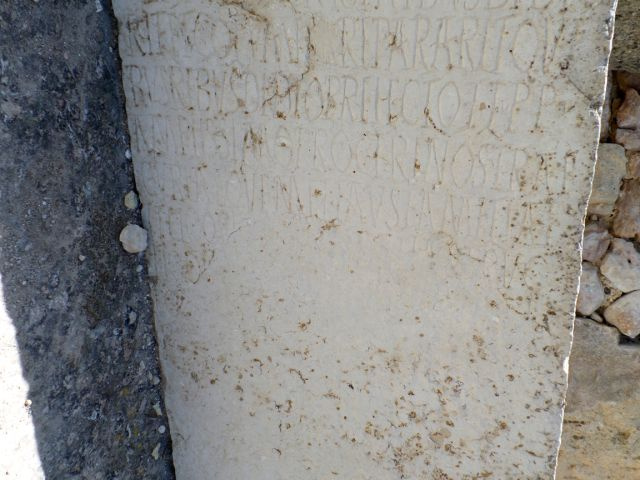
Didi Preiecti fl(aminis) p(er)p(etui). / Probatissimo adque integerrimo / viro, cuius multa praeclara / venefactorum (sic) praemia retinen/tur, quem adornat integritas, / (6) quem fides vera conmendat (sic), a cu/ius cunabulis titulis obsequemtem (sic) / probabimus (sic) liberalitatem, et ita / sum(p)tu proprio indulgentem / (10) ut et fastigia moenibus dede/rit et colomina (sic) reparaverit (sic). Qui/bus rebus Didio Preiecto fl(amini) p(er)p(etuo), / amplissimo proceri nostrae / curiae, quem et laus familiae / (15) et eloqui conmendat (sic) instruc/tio, ordo s[plendissim]ae / coloni[ae --- Phera]dam(aiensis) (?) / pro [---statuam] / de[dicavit (?) ---].
Inscription translation
[Statue of] Didius Preiectus, priest in perpetuity. To a most worthy and most blameless man, of whose benefactions many and excellent benefits are remembered, whom integrity adorns, whom true faith commends, of whose generosity following from his birthplace name (= family tradition) we give approval, and he is so generous with his own money that he gave roofs to the buildings and had the summits repaired. For these things, the ordo of the most splendid colony of Pheradi Maius has dedicated (?) ... to Didius Proiectus, priest in perpetuity, most noble father of our council, whom the glory of his family as well as his skill in speech recommends.
Bibliography
- L'Année épigraphique, , 1927, 28
- Merlin, A., Inscriptions latines de la Tunisie, Paris, 1944, 251
Discussion
INSCRIPTION
19 lines, of which the last three are partly illegible:
Didi Preiecti fl(aminis) p(er)p(etui). / Probatissimo adque integerrimo / viro, cuius multa praeclara / venefactorum (sic) praemia retinen/tur, quem adornat integritas, / (6) quem fides vera conmendat (sic), a cu/ius cunabulis titulis obsequemtem (sic) / probabimus (sic) liberalitatem, et ita / sum(p)tu proprio indulgentem / (10) ut et fastigia moenibus dede/rit et colomina (sic) reparaverit (sic). Qui/bus rebus Didio Preiecto fl(amini) p(er)p(etuo), / amplissimo proceri [father] nostrae / curiae, quem et laus familiae / (15) et eloqui conmendat (sic) instruc/tio [skill in speech], ordo s[plendissim]ae / coloni[ae --- Phera]dam(aiensis) (?) / pro [---statuam] / de[dicavit (?) ---].
'[Statue of] Didius Preiectus, priest in perpetuity. To a most worthy and most blameless man, of whose benefactions many and excellent benefits are remembered, whom integrity adorns, whom true faith commends, of whose generosity following from his birthplace name (= family tradition) we give approval, and he is so generous with his own money that he gave roofs to the buildings and had the summits repaired. For these things, the ordo of the most splendid colony of Pheradi Maius has dedicated (?) ... to Didius Proiectus, priest in perpetuity, most noble father of our council, whom the glory of his family as well as his skill in speech recommends.'
Letter height 5 cm.
We translate moenibus (line 5) not in its usual sense ‘defensive walls’, but in a more general sense as ‘buildings’, cf. Lepelley 1981, 301 n. 10.
DESCRIPTION (from Merlin 1944 and our own photos)
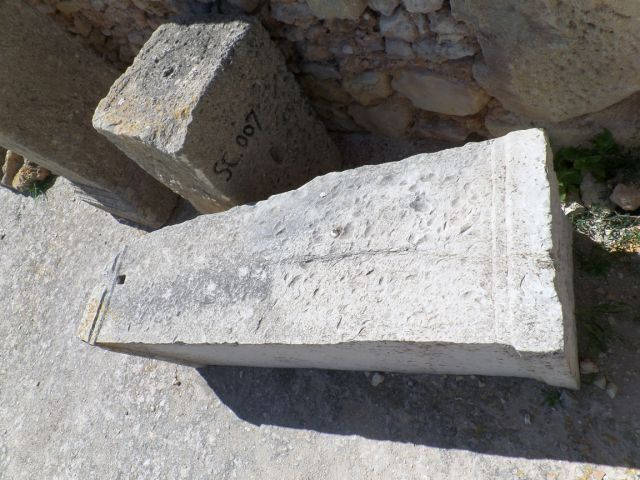
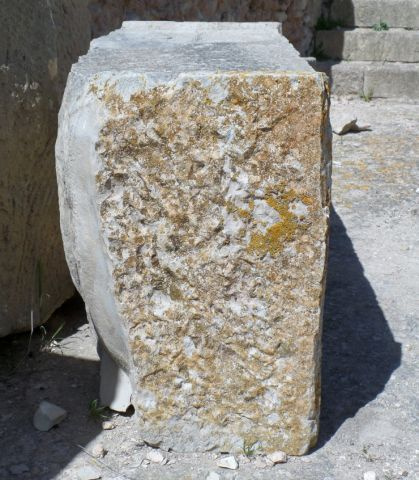
Rectangular base of white greyish marble with small mouldings at bottom and top; H 150, W 57, D 48 cm. All sides are finished; top and back face are only roughly finished with a claw. The first line of the inscription is carved on the upper moulding.
PROVENANCE AND CURRENT LOCATION
The inscription was found 1926 standing in situ in the southern colonnade of the forum of Pheradi Maius (Kleinwächter 2001, 188-90; http://www.trismegistos.org/place/17396). It is now lying at the western side of the forum.
Together with the inscription a statue was found, probably the portrait statue of Didius Preiectus (LSA-1744).
HONORAND, AWARDER AND DATE
Didius Preiectus, the honorand, was an outstanding local notable of Pheradi Maius. He was perpetual flamen (priest of the imperial cult in the city; line 1) and member of the city council (line 13).
The inscription was set up by the city council of Pheradi Maius (lines 16-17).
The mannered letter forms, the copious inscription, and the many mistakes in it lead Poinssot 1927, 59-60 to suggest a 4th century date for our inscription. This date has been accepted by Lepelley 1981 and Gascou 1982.
Discussion references
- Gascou, J., La politique municipale de Rome in Afrique du Nord, II. Après la mort du Septime-Sévère, Aufstieg und Niedergang der Römischen Welt II, 10, 2, 230-320., Berlin 1982
- Kleinwächter, C., Platzanlagen nordafrikanischer Städte : Untersuchungen zum sogenannten Polyzentrismus in der Urbanistik der römischen Kaiserzeit, Mainz, 2001
- Lepelley, C., Les cités de l'Afrique romaine au Bas-Empire, t. 2, Notices d'histoire municipale, Paris 1981
Cite: Last Statues of Antiquity, LSA-2305 (Ulrich Gehn).