
LSA-2309
Fragmentary base for statue of local notable (name lost), later re-used for Maximian, emperor. From Thysdrus (Byzacena). 286-305
Record details
Photographs
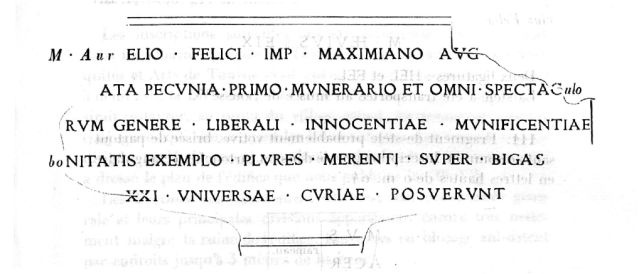
Inscription
[--- Aur]elio, felici imp(eratori), Maximiano Aug(usto) [---] / [---]tata pecunia primo munerario et omni spectac[ul---] / [---]rum genere liberali, innocentiae munificentiae / [benig]nitatis(?) exemplo, plures merenti super bigas [---] / [---]XXI universae curiae posuerunt.
Inscription translation
... Aurelius, fortunate emperor, Maximianus Augustus ... money...to the first giver of gladiatorial games, generous (liberalis) with respect to all kinds of spectacles, an example of innocence, munificence, benevolence, who deserved more than many two-horsed chariots ( bigas) … XXI (?) the collective of councils (?) set (this) up.
Bibliography
- Corpus Inscriptionum Latinarum; , VIII, 22852
- Lepelley, C., Les cités de l'Afrique romaine au Bas-Empire, t. 2, Notices d'histoire municipale, Paris 1981, 321
Discussion
INSCRIPTION
Partly preserved in five lines:
[--- Aur]elio, felici imp(eratori), Maximiano Aug(usto) [---] / [---]tata pecunia primo munerario et omni spectac[ul---] / [---]rum genere liberali, innocentiae munificentiae / [benig]nitatis(?) exemplo, plures merenti super bigas [---] / [---]XXI universae curiae posuerunt.
'To ... Aurelius, fortunate emperor, Maximianus Augustus ... money...to the first giver of gladiatorial games, generous (liberalis) with respect to all kinds of spectacles, an example of innocence, munificence, benevolence, who deserved more than many two-horsed chariots ( bigas) … XXI (?) the collective of councils (?) set (this) up.'
Letter height 2.5 cm.
DESCRIPTION (from Gauckler 1907 and CIL VIII)
Fragment of a marble base broken at both sides, H 30, W 43, D 28 cm. The first line is carved over a depression, possibly an erased earlier inscription. It was possibly added at a later time to the inscription.
The inscription refers to a biga (two-horsed chariot) which was set up on top.
PROVENANCE AND CURRENT LOCATION
The inscription was found in 1904 in El-Djem, the region of ancient Thysdrus (http://www.trismegistos.org/place/11845). From there it was transferred to the Soussa museum (without inv. no.) where it was recorded by CIL VIII in 1916. There is no more recent account of its location.
HONORAND, AWARDER AND DATE
The name of the honorand is lost in our inscription (and was possibly replaced at a later time by the imperial name of Maximian, see above, ‘Description’). The biga was dedicated to a local man whose generosity as a giver of games was outstanding
The honorands are the ‘collective councils’ (or: ‘of the entire council’ ?) (line 5). This word is preceded by two letters which were completed to XXI by the authors of CIL VIII. If so, this number possibly refers to the number of city councils in the province which participated in the erection of this statue.
The inscription is dated by the imperial name of Maximian (full name Marcus Aurelius Valerius Maximianus), Augustus 286-305 (line 1). However, it is possibly originally from an earlier date (see above, second to last paragraph, and ‘Description’).
Discussion references
- Chastagnol, A., Les Gouverneurs de Byzacène et deTripolitaine, Antiquités africaines, 1,1967, 119-134
- Gauckler P., Nouvelles archives des missions scientifiques et littéraires, XV, Paris, 1907, 343 no. 109
Cite: Last Statues of Antiquity, LSA-2309 (Ulrich Gehn).