
LSA-231
Plaque from base for statue of emperor, possibly Justinian. Aphrodisias (Caria). Sixth century.
Record details
Photographs
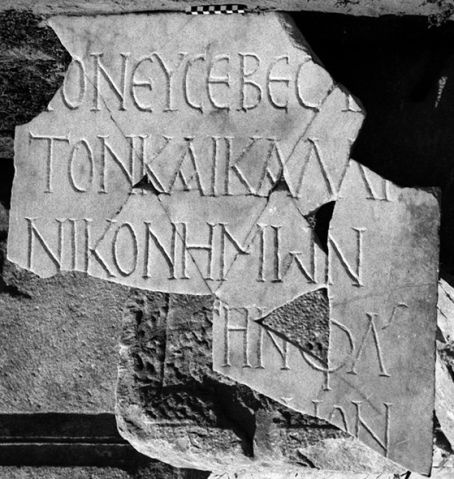
Inscription
τὸν εὐσεβέστ[α]/τον καὶ καλλί/νικον ἡμῶν / [δεσπό]την Φλ(άουιον) /(5) [?Ἰουστινια]νόν / [...]
Inscription translation
[(e.g.) The city honours] our most pious and splendidly victorious master, Flavius [?Justinia]nus.
(Trans: C. Roueché)
Bibliography
- Roueché, C., Aphrodisias in Late Antiquity (Journal of Roman Studies Monograph 5), London 1989, no. 81
Discussion
INSCRIPTION
Fragmentarily preserved in five lines:
τὸν εὐσεβέστ[α]/τον καὶ καλλί/νικον ἡμῶν / [δεσπό]την Φλ(άουιον) /(5) [?Ἰουστινια]νόν / [...]
'[The city honours] our most pious and splendidly victorious master, Flavius [?Justinia]nus.'
(Trans: C. Roueché)
Letter height 9.5 cm.
DESCRIPTION
Fragmentary panel, preserved in eight fragments. H: 74, W: 16, D: 2.5 cm. (These measures appear in ALA; there must however be an error in the height and/or width). White marble.
The upper corners and lower part are missing.
PROVENANCE
The panel fragments were found in the excavation of the Agora Gate which closed the eastern end of the South Agora. They were found in front of the central part of the Gate. That they were found behind the Theatre in the Byzantine wall (see Roueché in ALA) is an error that developed between the finding during the 1983 and the assignment of inventory numbers at the end of the 1983 season, a season in which both areas were excavated and rendered many finds.
HONORAND, AWARDER AND DATE
The honorand is an Emperor as is indicated by the standard imperial epithets: the adjectives, pious and victorious, in the superlative and the genitive ours. The nomen of the Emperor is Flavius and his cognomen ends in NUS. The lettering provides little aid; it might be placed anywhere between the fourth and sixth century, though the B in line 1 leads Roueché to prefer a later date.
There is space for seven or eight letters before the NUS ending of the cognomen. Roueché thus reasons simply that Constantine and Valentinian would be too long. Julian, Marcian, and Justin would all be too short. Justinian is the only good fit. This would then provide a date between 527 and 565.
Cite: Last Statues of Antiquity, LSA-231 (J. Lenaghan).