
LSA-2312
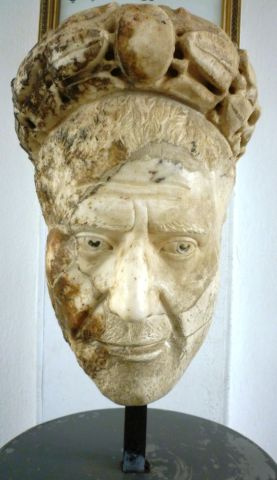
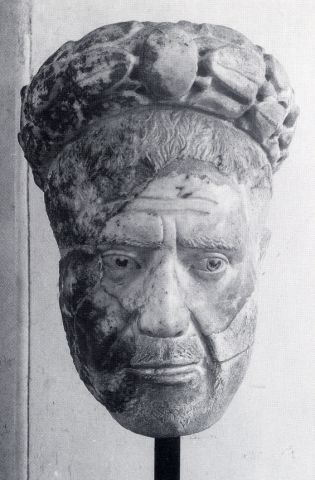
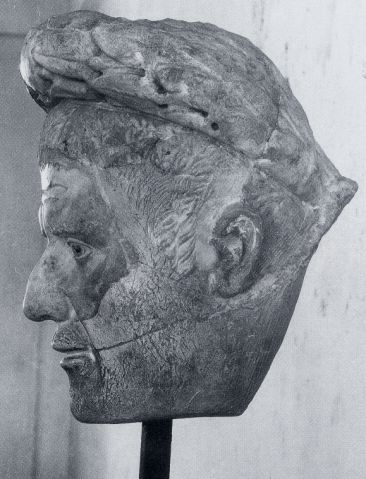
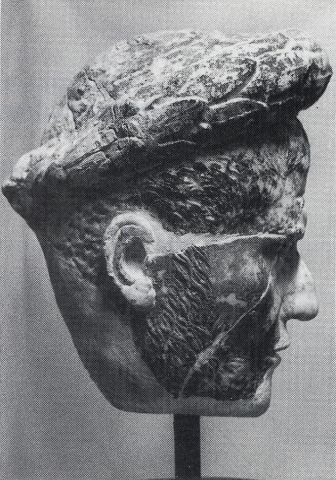
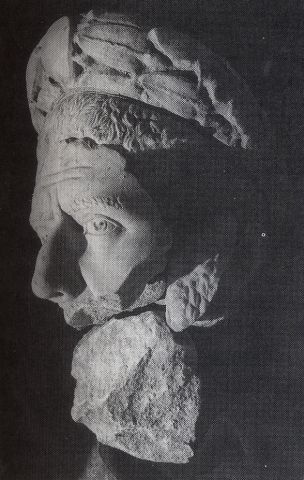
Fragmentary cuirassed statue of Emperor wearing corona civica. Philippopolis (Arabia). Later third century.
Record details
Photographs
Bibliography
- Balty, J. 'Un portrait de Shahba-Philippopolis et l'iconographie de Philippe l'Arabe', Resurrecting the Past. A Joint Tribute to Adnan Bounni, Leiden 1990, 5-15, pls. 3b, 4a-b (Philip the Arab)
- Freyberger, K.S. 'Die Bauten und Bildwerke von Philippoplis. Zeugnisse imperialer und orientalischer Selbstdarstellung der Familie des Kaisers Philippus Arabs', Damaszener Mitteilungen 6, Mainz 1992, 304-309, pls. 65a-b, 66a-b (Philip the Arab)
Discussion
DESCRIPTION (Object)
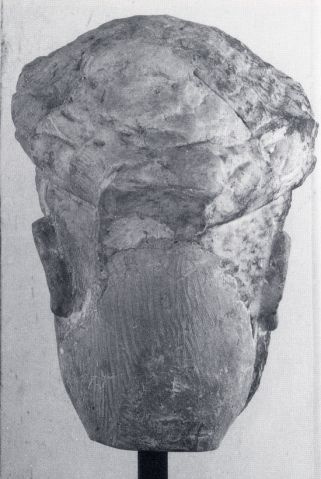
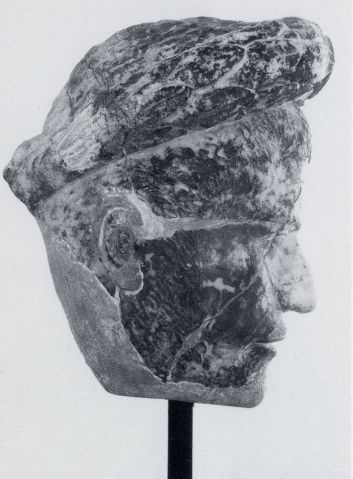
Fragmentary head, preserved in multiple pieces, from a cuirassed statue. H (of head): 31.5 cm. White marble.
The statue fragments include right shoulder, right leg with palm tree support, right hand which held sceptre or lance, and left handing holding a patera.
The back of the head, the area around the left temple, most of the right lower face and ear, much of the mouth, and the chin are restoration.
The hair is rendered in short curving locks with fine flat chisels. A deep drill channel separates the crown from the hair. The irises are engraved and larger than semicircular. The pupils are deeply hollowed U shapes which were filled with a dark substance of which traces remain. There are traces of red paint on the leaves of the crown.
PROVENANCE
Found at the Baths (on the cardo, c. 100 m southeast of the cardo-decumanus intersection) in 1970. It was found with fragments of a cuirassed statue. J. Balty also writes that he found a female statue and a statue of a boy which he proposes to identify as Otacilia and Philip Junior. Without full publication, this claim is difficult to assess.
DESCRIPTION (Subject)
The portrait shows an older emperor wearing a corona civica with a an oval central gem. He has short, straight hair that is brushed forward in overlapping layers. It is cut high over the brow. There is a part in the fringe over the inner corner of the right eye and over the middle of the left eye. At the right temple there is a small space between the locks. The beard and moustache are light and slightly wavy.
The face is long. The brow is broad, tall, and has two heavy creases across it and two vertical creases which rise from the root of the nose. The root of the nose is indented, and the nose is aquiline. The eyes are narrow and set under contracted eyebrows. The naso-labial folds are deep and long.
DATE AND HONORAND
The portrait shows an emperor whose fashion style places him after c. 250 and whose corona civica places him before the introduction of the diadem by Constantine in c. 325. Because it was found in the city of Philip the Arab, it has been argued forcefully that it represents Philip who is in known in two secure replicas (Vatican and Leningrad) and possibly one version (Copenhagen). This head does not follow the same type as the ‘secure’ replicas.
The portrait shares the same fundamental chronological problem that besets the Milan-Munich type (seeLSA-1027, LSA-1028, LSA-1029, LSA-1030, and LSA-1031). It is very difficult to identify the third century emperors, and at some point the strict formal adherence to a type that characterized high-imperial production yields to a general awareness of a model.
This Shahba head actually shares more particular detail with the examples of the Milan-Munich type than it does with the standard Philip the Arab portraits. Like those portraits it has the long face, the creased brow, the small narrow eyes, the hooked nose, the tightly-closed mouth, deep naso-labial folds, and some details of the hair, especially at the right corner of the brow.
Cite: Last Statues of Antiquity, LSA-2312 (J. Lenaghan).