
LSA-232
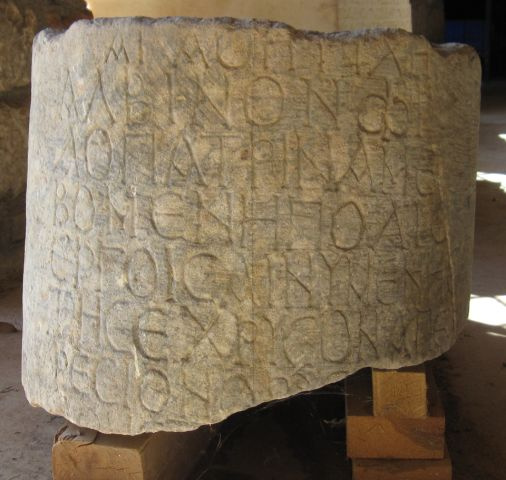
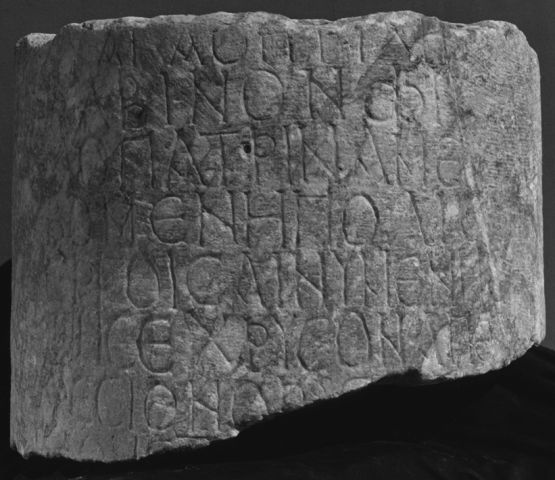
Fragmentary columnar base for statue of Albinus, local notable and benefactor. Aphrodisias (Caria). Sixth century.
Record details
Photographs
Inscription
Ἀγαθῇ Τύχῃ· / Ἀλβῖνον φι/λόπατριν ἀμει/βομένη πόλις /(5) ἔργοις αἰνυμένη σ/τῆσε χρυσὸν ἀπει/ρέσιον,
ορε[...] / αοιστ[...]
Inscription translation
To Good Fortune. The city, repaying his (good) works, set up (this statue of) Albinus, lover of his country, enjoying untold gold [?which he has given ...].
(Trans: C. Roueché)
Bibliography
- Roueché, C., Aphrodisias in Late Antiquity (Journal of Roman Studies Monograph 5), London 1989, no. 82
Discussion
INSCRIPTION
Verse inscription in elegiac distichs introduced by an invocation. One distich laid out in seven lines, andtwo lines with fragments of another one are preserved; in total nine lines:
Ἀγαθῇ Τύχῃ· /
Ἀλβῖνον φι/λόπατριν ἀμει/βομένη πόλις /(5) ἔργοις
αἰνυμένη σ/τῆσε χρυσὸν ἀπει/ρέσιον,
ορε[...] / αοιστ[...]
'To Good Fortune. The city, repaying his (good) works, set up (this statue of) Albinus, lover of his country, enjoying untold gold [?which he has given ...].' (Trans: C. Roueché)
Letter height 4 - 4.5 cm.
DESCRIPTION
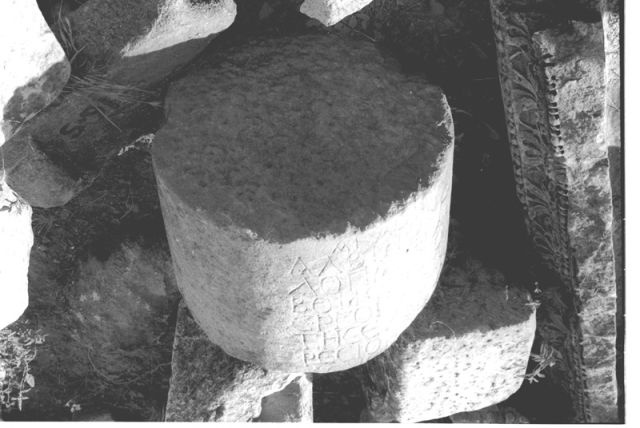
Fragment from top of column shaft. H: 37, W: 45, D: 46.5 cm. Blue marble.
The column is broken unevenly at the bottom; more is preserved on the proper right side. The upper surface is evenly picked with no cuttings.
PROVENANCE AND CURRENT LOCATION
Excavated in 1984 in the southern corner of the western stoa of the South Agora (exc. inv. 84-78). It was recorded in the Aphrodisias museum by Roueché 2005.
HONORAND, AWARDER AND DATE
Albinus is known at Aphrodisias from the outer columns of the western stoa of the South Agora. Nineteen of the twenty columns bear acclamations to Albinus. The base indicates that he was of Aphrodisian origins and a benefactor who perhaps gave money. This is confirmed by the acclamations which reveal also that he built the stoa among other works and was a man of clarissimus rank but yet not in the senate.
The early sixth century date, assigned by Roueché to this Albinus, depends on a series of connections.
1) The restoration of the southern stoa of the south Agora was done by a Philip in the late fifth or early sixth century; the date there depends on his rank. The more important western stoa was probably ‘built’ at the same general moment.
2) The honorand Albinus holds the rank of clarissimus but is not yet a senator. This should not be possible before the middle of the fifth century.
3) The wording of the base and the acclamations repeat two particularities that also appear on the bases for Rhodopaeus (see especially LSA-194 and LSA-233). Rhodopaeus belongs best in the mid-sixth century.
4) The acclamations to Albinus relate well to acclamations dated to the period of Justinian.
FURTHER DISCUSSION
The epithet, lover of his fatherland, which appears here and in the acclamations, as well as word used for forget in the acclamations, are particular and appear also on two of the three bases for Rhodopaeus (LSA-194 and LSA-233).
Cite: Last Statues of Antiquity, LSA-232 (J. Lenaghan).