
LSA-2323
Base for statue of Victory, set up by Ulpius Egnatius Faventinus, governor of Numidia. Cuicul (Numidia). 364-367
Record details
Photographs
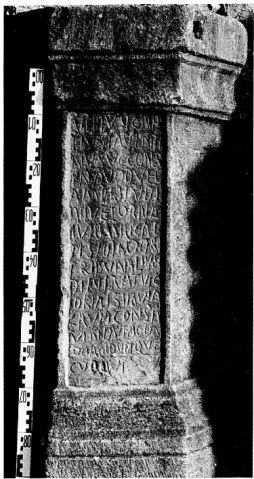
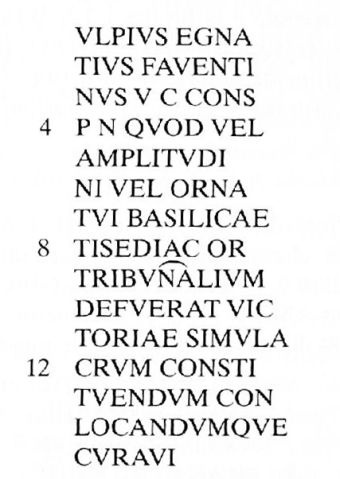
Inscription
Ulpius Egna-/tius Faventi-/nus, v(ir) c(larissimus), cons(ularis) / p(rovinciae) N(umidiae), quod vel / (5) amplitudi-/ni vel orna-/tui basilicae / Tisediacor(um) / tribunalium / (10) defuerat Vic-/toriae simula-/crum consti-/tuendum con-/locandumque / curavi.
Inscription translation
I, Ulpius Egnatius Faventinus, of clarissimus rank, governor (consularis) of the province of Numidia, took the care to set up and site [this] statue of Victoria, which had been lacking to both the greatness and ornament of the tribunal of the basilica of the Tisediaci.
Bibliography
- L'Année épigraphique, , 1946, 108=110
- Pflaum, H.-G., Inscriptions Latines de l'Algérie. 2. Inscriptions de la confédération cirtéenne, de Cuicul et de la tribu des Suburbures. Vol. 3, Paris 2003, 7914
Discussion
INSCRIPTION
In 15 lines:
Ulpius Egna-/tius Faventi-/nus, v(ir) c(larissimus), cons(ularis) / p(rovinciae) N(umidiae), quod vel / (5) amplitudi-/ni vel orna-/tui basilicae / Tisediacor(um) / tribunalium / (10) defuerat Vic-/toriae simula-/crum consti-/tuendum con-/locandumque / curavi.
'I, Ulpius Egnatius Faventinus, of clarissimus rank, governor (consularis) of the province of Numidia, took the care to set up and site [this] statue of Victoria, which had been lacking to both the greatness and ornament of the tribunal of the basilica of the Tisediaci.'
Letter height 2.5 - 3 cm.
We reproduce the inscription as given by ILAlg II, 3. In line 8, TISEDIACORUM possibly refers to the people of Tisedi, an urban centre close to Cuicul. As Lepelley 1981, 406 n. 21 points out, this is not satisfactorily since the basilica where the inscription was set up in Cuicul (see below, ‘Provenance and Current Location’) was a public building. However, earlier scholarship read PISIDIACOR which is incomprehensible.
DESCRIPTION (from ILAlg and the published image)
Hexagonal statue base moulded at top and bottom; H 117; W (of one face) 25.5 cm. the epigraphic field is depressed. In the top moulding, right of the front face, there is a rectangular clamp hole.
PROVENANCE AND CURRENT LOCATION
The inscription was found in the apsis of the basilica of Djemila (Lepelley 1981, 406 no. 6; see also below, ‘Honorand, Awarder and Date’). There it is still standing today.
HONORAND, AWARDER AND DATE
The inscription was set up to Victoria, the goddess of victory (lines 10-11).
Ulpius Egnatius Faventinus, the awarder, was governor (consularis) of Numidia in 364/7 (PLRE I, 325 Ulpius Egnatius Faventius 1). He was probably the immediate successor of Publilius Ceionius Cecina Albinus under whose governorship the basilica was built and dedicated in 364/7 (PLRE I, 34-5 Publilius Caeionius Caecina Albinus 8; see also above, ‘Provenance and Current Location’). Faventinus was a fervent pagan.
FURTHER DISCUSSION
Another inscription set up by Faventinus was found in the same basilica; it was probably to the victory of the emperors (Valentinian I and Valens) (Lepelley 1981, 406-7 no. 6 and note 22). The erection of a statue of Victory in Cuicul was possibly intended as a manifestation of traditional piety, only a few years before the conflict around the statue of that goddess in the senate building in Rome escalated. However, our inscription disguises such religious implications, arguing that it was set up solely for esthetic reasons (quod vel amplitudini vel ornatui basilicae … defuerat, lines 4-10).
Discussion references
- Jones, A. H. M. et al., The Prosopography of the Later Roman Empire. Vol. I 260-395, Cambridge et al. 1971 (1975)
- Jones, A. H. M., Inscriptions from Jerash, The Journal of Roman Studies 18, 1928, 144-78
- Lepelley, C., Les cités de l'Afrique romaine au Bas-Empire, t. 2, Notices d'histoire municipale, Paris 1981, 406-7 no. 6
Cite: Last Statues of Antiquity, LSA-2323 (Ulrich Gehn).