
LSA-233
Fragmentary base for statue of Rhodopaeus, local benefactor. Aphrodisias (Caria). Sixth century.
Record details
Photographs
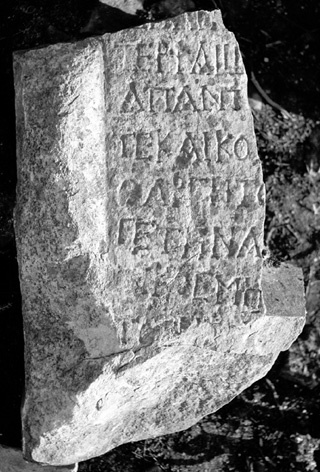
Inscription
Ἀγαθῇ [Τύ]χῃ· / [τὸν] μεγαλοπρεπέ/στατον / Ῥοδοπαῖον / τὸν φιλόπατριν καὶ /(5) [ἀ[ρ]ωγὸ]ν τοῦ δήμου, / [τὸν] [ἀρ]χηγὸν τῆς / φιλοτιμίας τοῦ / θερινοῦ Ὀλυμπί/ου λουτροῦ /(10) καὶ σιτοδότην ὁ/μοῦ δὲ κ[αὶ] κτίστην, / τὸν ἀν[α]νεωτὴν / τῶν λη[θ]αργηθισῶν / τέρψαιων, τ[ὸν] [δι]/ὰ πάντ[α] [[ἡμῶ]ν ἰδίᾳ] /(16) τε καὶ κο[ινῇ] [ἀλη]/θάργητο[ν] [εὐερ]/γέτην ἀ[νδριάν]/τι κοσμή[σασα] /(20) τὸ τρί[τον] [ἡ πόλις].
Inscription translation
To Good Fortune. The magnificentissimus Rhodopaeus, the lover of his country and defender of the people, the originator of the generous gift of the summer Olympian bath, and giver of corn as well as founder, renewer of pleasures that had been forgotten, the never-to-be-forgotten benefactor to us in everything, privately and public—the city (has honoured him) adorning him with a statue for the third time.
(Trans: C. Roueché)
Bibliography
- Roueché, C., Aphrodisias in Late Antiquity (Journal of Roman Studies Monograph 5), London 1989, no. 87
Discussion
INSCRIPTION
In 20 lines:
Ἀγαθῇ [Τύ]χῃ· / [τὸν] μεγαλοπρεπέ/στατον / Ῥοδοπαῖον / τὸν φιλόπατριν καὶ /(5) [ἀ[ρ]ωγὸ]ν τοῦ δήμου, / [τὸν] [ἀρ]χηγὸν τῆς / φιλοτιμίας τοῦ / θερινοῦ Ὀλυμπί/ου λουτροῦ /(10) καὶ σιτοδότην ὁ/μοῦ δὲ κ[αὶ] κτίστην, / τὸν ἀν[α]νεωτὴν / τῶν λη[θ]αργηθισῶν / τέρψαιων, τ[ὸν] [δι]/ὰ πάντ[α] [[ἡμῶ]ν ἰδίᾳ] /(16) τε καὶ κο[ινῇ] [ἀλη]/θάργητο[ν] [εὐερ]/γέτην ἀ[νδριάν]/τι κοσμή[σασα] /(20) τὸ τρί[τον] [ἡ πόλις].
'To Good Fortune. The magnificentissimus Rhodopaeus, the lover of his country and defender of the people, the originator of the generous gift of the summer Olympian bath, and giver of corn as well as founder, renewer of pleasures that had been forgotten, the never-to-be-forgotten benefactor to us in everything, privately and public—the city (has honoured him) adorning him with a statue for the third time.' (Trans: C. Roueché)
DESCRIPTION
Rectangular base, preserved in at least 7 fragments. H: 88, W: 59, D: 34 cm. White marble.
The shaft is shattered. The inscribed panel was framed by moulding.
PROVENANCE
The complete base was seen by Sherard in 1716. Five fragments have been recorded by the current New York University expedition. They come from a field northwest of the Temple.
HONORAND AND DATE
The honorand is the same Rhodopaeus who was honoured at Aphrodisias once in LSA-188 and twice in LSA-194. Both of the other bases are in verse and both of which were found in the eastern forecourt to the Hadrianic Baths.
This inscription, the third honour, again repeats that Rhodopaeus was a local magistrate in charge of the corn supply and a benefactor who had restored the Baths. It adds his rank, magnificentissimus which Roueché considers an indication that he was active in the later fifth and sixth centuries by which time that rank had filtered down to non-imperial officials. Roueché connects the emphasis on Rhodopaeus’ involvement with the food supply, mentioned again in LSA-194, as a possible reflection of the faminine of 541/2. She dates all three statues to the mid-sixth century.
Cite: Last Statues of Antiquity, LSA-233 (J. Lenaghan).