
LSA-234
Lintel with statue of Flavius Constantius, governor. Aphrodisias (Caria). c. 350-375.
Record details
Photographs
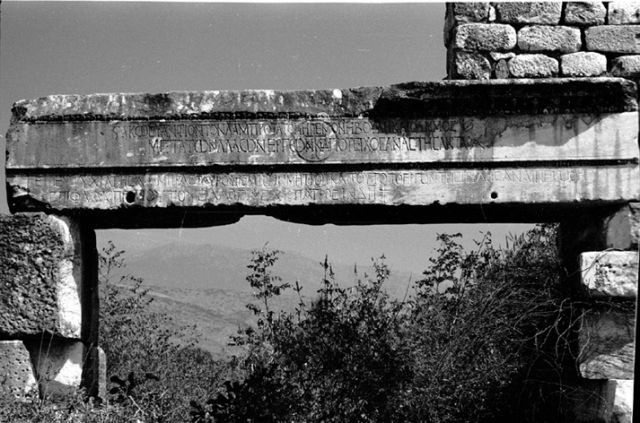
Inscription
Φλ(άουιον) Κωστάντιον τὸν λαμπρότατον / ἡγεμόνα ἡ βουλὴ καὶ ὁ δῆμος leaf / scroll v. μετὰ τῶν ἄλλων ἔργων καὶ τὸ τεῖχος / ἀναστήσαντα star /
cross ἐπὶ εὐτυχίᾳ τῆς λαμπρᾶς / [Σ]ταυρουπολίτων μητροπ(όλεως) καὶ τοῦτο τὸ / ἔργον τῆς πύλης stop ἀναινεώθη / cross ἐπὶ Φλ(αουίου) Ἀμπελίου τοῦ ἐλλογιμ(ωτάτου) / σχο(λαστικοῦ) κ(αὶ) πατρός stop ἰνδ(ικτίωνος) η´ cross
Inscription translation
The Council and the People (have honoured) Fl(avius) Co[n]stantius, clarissimus praeses, who, as well as his other works, put up the wall.
For the good fortune of the splendid metropolis of the [S]tauropolitans, this work of the gate was also renewed, under Fl(avius) Ampelius, the most eloquent scholasticus and pater, in the eighth indiction.
(Trans: C. Roueché)
Bibliography
- Roueché, C., Aphrodisias in Late Antiquity (Journal of Roman Studies Monograph 5), London 1989, no. 22
Discussion
INSCRIPTION
On upper fascia:
Φλ(άουιον) Κωστάντιον τὸν λαμπρότατον ἡγεμόνα ἡ βουλὴ καὶ ὁ δῆμος leaf /
scroll v. μετὰ τῶν ἄλλων ἔργων καὶ τὸ τεῖχος ἀναστήσαντα star
'The Council and the People (have honoured) Flavius Co[n]stantius, clarissimus praeses, who, as well as his other works, put up the wall.'
Letter height 7-8 cm.
On lower fascia:
cross ἐπὶ εὐτυχίᾳ τῆς λαμπρᾶς [Σ]ταυρουπολίτων μητροπ(όλεως) καὶ τοῦτο τὸ ἔργον τῆς πύλης stop ἀναινεώθη /
cross ἐπὶ Φλ(αουίου) Ἀμπελίου τοῦ ἐλλογιμ(ωτάτου) σχο(λαστικοῦ) κ(αὶ) πατρός stop ἰνδ(ικτίωνος) η´ cross
'For the good fortune of the splendid metropolis of the [S]tauropolitans, this work of the gate was also renewed, under Flavius Ampelius, the most eloquent scholasticus and pater, in the eighth indiction.'
(Trans: C. Roueché)
Letter height 7 cm.
The name of Flavius Constantius is in the accusative case and indicates a statue honour rather than the commemoration of his building of the walls. The second inscription follows the format of a traditional building inscription. It names an Ampelius, a local pater, who was responsible for numerous restorations in the city and who has been placed the middle of the fifth century. The second inscription has also received an intervention, the insertion of the name Stauropolitans, between 553 and 680
DESCRIPTION
Lintel block. H: 75, W: 495, D: 95 cm. White marble.
The cornice is mainly missing on viewer’s left side of the block. It is chipped elsewhere. The frieze is inscribed with a two-line inscription for Flavius Constantius. The architrave bears another two-line inscription secondary and with smaller lettering than the first. A large circle around a cross and an alpha and an omega on either side of the cross was inscribed over the first inscription. The name Stauropolitans was inserted into the second inscription.
PROVENANCE AND CURRENT LOCATION
The lintel spans the northeast portal in the city wall. The inscription faces inwards. The statue probably stood in a niche above the lintel.
HONORAND, AWARDER AND DATE
The honorand, Flavius Constantius, is a praeses of senatorial (clarissimus) rank. He is also recorded at Aphrodisias in the area of the civil basilica twice. One, LSA-235, is a from a statue base and the second is a floor mosaic which claims that he, the clarissimus praeses, made it.
The first securely datable governor of clarissimus rank of Caria is Antonius Tatianus, c. 361-364 (LSA-197 and LSA-223). The west gate of the city wall was built by a man named Eros Monaxius between 355 and 360, and in general the gradual building of the walls at Aphrodisias can best be understood in the context of imperial policy of the third-quarter of the fourth century. Thus, Roueché would place Flavius Constantius immediately after Antonius Tatianus, though she cannot exclude entirely the decade before Tatianus. She notes that the lettering is similar to that on the base for Valens (LSA-223).
The inscription was set up by the council and the people of Aphrodisias. This inscription is the last example at Aphrodisias in which the council and the people (boule and demos) together put up a statue.
Discussion references
- De Staebler, P.D. 'The city wall and the making of a late-antique provincial capital', Aphrodisias Papers 4. New Research on the City and its Monuments, Portsmouth RI 2008, 303
Cite: Last Statues of Antiquity, LSA-234 (J. Lenaghan).