
LSA-2343
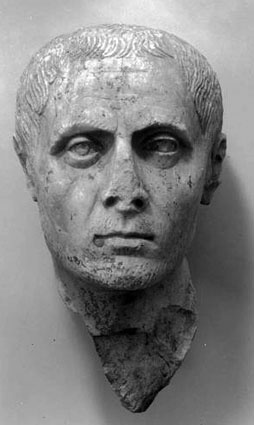
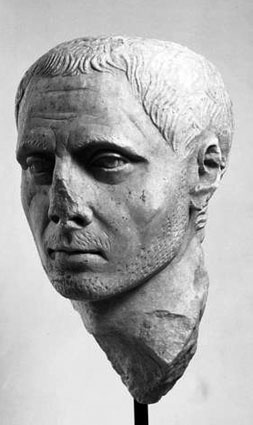
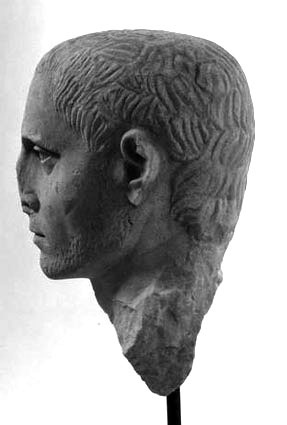
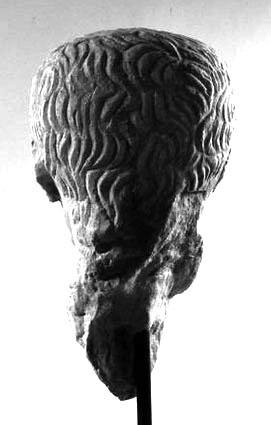
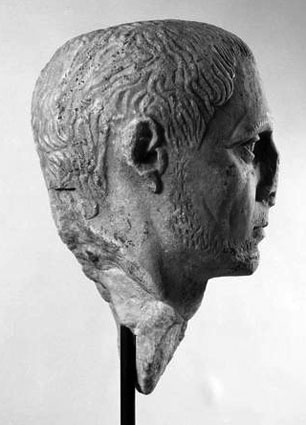
Portrait of bearded male, re-worked from earlier portrait. Corinth. Later third to earlier fourth century
Record details
Photographs
Bibliography
- de Grazia, C. E., American School of Classical Studies at Athens, "Excavations of the American School of Classical Studies at Corinth:
The Roman Portrait Sculpture," Ph.D. Dissertation
, Columbia University, 1973, pp. 194-6 no. 45 pl. 58, 59
Discussion
DESCRIPTION (Object)
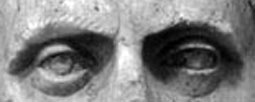
Worked for insertion; fine-grained white marble, H (overall) 36, (chin to crown) 24.5, W 20.5, D 23 cm. The neck is broken on all sides. The tip of the nose is broken off, the earlobes are chipped, and minor chips are scattered around the surface. The head in its present state is the result of a late-antique re-work of an earlier portrait of the early imperial period. Traces of the original hair are still visible at the back; the short cropped beard has been picked directly into the flesh; around the eyes substance has been removed, notably the orbitals, in order to enlarge them.
The hair is chiselled into long parallel strands around the face; behind the ears the mass original hair has been reduced leaving its structure still visible; in the back the original hair is untouched.
The eyebrows are marked with short vertical chisel strokes. The iris is circumscribed by a circular chiselled line, the pupil is a round shallow depression set against the upper lid. The eyes were enlarged in the process of re-work.
The moustache is marked by short lines, the beard by stipples picked in with a point.
PROVENANC/ LOCATION
The head was found 1934 on the southwest Agora. It is today in the Corinth museum, inv. no. S-1802.
DESCRIPTION (Subject)
The portrait shows a middle-aged man with his forward-brushed hair slightly thinning above the brow. The stubble beard charactrises him as a ‘man on campaign’; the portrayed was possibly an imperial office-holder.
DATE
The head was dated to the mid 3rd century by De Grazia, comparing it to portraits of Philipp the Arab and Trajanus Decius.
The forward brushed hair, the picked beard, and the marking of the eyes indicate a date in the later 3rd or earlier 4th century.
Cite: Last Statues of Antiquity, LSA-2343 (Amelia Brown/ Ulrich Gehn).