
LSA-2344
Base for statue of Lucius Flavius Felix Gabinianus, curator, probably of Abitinae. Probably from Carthago (Africa Proconsularis). 280-330
Record details
Photographs
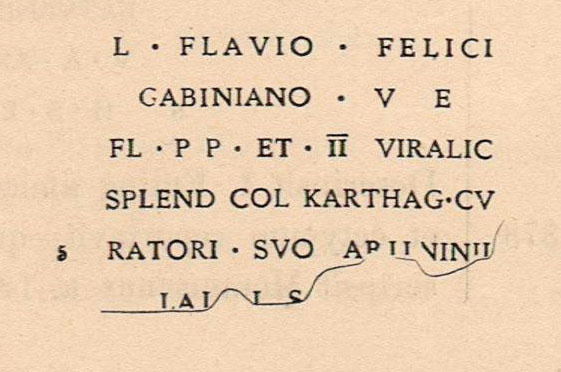
Inscription
L(ucio) Flavio Felici / Gabiniano, v(iro) e(gregio), / fl(amini) p(er)p(etuo) et II viralic(io) / splend(idae) col(oniae) Karthag(inis), cu/ratori suo Ab[iti]nen[ses] / [---]LA[...]S[---].
Inscription translation
To Lucius Flavius Felix Gabinianus, of egregius rank, priest in perpetuity and duumvir of the splendid colony of Carthago, the Abitinenses [set this up] to their curator ….
Bibliography
- Corpus Inscriptionum Latinarum; , VIII, 1165
- Lepelley, C., Les cités de l'Afrique romaine au Bas-Empire, t. 2, Notices d'histoire municipale, Paris 1981, 22-3 with n. 46; 58 no. 3
Discussion
INSCRIPTION
Partly preserved in six lines:
L(ucio) Flavio Felici / Gabiniano, v(iro) e(gregio), / fl(amini) p(er)p(etuo) et II viralic(io) /(4) splend(idae) col(oniae) Karthag(inis), cu-/ratori suo Ab[iti]nen[ses] / [---]LA[...]S[---].
'To Lucius Flavius Felix Gabinianus, of egregius rank, priest in perpetuity and duumvir of the splendid colony of Carthago, the citizens of Abitinae [set this up] to their curator ….'.
Letter height not recorded.
DESCRIPTION (from CIL VIII)
Rectangular block, H 73, W 50, D 11 cm. Apparently the block was broken at its bottom; there are no published images.
PROVENANCE AND CURRENT LOCATION
The inscription was recorded in the museum of Douai (Northern France) by CIL in 1881; before it was brought there, it had been in the collection Jomard in Paris. The collector Jomard was a member of the society of the excavations in Carthage; our inscription was possibly brought from Carthage to Paris after excavations in 1837 (so CIL). It is probable that our inscription is from Carthage, but it cannot be excluded that it is from another location in the province of Africa proconsularis.
The inscription was disappeared after Douai was bombarded in world war I; it is probably lost (Lepelley 1981, 23 n. 46).
HONORAND, AWARDER AND DATE
Lucius Flavius Felix Gabinianus, the honorand, was a local notable of Carthago (line 4); he held the offices of priest for the imperial cult in the city (flamen perpetuus, line 3) and of duumvir in his hometown (line 3). He was honoured in his property of being curator (overseer) of another city, probably Abitinae (line 5; the name is blurred). Members of the established families of Carthago often held office in other cities where they had property and interests (Lepelley 1981, 22-3).
The inscription was set up by the city of Abitinae.
Lepelley proposed a date in the late 3rd or early 4th century because of the honorand’s egregius rank (line 2). After 330, curators from Carthage hold the rank of clarissimus (Lepelley 1981, 23).
Cite: Last Statues of Antiquity, LSA-2344 (Ulrich Gehn).