
LSA-2348
Base for statue of Iulia Flavia Herennia Caecilia Honoratiana Optata, daughter of curator. Ammaedara (Africa Proconsularis). Later third century
Record details
Photographs
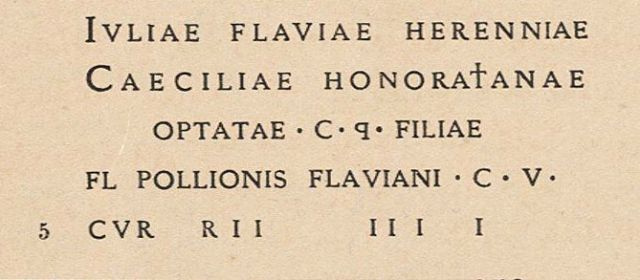
Inscription
Iuliae Flaviae Herenniae / Caeciliae Honoratianae Optatae, c(larissimae) p(uellae), filiae / Fl(avii) Pollionis Flaviani, c(larissimi) v(iri), / cur(atoris) rei p(ublicae), praet(oris) k(andidati), / [d(ecreto)] d(ecurionum) p(ecunia) [p(ublica)].
Inscription translation
To Iulia Flavia Herennia Caecilia Honoratiana Optata, girl of clarissimus rank, daughter of Flavius Pollio Flavianus, of clarissimus rank, curator of the city, candidate to the praetorship, [set up] by decree of the councillors, with public funds.
Bibliography
- Corpus Inscriptionum Latinarum; , VIII, 11536
- L'Année épigraphique, , 1889, 2
- L'Année épigraphique, , 1993, 1734
Discussion
INSCRIPTION
In five lines:
Iuliae Flaviae Herenniae / Caeciliae Honoratianae Optatae, c(larissimae) p(uellae), filiae / Fl(avii) Pollionis Flaviani, c(larissimi) v(iri), / cur(atoris) rei p(ublicae), praet(oris) k(andidati), /(5) [d(ecreto)] d(ecurionum) p(ecunia) [p(ublica)].
'To Iulia Flavia Herennia Caecilia Honoratiana Optata, girl of clarissimus rank, daughter of Flavius Pollio Flavianus, of clarissimus rank, curator of the city, candidate to the praetorship, [set up] by decree of the councillors, with public funds.'
Letter height 3 - 3.5 cm.
DESCRIPTION (from Ben Abdallah 1993)
Rectangular base, H 41, W 66 cm.
PROVENANCE AND CURRENT LOCATION
The inscription was first recorded in Haidra, the site of ancient Ammaedara, near the ruined bridge at the southern gate of the castle in 1888 (L'Année Épigraphique 1889). It was recorded in Haidra (with no further specifications) by Ben Abdallah, 1993, 966.
HONORAND, AWARDER AND DATE
Iulia Flavia Herennia Caecilia Honoratiana Optata, the honorand, is of senatorial (clarissimus) rank. Her father Flavius Pollio Flavianus was a Roman senator who held the office of praetor kandidatus (line 4), that is praetor proposed by the emperor. Flavianus held the office of curator rei publicae (line 4) in Ammaedara (on this office see LSA-2406, ‘Further Discussion’).
The inscription was set up by decree of the councillors, as recorded with the traditional formula (line 5).
Jacques 1982 proposed a date in the later 3rd century for our inscription; the same date was suggested by Lepelley 1981.
Discussion references
- Ben Abdallah, B. Z. D'Ammaedara à Carthage. Du nouveau sur les Flavii et sur les Ranii, familles clarissimes d'origine africaine, Mélanges de l'Ecole française de Rome. Antiquité T. 105, N°2. 1993, 961-973., 966-7 no. 1
- Jacques, F., Les curateurs des cités africaines au IIIe siècle, Aufstieg und Niedergang der römischen Welt, 2, 10, 2 62-135, Berlin 1982
- Lepelley, C., Les cités de l'Afrique romaine au Bas-Empire, t. 2, Notices d'histoire municipale, Paris 1981, 86
Cite: Last Statues of Antiquity, LSA-2348 (Ulrich Gehn).