
LSA-2351
Base for statue of one of two Magniliani, benefactors: Quintus Vetulenius Urbanus Herennianus, priest and curator, or his son, Magnilianus. Municipium Aurelium Commodianum... (Africa Proconsularis). Late third to fourth century, possibly early fourth century
Record details
Photographs
Inscription
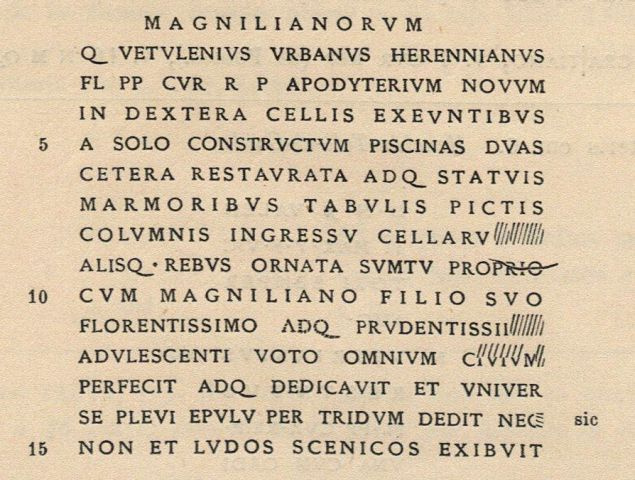
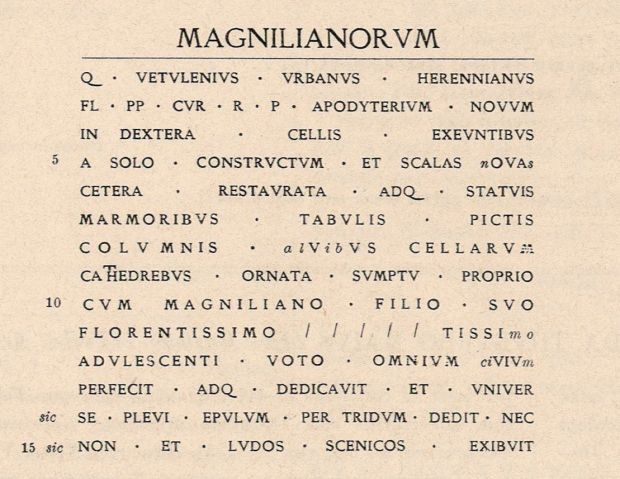
Magnilianorum. / Q(uintus) Vetulenius Urbanus Herennianus, / fl(amen) p(er)p(etuus), cur(ator) r(ei) p(ublicae), apodyterium novum / in dextera cellis exeuntibus / (5) a solo constructum, piscinas duas, / cetera restaurata adq(ue) statuis / marmoribus, tabulis pictis, / columnis ingressu cellaru[m], / alisq(ue) rebus ornata, sum(p)tu proprio, / (10) cum Magniliano filio suo, / florentissimo adque prudentissi[mo] / adulescenti, voto omnium civium / perfecit adq(ue) dedicavit, et univer/s(a)e plevi (sic) epulu(m) per tridu(u)m dedit, nec/non et ludos scenicos ex(h)ibuit.
Inscription translation
[Statue of the] Magniliani. Quintus Vetulenius Urbanus Herennianus, priest in perpetuity, curator of the city, completed and dedicated a new changing room (apodyterium), built from ground level to the right of the chambers by the exit, [and] two pools; the rest [of the building he] restored, and ornamented with marble statues, painted panels, columns at the entrance to the chambers, and other things, all with his own funds and with Magnilianus his son, brightest and most prudent of young man, [and] at the solemn request of all the citizens; and for the whole population he gave a three-day banquet, and presented theatrical displays.
Bibliography
- Corpus Inscriptionum Latinarum; , VIII, 23964=828
- Lepelley, C., Les cités de l'Afrique romaine au Bas-Empire, t. 2, Notices d'histoire municipale, Paris 1981, 77
Discussion
INSCRIPTION
In 15 lines:
Magnilianorum. / Q(uintus) Vetulenius Urbanus Herennianus, / fl(amen) p(er)p(etuus), cur(ator) r(ei) p(ublicae), apodyterium novum / in dextera cellis exeuntibus / (5) a solo constructum, piscinas duas, / cetera restaurata adq(ue) statuis / marmoribus, tabulis pictis, / columnis ingressu cellaru[m], / alisq(ue) rebus ornata, sum(p)tu proprio, / (10) cum Magniliano filio suo, / florentissimo adque prudentissi[mo] / adulescenti, voto omnium civium / perfecit adq(ue) dedicavit, et univer/s(a)e plevi (sic) epulu(m) per tridu(u)m dedit, nec/non et ludos scenicos ex(h)ibuit.
'[Statue of the] Magniliani. Quintus Vetulenius Urbanus Herennianus, priest in perpetuity, curator of the city, completed and dedicated a new changing room (apodyterium), built from ground level to the right of the chambers by the exit, [and] two pools; the rest [of the building he] restored, and ornamented with marble statues, painted panels, columns at the entrance to the chambers, and other things, with his own funds, and with Magnilianus his son, brightest and most prudent young man, [and] at the solemn request of all the citizens; and for the whole population he gave a three-day banquet, and presented theatrical displays' (translation C. Machado).
Letter height 5 cm (signum in line 1: 14 cm).
We reproduce the inscription according to CIL VIII, 2396 (accepted by Lepelley 1981, 77 n. 2) which corrects some errors of the first publication in CIL VIII, 828.
DESCRIPTION (from CIL VIII)
Statue base, H 120, W 60 cm. There is no published image.
PROVENANCE AND CURRENT LOCATION
The inscription was recorded in Henchir Bou-Cha, the area of ancient Municipium Aurelium Commodianum, by CIL VIII in 1881 and again in 1916 (http://www.trismegistos.org/place/17200). There is no more recent record of its location.
HONORAND, AWARDER AND DATE
The honorand is either Quintus Vetulenius Urbanus Herennianus Magnilianus (line 2), or his son Magnilianus (line 10), both local notables. Our inscription was set up together with a counter piece carrying a similar inscription (LSA-2352).
Quintus Vetulenius Urbanus Herennianus Magnilianus was priest of the imperial cult in Aurelium Commodianum (flamen perpetuus, line 3); this priestly office had become the highest municipal dignity in late antiquity and was charged with munera (Lepelley I, 165-7). Moreover, Magnilianus was curator rei publicae (see LSA-2406, ‘Further Discussion’). He is praised for his restoration work in the public baths which included the setting up of statues (lines 6-7). Additionally, our inscription praises him for giving a banquet to the entire population, and for giving theatrical games, both on occasion of the dedication of the restored baths.
Magnilianus, the son of Quintus Vetulenius Urbanus Herennianus Magnilianus, was associated by his father into this act of benefaction.
The awarder of the inscription is not stated; it was probably the city of Aurelium Commodianum.
The name of the honorand is recorded without tribus and without filiation; this indicates a terminus post quem in the late 3rd century for our inscription. This date is supported by the presence of the signum in line 1. Moreover, the fact that the office of curator is held by a local man indicates a date in the 4th century (Lepelley 1981, 77; LSA-2406).
Quintus Vetulenius Urbanus Herennianus Magnilianus is possibly identical with the curator Magnilianus mentioned in nearby Thibiuca in 303 (Lepelley 1981, 77-8 n. 3).
Discussion references
- Lepelley, C., Les cités de l’Afrique romaine au Bas-Empire, I-II, Paris 1979-1981
Cite: Last Statues of Antiquity, LSA-2351 (Ulrich Gehn).