
LSA-2354
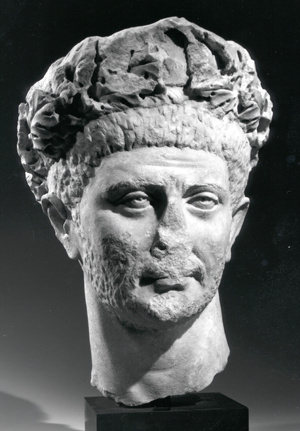
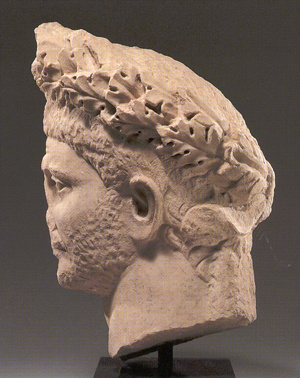
Re-cut portrait of Emperor wearing corona civica. From Asia Minor? Late third century.
Record details
Photographs
Bibliography
- Sotheby's Antiquities New York 8th December 2000, , 110-111, lot no. 137
Discussion
DESCRIPTION (Object)
Over life-size head. H: 44.5 cm. White marble.
The head has broken off a statue (indicated by size of portrait and neck pillar) at the base of the neck. The nose and upper lip are missing.
The head has been re-cut from an earlier portrait. The hair beneath the corona civica has been turned into short straight locks that fall forward. The longer hair of the original portrait is visible behind the left ear. The beard has been engraved onto the cheeks. It is difficult from the pictures to see whether the original portrait had a beard which has been mainly removed or whether it was clean-shaven. The back of the neck pillar has been evenly taken down; this may have happened however in the modern era.
Each pupil has been marked by two large unattached drill holes which yield a broad U-shaped impression. The irises are engraved semi-circles.
PROVENANCE
Probably Asia Minor. Possibly Perge (see below).
DESCRIPTION (Subject)
The head shows an emperor who wears the corona civica and who turns to his left. He has short-cropped hair and a short-cropped beard. Two creases cross the brow, and vertical lines of contraction are visible above the nose. The fillet which ties the crown is visible at the back of the neck.
DATE AND HONORAND
The head represents an Emperor of the later third century; his portrait has been re-cut from that of an earlier emperor. The corona civica, which was not worn after the early fourth century, provides a terminus ante quem.
The head technically, stylistically, and iconographically is almost identical to LSA-464 and LSA-2542, the latter of which was excavated at the Theatre of Perge. Another portrait from the same context in Perge, LSA-2543, repeats the same technique and iconography with a slightly longer beard. It is conceivable that these four portraits represented the Tetrarchs.
Cite: Last Statues of Antiquity, LSA-2354 (J. Lenaghan).