
LSA-236
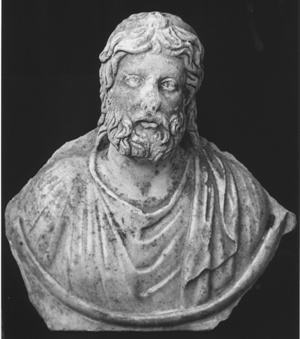
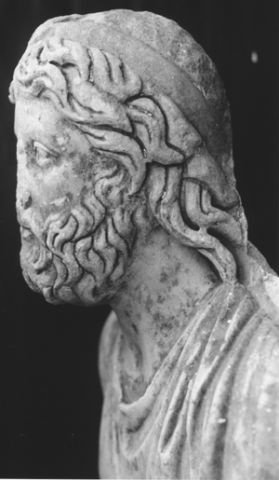
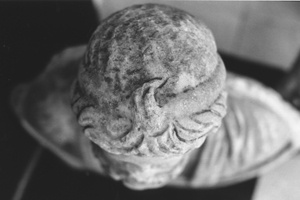
Tondo portrait of man with long hair and beard in Bornova-Heidelberg type. From Aphrodisias (Caria). Fourth century.
Record details
Photographs
Bibliography
- Smith, R.R.R. 'A New Shield Portrait in Izmir', Mitteilungen des Deutschen Archäologischen Instituts, Römische Abteilung 102, Heidelberg 1995, 332-5, pls. 77-8
Discussion
DESCRIPTION (OBJECT)
Over life-size shield portrait. H: 61.5, W: 57.5, D: 25 cm. H (chin to crown): 27 cm. Large-grained white marble.
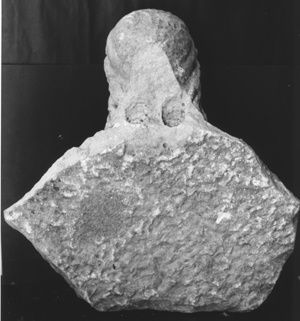
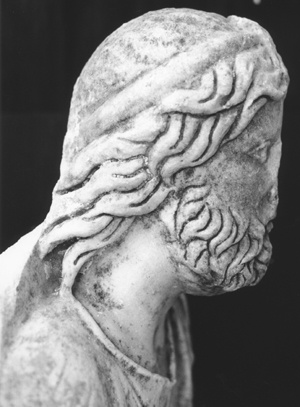
The shield portrait was made in one piece with a rectangular supporting panel. The back is worked flat with a point chisel. The back has clamp cuttings which served to attach it to a wall. The pupils are lightly engraved and U-shaped. The hair around the face and of the beard is deeply drilled in thick channels. In the hair, occasional ‘bridges’, small areas of marble, have been left over some channels.
PROVENANCE
Found in Bornova at the Anadolu Licesi in 1991. Paul Gaudin, who excavated at Aphrodisias in the early twentieth century, brought many finds to Bornova. It is, therefore, perhaps from Aphrodisias.
DESCRIPTION (Subject)
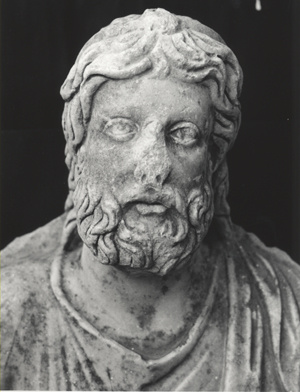
The shield portrait bust shows long-haired and long-bearded man who wears a fillet.
The man has long, centrally parted hair that frames the brow in a symmetrical manner. Over the centre of the brow, at the parting, a single lock is brushed backwards over the fillet. The hair at the sides is brushed off the face and covers the ears. It falls onto the shoulders.
The face is broad with a tall brow. The mouth is small from side to side but the lower lip is full. The beard has a central parting at the chin.
HONORAND
The honorand wears a fillet and exists in another version of the same type LSA-2441. LSA-766 is also related to the type . The model for the portrait was either a late classical creation (Smith, p. 338) or a classicizing invention (see discussion in Danguillier, 154-5) and was intended to represent a thinker of the earliest period of the Greek world.
DATE
Stylistically Smith considers the portrait earlier than the series of shield portraits from the Atrium House (main series: LSA-206, LSA-207, LSA-210, LSA-211, LSA-212, LSA-213) and closer to those of Evangelical school (LSA-238, LSA-602, LSA-603, LSA-604). The pupils suggest a fourth century date.
Discussion references
- Danguillier, C., Typologische Untersuchungen zur Dichter- und Denkerikonographie in römischen Darstellungen von der mittleren Kaiserzeit bis in die Spätantike, Oxford 2001, 153-4
Cite: Last Statues of Antiquity, LSA-236 (J. Lenaghan).