
LSA-2360
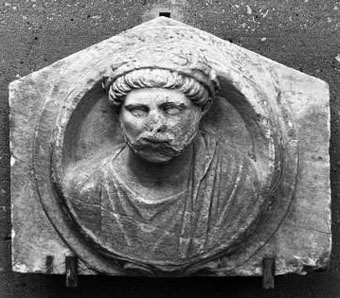
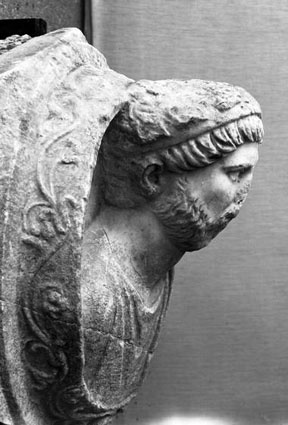
Shield portrait in pediment, of man wearing wreath. Corinth. Second century, reworked in fourth century(?)
Record details
Photographs
Bibliography
- de Grazia, C. E., American School of Classical Studies at Athens, "Excavations of the American School of Classical Studies at Corinth:
The Roman Portrait Sculpture," Ph.D. Dissertation
, Columbia University, 1973, pp. 132-6 no. 21 pl. 28
Discussion
DESCRIPTION (Object)
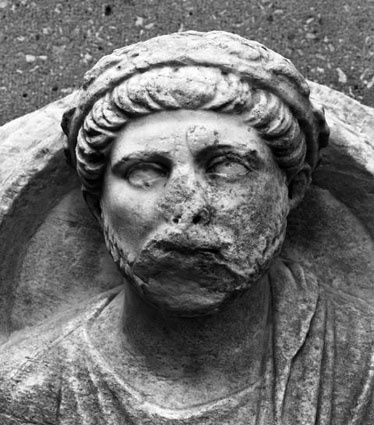
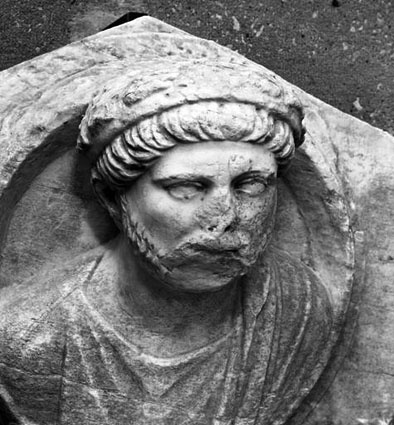
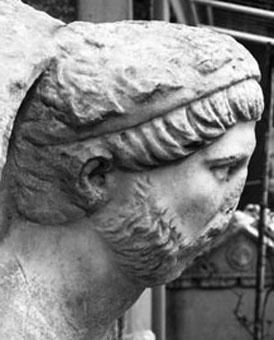
The shield portrait is set into a tympanum. The tip of the nose, the chin and the lower lip are broken off, the upper lip is chipped.
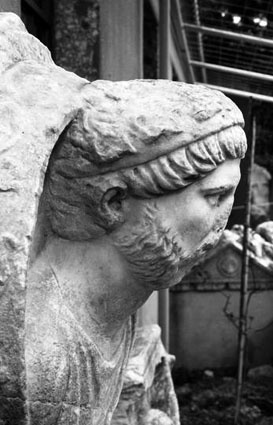
The hair around the face is divided into strands by deep drilled or chiselled lines; it is only summarily worked above the wreath and behind the ears. The beard is accentuated by chiselled lines of irregular length and direction.
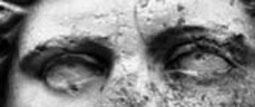
The eyes are marked by a small circular hole set against the upper lid.
PROVENANCE/ LOCATION
The medallion was found in 1908 on the northwest side of the Agora, between the temple D (‘Temple of Hermes’) and the end of the northwest shops. It is now in the Corinth museum, inv. no. S-890.
DESCRIPTION (Subject)
The portrait depicts a full-bearded man wearing tunic and himation; his head is crowned with an ivy wreath. The lank hair of the man is brushed forward, the single strands are bent inwards and meet above the centre of the brow.
The portrait is set into a medallion, the medallion into a tympanum; the rim of the medallion is decorated with vine leaves. The tympanum ‘formed the centrepiece of a small pediment, perhaps from a gate or shrine in the Forum (Ridgway 1981, 436 n. 59). The identity of the honorand remains unclear; De Grazia considered an emperor, god or hero as possible; if an emperor, however, ‘the rendering of the face is so removed from a true portrait that we fail to recognize the ruler’ (Ridgway 1981, 436 n. 59).
DATE
The portrait was dated to the early or mid 2nd century by almost all scholars who discussed it, considering the hairstyle Trajanic and/ or the beard Hadrianic (Johnson 1931, 90 no. 173: Trajanic; Deubner 1937, 78 n. 5: ; Becatti 1942, 173; Jucker 1961, 149: Winkes 1969, 68-71, 175-6:: de Grazia 1973: Hadrianic). Ridgway 1981 was the first to take a late-antique date into consideration: ‘Our problems in identification may stem from a wrong chronology. The Trajanic bangs return to favour during the 4th century...’ (Ridgway 1981, 436 n. 59). The portrait head with straight fringe looks similar in style to late antique philosopher portraits from Aphrodisias (Smith 1990).
The best solution to the portrait's apparent contradictions might be to see here an early second century piece which was later refreshed with drilled eyes and perhaps adjustment or sharpening of the hair fringe in the fourth century.
Discussion references
- Becatti, G., Due 'Imagines Clipeatae' ostiensi, Le Arti 4, 1942, p. 173
- Deubner, O., Zu den großen Propyläen von Eleusis, Athenische Mitteilungen 62, pp. 73-81, 1937, p. 78 n. 5
- Johnson, F. P., Sculpture, 1896-1923: Corinth IX, 1, Cambridge, Mass. 1931, p. 90 no. 173
- Jucker, H., Das Bildnis im Blätterkelch. Geschichte und Bedeutung einer römischen Porträtform, Olten 1961, p. 149
- Ridgway, B. S., Sculpture at Corinth, Hesperia 50, 1981, 422-448, p. 436 n. 59
- Winkes, R., Clipeata imago: Studien zu einer römischen Bildnisform, Bonn 1969, pp.68-71, 175-6 pl. 4 1, b
Cite: Last Statues of Antiquity, LSA-2360 (Amelia Brown).