
LSA-2361
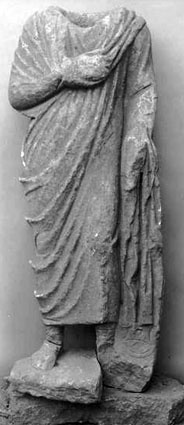
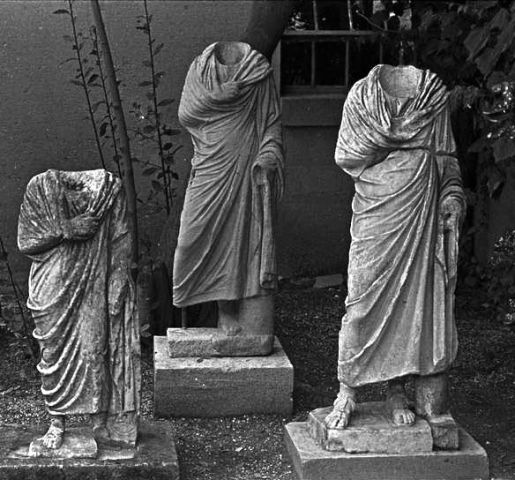
Headless statue of man wearing himation. Corinth. Third to fourth century (?)
Record details
Photographs
Bibliography
- de Grazia, C. E., American School of Classical Studies at Athens, "Excavations of the American School of Classical Studies at Corinth:
The Roman Portrait Sculpture," Ph.D. Dissertation
, Columbia University, 1973, pp. 279-80 no. 87 pl. 94
Discussion
DESCRIPTION (Object)
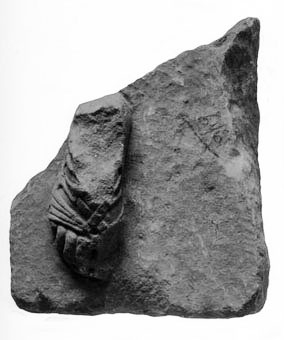
Fine-grained white marble, preserved with portions of the plinth at both feet; H (overall 102, (body) 95, (plinth) 7; W (shoulders) 31.7; D (tenon) 10 cm; this is well under life-size. The head was worked for insertion and is now missing. The left hand and wrist, the left forefoot, and the left front and back right corners of the plinth are broken off; the right foot is broken but re-attached. The surface is weathered.
PROVENANCE AND CURRENT LOCATION
The statue was found 1904 standing erect in a late wall in front of the west shops in the Agora. It was found with the alien, far oversized head LSA-81 inserted into the cutting. The statue is now in the Corinth museum courtyard, inv. no. S-696 (body) and S-696a (right foot).
DESCRIPTION (Subject)
The portrayed is wearing a himation which covers the entire body, and a tunic which is visible only at the breast below the neck, and elaborate sandals. He stands with his weight on the right leg, the left leg is slightly bent. The left arm is held to the body, slightly flexed, the right arm is bent across the chest. At the left leg there is a rectangular pillar support on which an ornament is incised (a scrinium?).
DATE
Johnson 1931 dated the statue to the 2nd century. De Grazia stated a ‘poor quality’; the patternization of the folds and their shallow relief made her suggest a date in the 3rd century.
The body was found with the late antique head LSA-81 inserted (see above, ‘Provenance and Current Location’). It is not clear when and why they were combined.
The quality and style of the statue is different from other 2nd century statues in Corinth and could, as De Grazia put it, ‘be an incompetent piece from almost any period’ (quote De Grazia 1973, 280); with its misshapen shoulders perhaps even of the 4th rather than the 3rd century. If the statue is earlier, it was possibly re-used in late antiquity.
Discussion references
- Johnson, F. P., Sculpture, 1896-1923: Corinth IX, 1, Cambridge, Mass. 1931, p. 96 no. 198
Cite: Last Statues of Antiquity, LSA-2361 (Amelia Brown/ Ulrich Gehn).