
LSA-2363
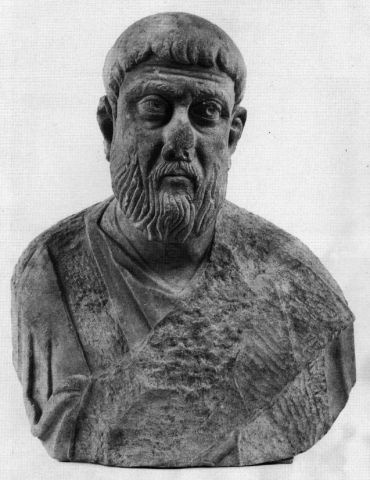
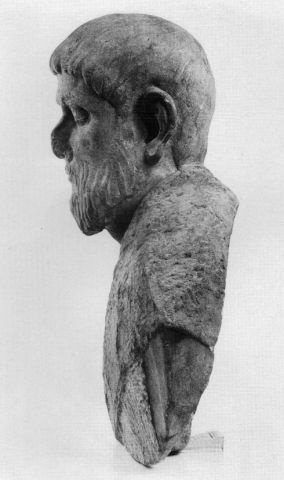
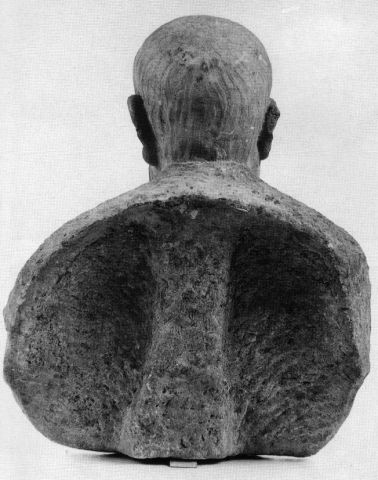
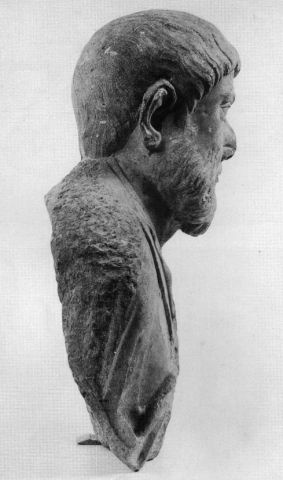
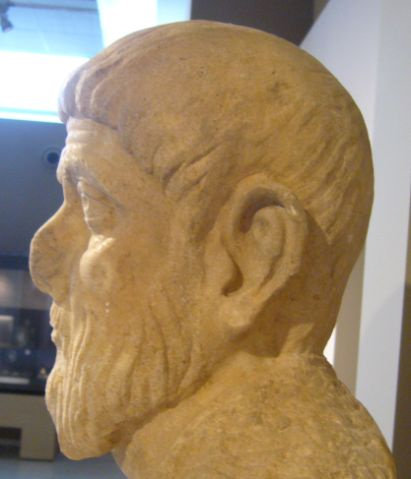
Bust of long bearded man wearing two tunics and cloak. Thessalonica. Third century, re-worked late fourth to earlier fifth century
Record details
Photographs
Bibliography
- Despines, G., Stefanidou-Tiveriou, Th & E. Voutiras, Katalogos Glypton tou Archaiologikou Mouseiou Thessalonikes II, Thessaloniki 2003, pp. 219-23 no. 308 figs. 979-82
- Stefanidou-Tiveriou, T., Ein Beamter und ein Philosoph aus dem spätantiken Thessaloniki, Archaeologica Adriatica 11, 659-69, Zadar 2008, pp. 663, 666-7, figs. 7, 8
Discussion
DESCRIPTION (Object)
Coarse-grained white marble, possibly Thassian; H (total) 51.1, (head) 27 cm. The bust is almost complete, only the left nostril and the earlobs are chipped. The base which was worked separately is lost; at the bottom of the bust there is a dowel hole to connect bust and base.
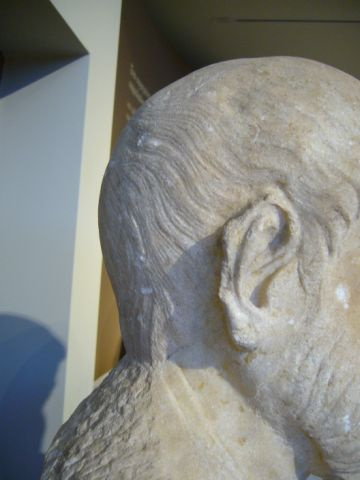
The hair is a dense mass marked with fine parallel hatches on the skull. Above the forehead it is separated into single strands by few short and deeply drilled channels. The beard is marked by long and deep chiselled lines.
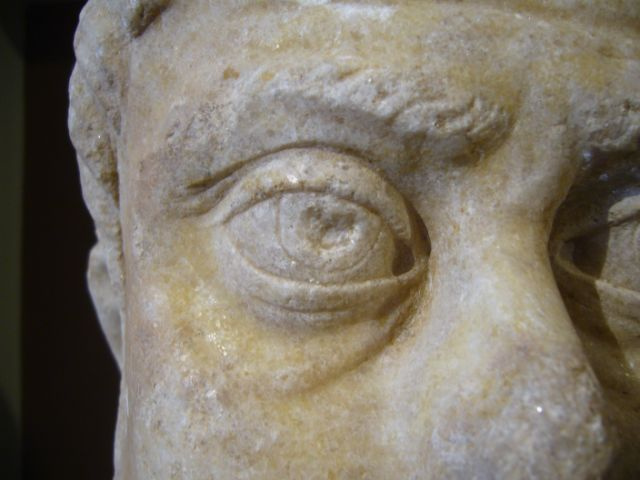
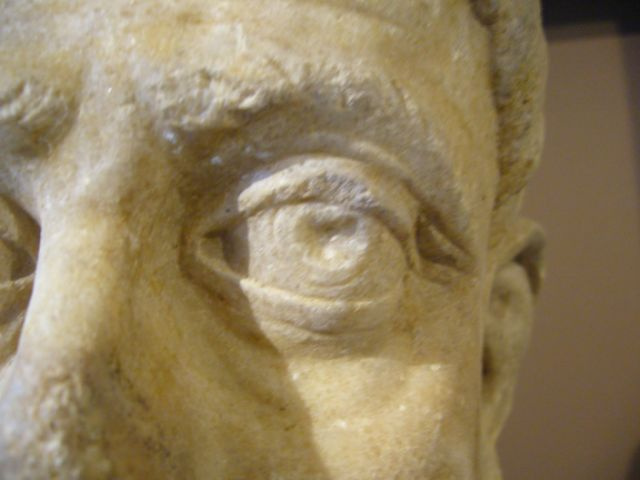
The eyebrows are marked by rough chisel strokes. The iris is circumscribed by an incised line. The pupil is a large crescent shape hollow set against the upper lid.
Evidence of earlier use is visible notably in front of the ears where the beard has been hatched into the smooth surface of the original portrait. The ears, notably the left one, are misshapen. The eyes have been enlarged for the late-antique use of the head.
The garment has been worked back secondarily on breast and shoulders, marks of point and rasp are visible; this process took off a portion of the bust at the right side (see below, 'Description (Subject)').
PROVENANCE/ LOCATION
The bust was found 1972 in the south stoa of the ancient agora of Thessaloniki. It is today in the Thessaloniki Archaeological museum, inv. no. 6100.
DESCRIPTION (Subject)
The portrait depicts an elderly man with long beard, his hair brushed forward to form a moderate wreath around the face; the ears are uncovered. The eyes are wide open, two horizontal wrinkles fur the brow. The head is bent to its left. The wreath-hairstyle is displayed by the portraits of high ranking state officials on the obelisk base in Constantinople (390/2) and by late-4th/ 5th century portraits in the round attributable to the same group of persons; among the comparanda is a chlamys bust from Thessalonica (LSA-90; further examples: LSA-150; LSA-447; LSA-2282). The long beard is a feature often associated with philosophers or ‘Holy men’ (Stefanidou-Tiveriou 2008, 666-7, LSA-1083); the combination of the short hair with the long beard is not unique, however, in late-antique portraiture (LSA-131; LSA-142), and high ranking state officials are often praised for their education and intellect in the verse inscriptions accompanying honorific statues. The portrayed may have been an outstanding intellectual, or a state official with affinity to the Muses.
The portrayed wears two tunics, the two seams of which are visible at the right side of the neck, and a cloak. The latter is chiselled out but recognizable as a toga, more probably of the late antique than of the contabulated type; the balteus and the lorum as the most significant parts of the garment have been removed. The vertical stripe chiselled out on the right shoulder is where the purple stripe indicating the affiliation to the senatorial class was visible within traditional Roman toga-costumes; stripes of this kind are still displayed on pictures of the late-antique toga (marriage of Moses and Saphira on the wall-mosaics of Santa Maria Maggiore in Rome). The bust was possibly re-used as an image of a saint at a date later than its use as honorific monument (Stefanidou-Tiveriou 2008, 667). This could explain why the senatorial garment was chiselled out.
DATE
The portrait bust was dated to the early fifth century by Despines 2003 (in Despines et al. 2003), followed by Stefanidou-Tiveriou 2008.
The emphatic eyes and the modest form of the wreath-hairstyle assign a date not earlier than the late 4th century and before the middle of the 5th century to the portrait in its present state. The original bust (see above, 'Description (Subject)') was already late antique, probably as late as the late 4th century as indicated by the (chiselled out) late antique toga and the two tunics.
Cite: Last Statues of Antiquity, LSA-2363 (Ulrich Gehn).