
LSA-2364
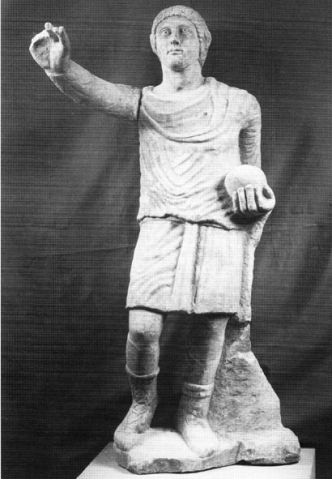
Statue of emperor holding orb, re-carved from earlier statue. Messene (Achaea). Earlier fourth century
Record details
Photographs
Bibliography
- Deligiannakis, G., Two Late-antique statues from Ancient Messene, The Annual of the British School at Athens 100, pp. 387-406, 2005, 393-400 no. 1 pl. 10-13 b, figs. 4, 6
Discussion
DESCRIPTION (Object)
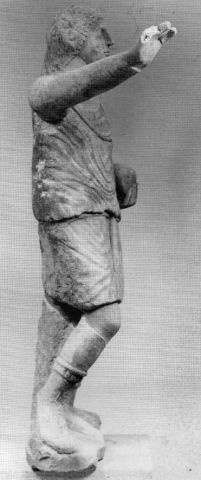
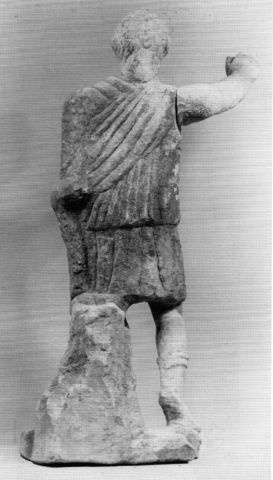
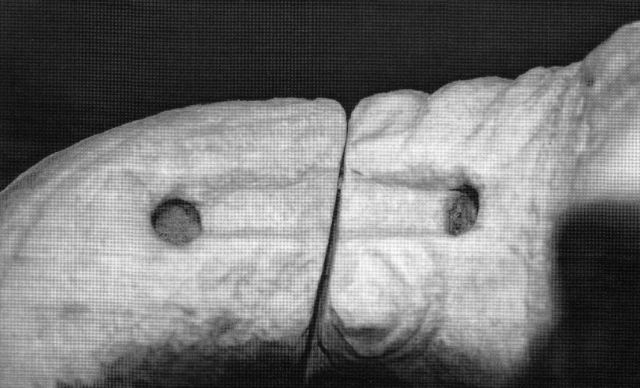
The statue is preserved with a portion of its plinth, white marble with yellow veins, possibly pentelic; H (overall) 146, (plinth) 9; D (plinth) 57 cm; H (chin to hairline) 15 cm. The statue is preserved in three main joining pieces, (i) the head and the torso down to the knees, (ii)the right arm, (iii) the lower legs with the plinth. The fingers of the right hand are broken, the left nostril is chipped, and the back of the left arm is broken off; the margins of the plinth are broken at front and back. The right hand is attached to the arm with a dowel, and the arm is held with a clamp at the shoulder. The surface is smoothly finished at the front and right side, but only roughly finished at the back and parts of its left side; the support is left coarse and unformed. At the back of the neck there is an ashlar. Traces of red colour are extant at the garment and the boots. At the back of the support folds of a garment are extant which show that the statue was re-carved from an earlier draped statue (Deligiannakis 2005, 393-4).
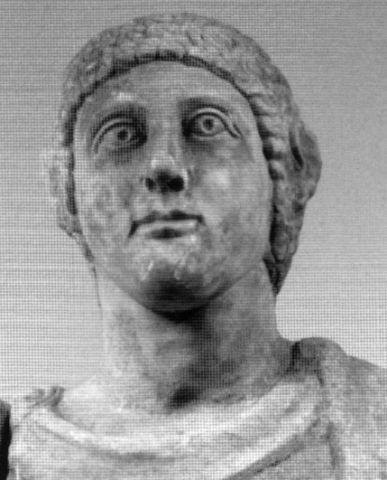
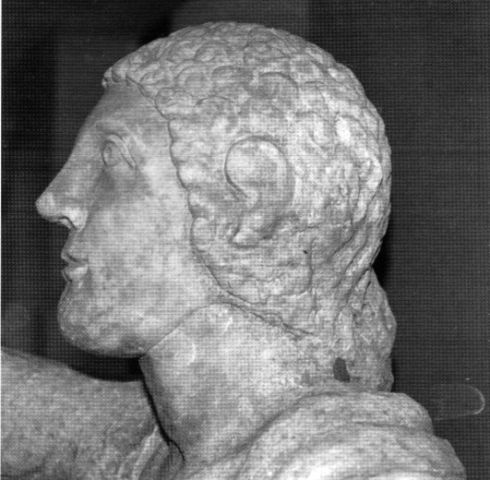
The hair is fitting to the skull like a wool cap and is arranged into knobby curls by chisel-work; it is only roughly worked at the rear. Around the face it is arranged into forward-brushed bulbs separated from each other by short drill-lines.
The pupils are marked by a large, shallowly drilled hole; the irises are not marked.
PROVENANCE/ LOCATION
The statue was found during excavations in 1966 (right hand) and 1969 in a large Roman house in the city centre of Messene. It formed part of the decoration of the triclinium of that house, where it was probably set up in a niche in the north wall (Deligiannakis 2005, 392). The statue is today in the Messene museum, inv. no. 263. In the same room a head and the lower portion of a stue of Hermes were found in 1969 (LSA-2365), and a statue of Artemis in 1989.
DESCRIPTION (Subject)
The portrayed stands with the weight on his left leg, the right heel raised and the right knee bent. His left arm is flexed and held close to the body, in the left hand he holds an orb. The right arm is raised to shoulder-height and stretched forward, the hand once held in the gesture of tres digiti porrecti.
The portrayed is dressed in a knee-length long sleeved tunic girded with a belt, the belt partly covered by a pouch. At the right shoulder a chlamys is fastened with a round fibula. The footwear is an elaborate boot tied on the instep and reaching to the middle of the shin. Under the boot he wears a sort of stockings or gaiters reaching up to the knee.
The eyes are wide open; the face is without wrinkles. The thick hair is arranged in knobby curls; it frames the brow in an arching line, along the hairline the curls are brushed forward. . The ears stick out of the mass of hair surrounding them from all sides; the sculptor had obvious difficulties to form the hairstyle appropriate for the honorand.
The orb in the left hand, the gesture of the right hand, and the costume identify the portrayed as an emperor; this identification holds despite the fact that the hairstyle is not matched by any known imperial portrait (Deligiannakis 2005, 398). The date of the statue allows for Constantine I or one of his sons and nephews (see below, ‘Date’). As Deligiannakis points out, the epigraphic evidence from the region testifies to more honorific monuments to Constantine than to any other 4th-century ruler (Deligiannakis 2005, 399); Constantine is the most likely of the possible honorands.
DATE
The rendering of the eyes assigns a late antique date to the statue. The terminus ante quem is provided by the findspot; the house was destroyed and abandoned by 360/70, probably short after 361 since the latest coins found in the debris are of Constans (Augustus 337-50) and Constantius II (Augustus 337-61) (Deligiannakis 2005, 392). The absence of a diadem might lower the terminus ante quem to a date before c. 325 when Constantine adopted the diadem on his coins; it seems, however, that the introduction of the diadem as a regular badge of imperial office in sculptured portraits postdates Constantine’s death (Smith 1997, 177-8).The clean-shaven face indicates a date after Constantine had changed the stubble-bearded, short-haired imperial image of the tetrarchy into the clean-shaven youthful portrait first testified to on his arch in Rome (312/15). In 316/17 the control over the province of Achaea in which Messene lay passed from Licinius to Constantine.
To sum up, the iconography of the statue and the findspot secure a date of 312/61 for the statue; there is some probability that it dates between 316 (the year when control over Achaea was passed to Constantine) and 337 (Constantine’s death).
ACKNOWLEDGEMENTS
I am grateful to Dr U. Hübinger, Berlin, for alerting me to this statue.
Discussion references
- Smith, R.R.R.,'The public image of Licinius I: Portrait sculpture and imperial ideology in the early fourth century', JRS 87, 1997
Cite: Last Statues of Antiquity, LSA-2364 (Ulrich Gehn).