
LSA-2365
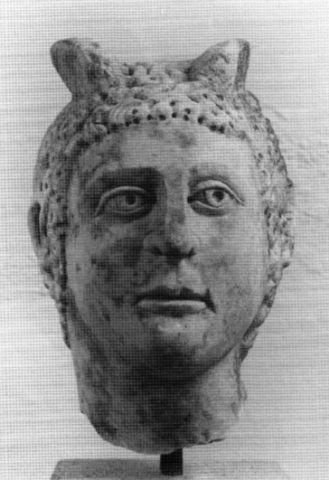
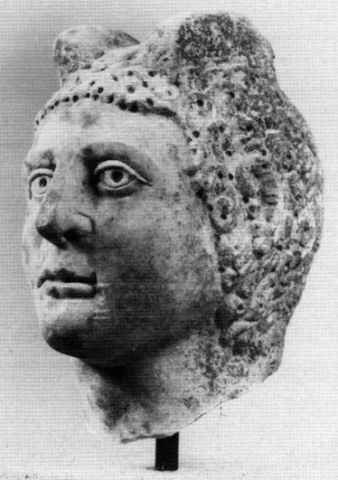
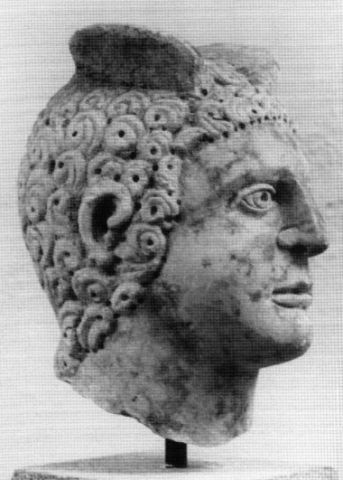
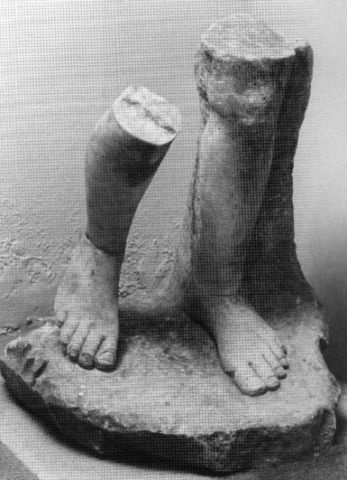
Head and lower portion of statue of Hermes, re-carved from earlier statue. Messene (Achaea). Earlier fourth century
Record details
Photographs
Bibliography
- Deligiannakis, G., Two Late-antique statues from Ancient Messene, The Annual of the British School at Athens 100, pp. 387-406, 2005, pp. 400-2pl. 14, 15, fig. 7
Discussion
DESCRIPTION (Object)
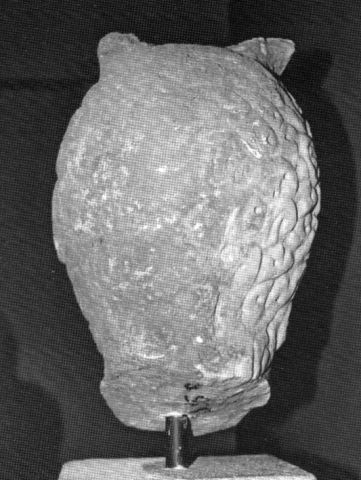
The head is of white marble with yellow veins, possibly pentelic; H (overall) 32, (chin to hairline) 16 cm. The head is preserved in one piece with biggest portion of the neck. At the front and both sides the hair is arranged into knobby curls separated from each other by drilled lines and with round drill-points in their centre; further drill points mark the hairline above the brow. At the back the head is only roughly finished. The irises is circumscribed by incised lines, the pupils are indicated by round drill hole of unequal size.
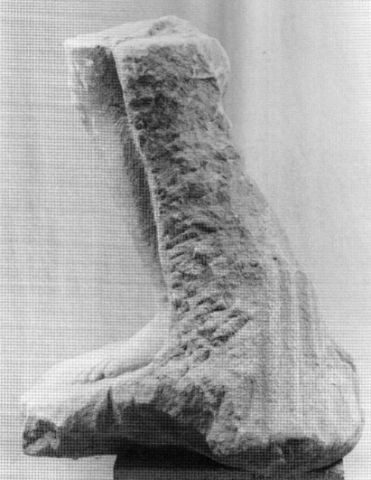
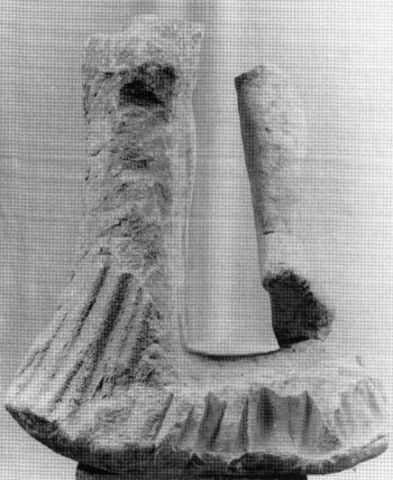
The lower portion of the body is from a male statue with bare legs. It is preserved in two parts from the knees downwards; H (overall) 52, (left leg) 52, (right leg) 44 (plinth) 7; D (plinth) 57 cm. At the left leg stands a trunk support. There are several breaks around the boarder of the plinth. The surface of the flesh is polished; the support is only roughly finished. At the back of the support and the plinth the folds of the draped statue from which our statue was re-carved are clearly visible.
Style, scale and technique of this statue closely resemble those of the imperial statue found in the same room (LSA-2364; see below, ‘Provenance/ Location’, and ‘Date’).
PROVENANCE/ LOCATION
The statue was found in 1969 during excavations of a large Roman house in the city centre of Messene. The two parts were lying in close proximity, fit in scale, and therefore belong probably together. The statue formed part of the decoration of the triclinium of that house, where it was probably set up in a niche in the north wall (Deligiannakis 2005, 392, 400). The statue is today in the Messene museum, inv. no. 26 (head) and 258 (lower portion). In the same room an imperial portrait statue was found in 1966/1969 (LSA-2364), and a statue of Artemis in 1989.
DESCRIPTION (Subject)
The two lumps of stone springing out of the head model the wings of the god Hermes and give prove that the statue was intended to represent that deity. The extant legs show that the god was standing with the weight over his left leg. He was probably shown naked holding his chlamys.
DATE
The rendering of the eyes assigns a late-antique date to the statue. The stylistic and technical similarity to the imperial statue found in the same room suggest that both statues belong to the same period and come from the same workshop.
ACKNOWLEDGEMENTS
I am grateful to Dr U. Hübinger, Berlin, for alerting me to this statue.
Cite: Last Statues of Antiquity, LSA-2365 (Ulrich Gehn).