
LSA-237
Base for statue with dedication to emperors. Aphrodisias (Caria). 293-311
Record details
Photographs
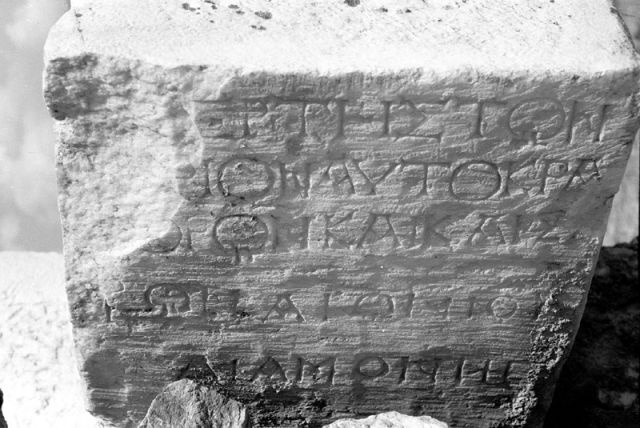
Inscription
[ὑπ]ὲρ τῆς τῶν / [κυ]ρίων Αὐτοκρα/[τ]όρων καὶ Καισά/ρων αἰωνίου / 5 vac. διαμονῆς
Inscription translation
For the eternal endurance of the lords Imperators and Caesars.
(Trans: C. Roueché)
Bibliography
- Roueché, C., Aphrodisias in Late Antiquity (Journal of Roman Studies Monograph 5), London 1989, no. 9
- Roueché, C., Rome, Asia and Aphrodisias in the third century, Journal of Roman Studies 71, 1981, 103-120
Discussion
INSCRIPTION
In five lines:
[ὑπ]ὲρ τῆς τῶν / [κυ]ρίων Αὐτοκρα/[τ]όρων καὶ Καισά/ρων αἰωνίου /(5) διαμονῆς
'For the eternal endurance of the lords Imperators and Caesars.' (Trans: C. Roueché)
Letter height not recorded.
DESCRIPTION
Plain rectangular shaft. H: 177, W: 42, D: 46 cm. White marble.
The top, viewer’s left, corner is chipped. The lower part has been recorded as broken.
PROVENANCE AND CURRENT LOCATION
The base was built into the city wall near the northeast corner of the Stadium. The inscribed side faced inwards.
DATE
The plural forms both of emperor and caesar date this to the Tetrarchic period. Interestingly it is devoid of the specific imperial names. Roueché suggests that this might reflect genuine confusion about them after the abdication of Diocletian and Maximian in 305. The name of the dedicating body may have appeared on an upper moulding.
Cite: Last Statues of Antiquity, LSA-237 (J. Lenaghan).