
LSA-2372
Base for statue of Diocletian, emperor. Thamugadi (Numidia). 286-287
Record details
Photographs
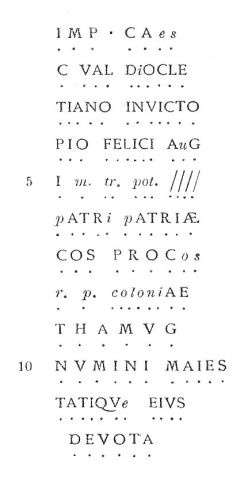
Inscription
[[Imp(eratori) Ca[es(ari)], / C(aio) Val(erio) D[i]ocle/tiano, invicto, / pio, felici A[u]g(usto), / (5) p(ontifici) [m(aximo), tr(ibunicia) pot(estate) IIII, / p]atr[i p]atriae, / co(n)s(uli), proc[o(n)s(uli), / r(es) p(ublica) coloni]ae / Thamug(adensium), / (10) numini maies/tatiqu[e] eius / devota]].
Inscription translation
To the emperor Caesar, Caius Valerius Diocletianus, unconquered, pious, fortunate Augustus, highest priest, holding tribunician power four times, father of the fatherland, consul, proconsul. The community (res publica) of the colony of the Thamugadenses, devoted to his divine spirit and majesty, [set this up].
Bibliography
- Corpus Inscriptionum Latinarum; , VIII, no. 17882
- Lepelley, C., Les cités de l'Afrique romaine au Bas-Empire, t. 2, Notices d'histoire municipale, Paris 1981, p. 448, no. 2
Discussion
INSCRIPTION
In twelve lines:
[[Imp(eratori) Ca[es(ari)], / C(aio) Val(erio) D[i]ocle/tiano, invicto, / pio, felici A[u]g(usto), / (5) p(ontifici) [m(aximo), tr(ibunicia) pot(estate) IIII, / p]atr[i p]atriae, / co(n)s(uli), proc[o(n)s(uli), / r(es) p(ublica) coloni]ae / Thamug(adensium), / (10) numini maies/tatiqu[e] eius / devota]].
'To the emperor Caesar, Caius Valerius Diocletianus, unconquered, pious, fortunate Augustus, highest priest, holding tribunician power four times, father of the fatherland, consul, proconsul. The community (res publica) of the colony of the Thamugadenses, devoted to his divine spirit and majesty, [set this up].'
The inscription has been erased, but remains substantially legible.
DESCRIPTION (from Poulle, 1883)
Base with crown ('dé d'autel avec chapiteau'). It is inscribed on two faces, being reused a few years later for Constantius I or II (LSA-2375), when the base was turned round and a new inscription carved on the back. H 116, W 50 cm, depth unrecorded.
PROVENANCE AND CURRENT LOCATION
Found in the inner portico of the forum by Poulle in 1883, where it remains.
HONORAND, AWARDER AND DATE
The honorand, Diocletian, was Augustus from 284 to 305.
The awarder was the city, as was usual in Africa for imperial statues.
Diocletian held tribunician power for the fourth time between 10 December 286 and 9 December 287.
FURTHER DISCUSSION
Our base was later reused for another imperial statue, to a Constantius 'Caesar', probably Constantius II, Caesar 324-337 (LSA-2375). Bases to Diocletian appear on occasion to have been defaced by zealous Christians; but this is unlikely to have occurred before 337. Rather our base is a good example of the rapid recycling of a base, even one to an emperors who was still highly respected.
Cite: Last Statues of Antiquity, LSA-2372 (Gabriel de Bruyn).