
LSA-2374
Base for statue of Galerius, emperor. Thamugadi (Numidia). 305-311
Record details
Photographs
Inscription
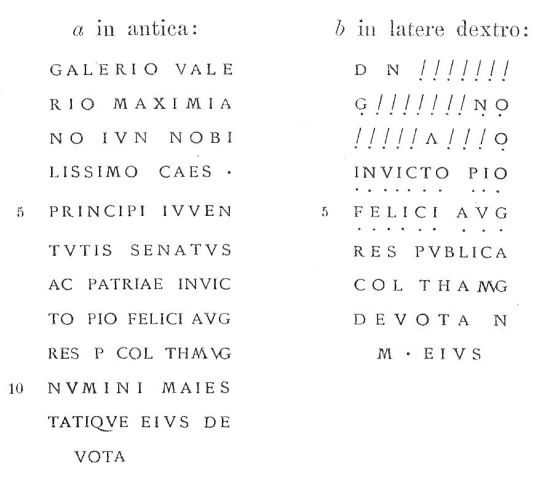
(A) (front): Galerio Vale/rio Maximia/no iun(iori), nobi/lissimo Caes(ari), / (5) principi iuven/tutis, senatus / ac patriae, invic/to, pio, felici Aug(usto), / res p(ublica) col(oniae) Thamug(adensium), / numini maies/tatique eius de/vota.
B (right side): D(omino) n(ostro) [[---] / G[---]no / [---]a[---]o / invicto, pio, / (5) felici Aug(usto)]], / res publica / col(oniae) Thamug(adensium), / devota n(umini) / m(aiestatique) eius.
Inscription translation
A (front): To Galerius Valerius Maximianus the younger, most noble Caesar, prince of youth, of the senate and of the fatherland, unconquered, pious, fortunate Augustus; the community (res publica) of the colony of the Thamugadenses, devoted to his divine spirit and majesty, [set this up].
B (right side): To our lord [...], unconquered, pious, fortunate Augustus, the community (res publica) of the colony of Thamugadi, devoted to his divine spirit and majesty, [set this up].
Bibliography
- Corpus Inscriptionum Latinarum; , VIII, no. 17884
- Lepelley, C., Les cités de l'Afrique romaine au Bas-Empire, t. 2, Notices d'histoire municipale, Paris 1981, p. 350, no. 7
- Zimmer, G., Wesch-Klein, G., Locus datus decreto decurionum : zur Statuenaufstellung zweier Forumsanlagen im römischen Afrika, München, 1989, p. 80, T33
Discussion
INSCRIPTION
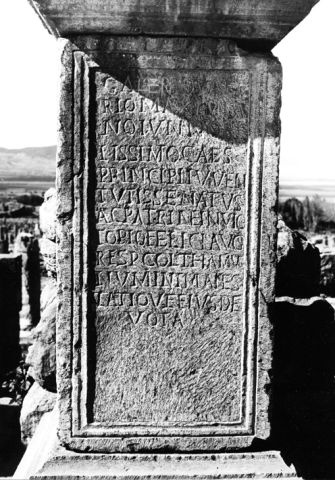
On two faces of the base. The first (A) in twelve lines, the second (B) in nine:
(A) (front): Galerio Vale/rio Maximia/no iun(iori), nobi/lissimo Caes(ari), / (5) principi iuven/tutis, senatus / ac patriae, invic/to, pio, felici Aug(usto), / res p(ublica) col(oniae) Thamug(adensium), / numini maies/tatique eius de/vota.
'To Galerius Valerius Maximianus the younger, most noble Caesar, prince of youth, of the Senate and of the fatherland, unconquered, pious, fortunate Augustus; the community (res publica) of the colony of the Thamugadenses, devoted to his divine spirit and majesty, [set this up].'
(B) (right side): D(omino) n(ostro) [[---] / G[---]no / [---]a[---]o / invicto, pio, / (5) felici Aug(usto)]], / res publica / col(oniae) Thamug(adensium), / devota n(umini) / m(aiestatique) eius.
'To our lord [...], unconquered, pious, fortunate Augustus, the community (res publica) of the colony of Thamugadi, devoted to his divine spirit and majesty, [set this up].'
Letter height : 4 cm.
Lines 2-3 of the second inscription, with the name of the honorand, have been deliberately erased. The similarity of the wording that it uses shows that it was set up close in date to inscription (A); it may indeed be a second inscription to the same Galerius (see below, 'Honorand and Date').
DESCRIPTION (from the CIL photograph and Wesch-Klein)
Rectangular base, with separately worked plinth and crown, inscribed on two sides. The inscription on the front (A) is framed within a moulding; the second inscription (B) is on the right face. H 117, W 62, D 62 cm.
PROVENANCE AND CURRENT LOCATION
Found in the forum. The plan published by Zimmer and Wesch-Klein shows it in the portico's north-east corner. It remains where it was found.
HONORAND AND DATE
The honorand of inscription (A) (and possibly of (B)), Galerius, was Caesar from 293 to 305 and Augustus from 305 until his death in 311.
The awarder of both dedications was, as usual for statues to emperors in Africa, the city.
Inscription (A) terms Galerius both 'Caesar' (which he was from 293 to 305), and 'Augustus' (which he was from 305 to 311), but also uses an epithet, 'prince of youth, of the Senate and of the fatherland', appropriate for a Caesar but not for an Augustus. Either the drafter of this inscription was simply confused (perhaps by the novelty of the tetrarchic system, when it was established in 293); or the dedication was drafted, again with some confusion, around 305, when Galerius moved from being a Caesar to being an Augustus.
Inscription (B) presumably postdates (or is directly contemporary with) inscription (A), since it is set on a less well-prepared face of the block. It is almost certainly earlier than 324, since it includes 'invictus' amongst its imperial titles, an epithet which Constantine abandoned in that year. If it was a second dedication to Galerius, as is quite likely, it may have been set up after 305, with a dedication to him unambiguously as 'Augustus', thereby clarifying and correcting the uncertainty of inscription (A) on the front face of the block.
FURTHER DISCUSSION
The later history of this base is puzzling. If both dedications were to Galerius, why was only one of them (B) defaced; and why, even if (B) was not to Galerius, was inscription (A) left intact in the political heart of Thamugadi, when another inscription to Galerius elsewhere in the city (LSA-2373) was carefully defaced, almost certainly when his political rival, Maxentius, seized Africa in 310?
One possible explanation, if both inscriptions were to Galerius, is that inscription (A) was plastered over in 310, an operation that was reasonably straightforward, because of its rough surface and because the epigraphic field was sunk within a frame. Whereas inscription (B), set flush on the side of the base, and without a projecting frame, had to be defaced. If this explanation is correct, the people of Thamugadi had a simple job to do in 312, when, on the fall of Maxentius, Galerius' good name was resurrected - they only had to remove a thin layer of plaster!
Cite: Last Statues of Antiquity, LSA-2374 (Gabriel de Bruyn).