
LSA-2376
Base for statue or bust of Crispus, emperor. Thamugadi (Numidia). 317-326
Record details
Photographs
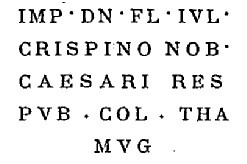
Inscription
Imp(eratori), d(omino) n(ostro), Fl(avio) Iul(io) / Crispino, nob(ilissimo) / Caes(ari), res / pub(lica) col(oniae) Tha/mug(adensium).
Inscription translation
To the emperor, our lord Flavius Iulius Crispinus, most noble Caesar, the community (res publica) of the colony of the Thamugadenses [set this up].
Bibliography
- Lepelley, C., Les cités de l'Afrique romaine au Bas-Empire, t. 2, Notices d'histoire municipale, Paris 1981, 450 no. 12
Discussion
INSCRIPTION
In five lines:
Imp(eratori), d(omino) n(ostro), Fl(avio) Iul(io) / Crispino, nob(ilissimo) / Caes(ari), res / pub(lica) col(oniae) Tha/mug(adensium).
'To the emperor, our lord Flavius Iulius Crispinus, most noble Caesar; the community (res publica) of the colony of the Thamugadenses [set this up].'
Letter height: 5 cm
DESCRIPTION (from Vars, 1901)
Sandstone column: H 53, diameter 27 cm. Vars supposed, presumably on the basis of the small size of this base, that it was designed to carry a bust, rather than a full size statue. If it was originally set up within the house where it was found (see below 'Provenance'), this would support an interpretation of the base as for a bust.
PROVENANCE AND CURRENT LOCATION
Found by Vars, in August 1901, in a house bordering the decumanus maximus, in front of the former museum. There is no published record of its present location.
HONORAND, AWARDER AND DATE
The honorand, Crispus, the eldest son of Constantine, was elevated to the rank of Caesar in 317, but disgraced and executed in 326.
The awarder was the city, as usual for imperial statuary in Africa.
Cite: Last Statues of Antiquity, LSA-2376 (Gabriel de Bruyn).