
LSA-2377
Plaque from base for statue of Constantine I, emperor. Thamugadi (Numidia). 312-337
Record details
Photographs
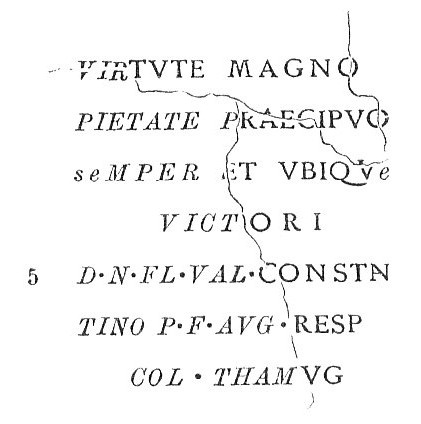
Inscription
Virtute magno, / pietate praecipuo, / [se]mper et ubiqu[e] / victori, / (5) d(omino) n(ostro) Fl(avio) Val(erio) Constan/tino, p(io), f(elici) Aug(usto), res p(ublica) / col(oniae) Thamug(adensium).
Inscription translation
To one great in virtue, outstanding in piety, always and everywhere the victor, our lord Flavius Valerius Constantinus, pious, fortunate Augustus; the community (res publica) of the colony of the Thamugadenses [set this up].
Bibliography
- Corpus Inscriptionum Latinarum; , VIII, no. 17885
Discussion
INSCRIPTION
In seven lines:
Virtute magno, / pietate praecipuo, / [se]mper et ubiqu[e] / victori, / (5) d(omino) n(ostro) Fl(avio) Val(erio) Constan/tino, p(io), f(elici) Aug(usto), res p(ublica) / col(oniae) Thamug(adensium).
'To [him who is] great in virtue, outstanding in piety, always and everywhere the victor, our lord Flavius Valerius Constantinus, pious, fortunate Augustus; the community (res publica) of the colony of the Thamugadians [set this up].'
Letter height: 9.5 cm
DESCRIPTION (from Poulle, 1883)
Plaque, broken into three pieces: H 90, W 96 cm, depth unrecorded. The width of this plaque is exceptional for a statue base, unless equestrian, but the wording is typical, and we must suppose that it was originally fixed to a base built in some other material.
PROVENANCE AND CURRENT LOCATION
Found in the forum. There is no published record of its subsequent location.
HONORAND, AWARDER AND DATE
The honorand, Constantine I, was Augustus from 307 to 337.
The awarder was the city, as usual for imperial statues in Africa.
The formula 'semper et ubique victor, always and everywhere the victor' must certainly postdate Constantine's victory over Maxentius in 312. It is possible (but not certain) that it also reflects his abandonment of the epithet 'invictus' in 324 (Lassère, 607).
Discussion references
- Lassère, J.-M., Manuel d'épigraphie romaine, Paris, 2005, p. 607
Cite: Last Statues of Antiquity, LSA-2377 (Gabriel de Bruyn).