
LSA-2379
Base for statue of Constantius I, Constantine I, or Constantine II, emperor. Thamugadi (Numidia). 293-340
Record details
Photographs
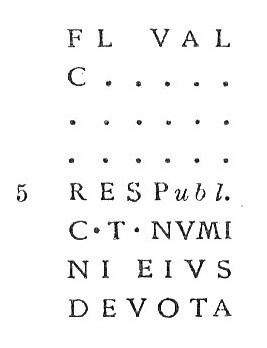
Inscription
Fl(avio) Val(erio) / C[----- / ----- / -----] / (5) res p[ubl(ica)] / c(oloniae) Thamug(adensium) numi/ni eius / devota.
Inscription translation
To Flavius Valerius C..., the community (res publica) of the colony of the Thamugadenses, devoted to his divine spirit, [set this up].
Bibliography
- Corpus Inscriptionum Latinarum; , VIII, no. 17887
- Lepelley, C., Les cités de l'Afrique romaine au Bas-Empire, t. 2, Notices d'histoire municipale, Paris 1981, p. 450, no. 9
Discussion
INSCRIPTION
In eight lines:
Fl(avio) Val(erio) / C[----- / ----- / -----] / (5) res p[ubl(ica)] / c(oloniae) T(hamugadensium) numi/ni eius / devota.
'To Flavius Valerius C..., the community (res publica) of the colony of the Thamugadians, devoted to his divine spirit, [set this up].'
Lines 2-4, with much of the imperial name and all the imperial titles, were evidently already lost when this inscription was first recorded. This damage may have been caused by time or accident, but deliberate erasure is perhaps more likely (though why it did not include the first part of the name is not clear).
DESCRIPTION
There are no published descriptions or measurements of this base, and no published image.
PROVENANCE AND CURRENT LOCATION
Found in the forum. There is no published record of its subsequent location.
HONORAND, AWARDER AND DATE
Enough survives of the name of the honorand for us to be certain that he was a member of the Constantinian dynasty whose name began 'Flavius Valerius'. There are three possible candidates: Constantius I, Caesar from 293 to 305, and then Augustus until his death in 306; Constantine I, Augustus from 306 to 337; Constantine II (called 'Flavius Valerius Constantinus' until 337), Caesar from 317 to 337. Lepelley assumes our base was dedicated to Constantius I and erased in 310-12 when Maxentius, his political rival and enemy, ruled over Africa. However, all of these emperors could have suffered the erasure of their names, if it was deliberate erasure (see above, 'Inscription'): Constantius I and Constantine I during Maxentius' rule; Constantine II after his fall from power in 340.
The awarder was the city, as usual with imperial statues in Africa.
Cite: Last Statues of Antiquity, LSA-2379 (Gabriel de Bruyn).