
LSA-2384
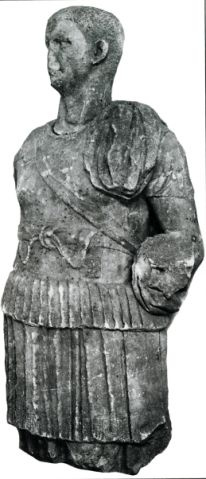
Cuirassed statue (?) of emperor, head re-cut from Claudius. From Locris. Late third to early fourth century.
Record details
Photographs
Bibliography
- Faedo, L. 'Aspetti della cultura figurativa in età romana', Storia della Calabria antica. Vol. II. , Rome 1994, 629-631, figs. 31-3
Discussion
DESCRIPTION (Object)
Over life-size statue with separately worked head. Marble
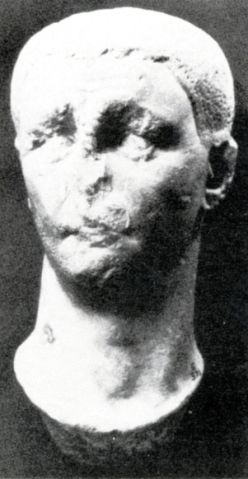
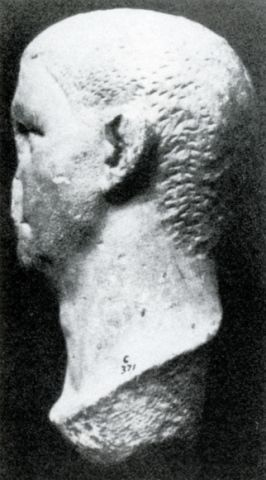
The head was worked separately. It is cut tightly around the neck and has a fully-finished tenon which continues beneath the neck. It is missing its nose and parts of the ears. The brow and the mouth are battered. The head has been re-cut from an earlier head (possibly of Claudius). The original hairstyle is visible at the crown of the head and over the brow. A stubble beard has been engraved into the surface of the face with the point of a chisel.
The head is shown on the statue in photographs dated to 1933 in the possession of the DAI in Rome. The fit is not perfect but this is not a good reason to argue that the two were not used together in the late third century.
The statue is preserved from the shoulder to the knees. It has a socket for the head.
PROVENANCE
The head is said to be from Locri without further information. The statue is associated by Faedo with a passing reference in Notizie degli Scavi 1882, pp. 402-403. There in discussion of the excavation of a house a Locri at the end of 1879 is the following sentence: “presso all’accennata abitazione colonica nel fondo dell Centocamere trovasi un tronco di statua marmorea.” (near the cited colonial in habitation at Centocamere the trunk of a marble statue was found.) Interestingly a fragmentary base for an emperor of c. 280-350, LSA-1809, also comes from Locri.
DESCRIPTION (Subject)
The portrait head turns to its right. It preserves the neck and the smallest possibly area of flesh around the neck. It was therefore intended to be inset into a cuirassed statue.
The head has been re-worked from a portrait of Claudius. It therefore retains much of the triangular shape of his well-known face. Even the two creases across the forehead probably belong to the portrait of Claudius. The hair however has been shortened to a close crop, and a beard (possibly without a moustache) has been added.
The head has been set on a cuirassed statue which bears its weight over the right leg. The left arm is bent. A chlamys is bunched on the left shoulder and wrapped around the left arm. A sword strap crosses the body from the right shoulder to the left hip. A belt, cingulum, encircles the waist, and its ends, is knotted at the centre, and its ends are tucked underneath its horizontal passage. The cuirass terminates in a straight line and a fringe of flaps, below which is a leather skirt. It is without the rounded lower edge and the ptergyes of the high-imperial cuirass.
DATE
The head, once a portrait of Claudius, has been given a new hair and beard style which corresponds to that of the emperors of the late third century and early fourth century. At that point the head may well have been set on the statue which wears a cuirass of the Hellenistic period. If the head and statue were combined in the late third or early fourth century, the statue would most probably represent an emperor. The cuirass had at that point become the uniform of only the emperor. A base, LSA-1809, for an emperor of the late third or early fourth century was found at the same site.
Discussion references
- Vermeule, C.C.C. 'Hellenistic and Roman cuirassed statues' , Berytus 13, Beirut 1959, 71, no. 308 (c. 250)
Cite: Last Statues of Antiquity, LSA-2384 (J. Lenaghan).