
LSA-2385
Base for statue of governor of Africa Proconsularis, possibly Valerius Felix. Bulla Regia (Africa Proconsularis). 324-337
Record details
Photographs
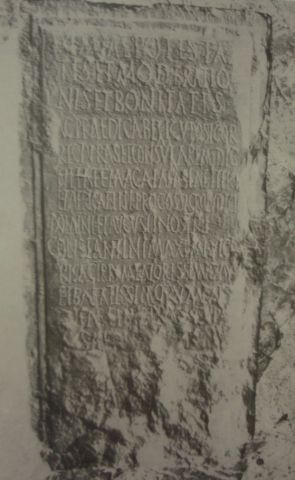
Inscription
Eximiae potesta-/tis et moderatio-/nis et bonitatis / (4) ac praedicabili c(larissimo) v(iro), post cor-/recturas et consularem dig-/nitatem Ac(h)aiae, Asiae iteru[m] / et Africae IIII proco(n)s(uli), sacro iudici[o] / domini et Augusti nostri / (9) Constantini maximi vict[o]-/ris ac triumfatoris semper Au[g(usti)] / et beatissimorum Caes[arum] / ENEAS[---] / TVS A[---].
Inscription translation
To a man of outstanding ability, moderation and goodness, as well as praiseworthy, of clarissimus rank, after holding governorships (correcturas), the consular dignity (i.e., governorship) of Achaia and Asia for the second time, and governor (proconsul) of Africa four times (i. e., for four years), with the sacred judgment of our lord and Augustus Constantinus the greatest, victor and triumphator, forever Augustus, and of the most blessed Caesars (…).
Bibliography
- Cagnat, R., Merlin, A., Inscriptions latines d'Afrique, Paris, 1923, 456
- L'Année épigraphique, , 1991, 1682
Discussion
INSCRIPTION
Partly preserved in 19 lines:
Eximiae potesta-/tis et moderatio-/nis et bonitatis / (4) ac praedicabili c(larissimo) v(iro), post cor-/recturas et consularem dig-/nitatem Ac(h)aiae, Asiae iteru[m] / et Africae IIII proco(n)s(uli), sacro iudici[o] / domini et Augusti nostri / (9) Constantini maximi vict[o]-/ris ac triumfatoris semper Au[g(usti)] / et beatissimorum Caes[arum] / ENEAS[---] / TVS A[---].
'To a man of outstanding ability, moderation and goodness, as well as praiseworthy, of clarissimus rank, after holding governorships (correcturas), the consular dignity (i.e., governorship) of Achaia and Asia for the second time, and governor (proconsul) of Africa four times (i. e., for four years), with the sacred judgment of our lord and Augustus Constantinus the greatest, victor and triumphator, forever Augustus, and of the most blessed Caesars (…).'
Letter height 4 – 4.5 cm.
We reproduce the inscription with the completions suggested by L’Année Épigraphique (AE) 1991.
DESCRIPTION (from AE and the published image)
Rectangular limestone base, H 110, W 47, D 55 cm. The epigraphic field is framed; the surface is damaged in the lower portion, leaving the last two lines illegible. The first three lines are erased (see also below, ‘Honorand, Awarder and Date’).
PROVENANCE AND CURRENT LOCATION
The inscription was found out of context during excavations of the entrance colonnade of the baths of Iulia Memmia in Bulla Regia in 1916. There it was still recorded by Thébert 1990.
HONORAND, AWARDER AND DATE
The name of the honorand is erased in our inscription (PLRE I, 1012 Anonymus 37). He was of senatorial (clarissimus) rank and held many provincial governorships. His career started with lower ranking governorships (correcturas, lines 4-5) before he invested the higher ranking governorships in Achaia and Asia. Both provinces were administered by a proconsul; the governorships are styled dignitas consularis, lines 5-6) in our inscription. He was governor (proconsul) of Africa for at least four years (line 7). Thébert 1990 suggested that our honorand could be Valerius Felix (no record in PLRE) whose name is likewise erased in an inscription from Tubernuc (Merlin 1944, 814). Lepelley 1981 suggested Tertullus (PLRE I, 882 Tertullus 1), Domitius Zenophilus (PLRE I, 993 Domitius Zenophilus), Ausonius Marcellinus (honoured with another statue at Bulla Regia, LSA-2358), or Ceionius Iulianus (likewise honoured with another statue at Bulla Regia, LSA-2357).
The name of the awarder is lost; the erection of the statue was approved by the emperor Constantine (Augustus 306-37) and his co-regents (beatissimorum Caesarum, line 11).
Constantine I is styled victor in our inscription, a title which replaced invictus in the official titulature after his defeat of Licinius in 324. The terminus ante quem is Constantine’s death in 337.
Discussion references
- Jones, A. H. M. et al., The Prosopography of the Later Roman Empire. Vol. I 260-395, Cambridge et al. 1971 (1975)
- Lepelley, C., Les cités de l'Afrique romaine au Bas-Empire, t. 2, Notices d'histoire municipale, Paris 1981, 89 no. 3
- Merlin, A., Inscriptions latines de la Tunisie, Paris, 1944
- Thébert, Y., L’Africa romana 7, 1990, 879-85
Cite: Last Statues of Antiquity, LSA-2385 (Ulrich Gehn).