
LSA-2393
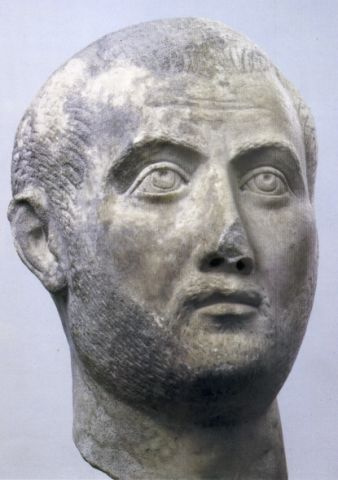
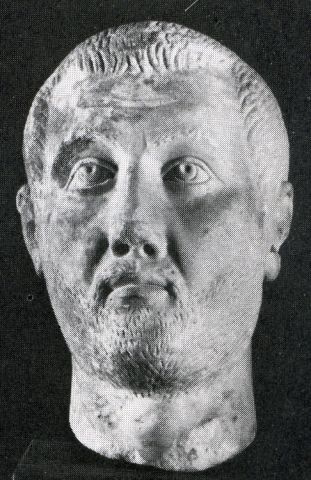
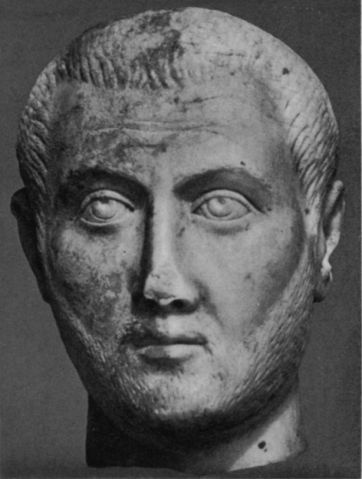
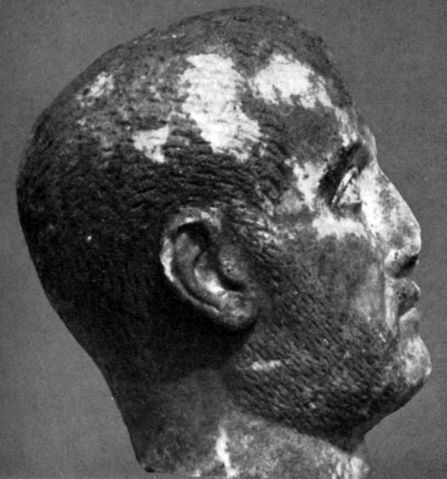
Portrait head of man with short-cropped beard and hair. From Styberra (Macedonia). Mid third to early fourth century
Record details
Photographs
Bibliography
- Jevtovic, J. (ed.), Antički portret u Jugoslaviji : Narodni muzej, Beograd, Muzeji Makedonije, Skopje, Arheološki muzej, Zagreb, Arheološki muzej, Split, Narodni muzej, Ljubljana , Belgrade 1987, p. 220, no. 194 (V. Sokolovska)
- Rüsch, A., Das kaiserzeitliche Porträt in Makedonien, Jahrbuch des Deutschen Archäologischen Instituts 84, 1969, 59-196, p. 118 no. P16 figs. 6, 7
Discussion
DESCRIPTION (Object)
Over life-size white marble head, broken at neck, H 30.5 cm. Tip of nose and earlobs are slightly chipped.
Hair and beard are marked by evenly directed short chisel strokes; the beard is set plastically against the flesh.
The eyebrows are raised, the iris is circumscribed by a circular incision, the pupil is marked by a shallow round chisel hole.
The flesh is scarsely modelled.
The head has been evenly cut at the base of the neck; this is a possible indicator that it was re-cut from an earlier head.
PROVENANCE AND LOCATION
The head was found in Cepigovo, in the region of Prilep, the area of the ancient city of Styberra (map in Rüsch 1969, 111). It is today in the Skopje Museum of Macedonia, inv. no. 593.
DESCRIPTION (Subject)
Portrait head of a male with short cropped hair and beard, the eyes wide open, and the mouth slightly opened. The face is smooth, there are just two horizontal wrinkles incised on the brow. The full beard and and the hairline receding over the temples are the only indicators of a mature age.
DATE
The head has been dated to the 2nd quarter of the 3rd century by Rüsch 1969 and by Sokolovska in Jevtovic 1987 (see also Bergmann 1977, pl. 48, 1-2).
The indication of hair and beard by regularly incised short chisel strokes, together with a classicising smoothness, re-appears in the post Gallienic 3rd century, as well as with portraits of the later tetrarchic periods in the early 4th century. This later date is supported by the marking of the eyes; this author favours a date in the early 4th century, the late tetrarchic or early Constantinian period.
Discussion references
- Rüsch, H. 'Das kaiserzeitliche Porträt in Makedonien', Jahrbuch des Deutschen Archäologischen Instituts 84, Berlin 1969, 115, cat. no. P 16, figs. 6-7
Cite: Last Statues of Antiquity, LSA-2393 (Ulrich Gehn).