
LSA-2395
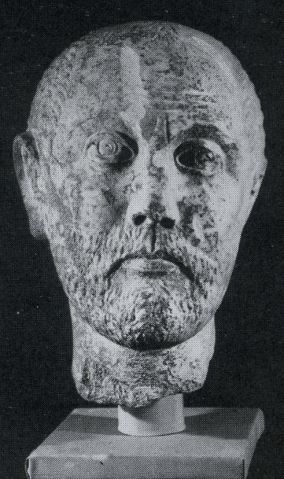
Portrait head of large-eyed man with short-cropped hair and beard. From Margum (Moesia Prima). Mid third to fourth century.
Record details
Photographs
Bibliography
- Jevtovic, J. (ed.), Antički portret u Jugoslaviji : Narodni muzej, Beograd, Muzeji Makedonije, Skopje, Arheološki muzej, Zagreb, Arheološki muzej, Split, Narodni muzej, Ljubljana , Belgrade 1987, 222-3, no. 198
Discussion
DESCRIPTION (Object)
Over life-size marble head broken at neck, H 32.5, W 23.5 cm. The surface is weathered.
The short-cropped hair and the short beard are articulated by short, shallow chisel strokes.
On the brow three horizontal furrows are incised, two short sharp vertical furrows start at the root of the nose.
The eyes are enlarged, the iris is circumscribed by an incised line, the pupil marked by a lunular chisel stroke.
The head is slightly bent and turned to the left.
PROVENANCE AND CURRENT LOCATION
The head was found in the village of Dubravica in the municipality of Požarevac, Serbia. This is the area of ancient Margum, in the vicinity of Viminacium. The head is today in the National Museum of Požarevac, Classical-Byzantine Collection of Viminacium inv. no. 2245.
DESCRIPTION (Subject)
The portrayed is a man of mature age whose hair is receding above the brow. His head is oval shaped, the face meagre. He wears short hair and a trimmed beard. His eyes are wide open, signalling attentiveness.
HONORAND AND DATE
The head was dated to the mid 3rd century by Jevtović 1987 who compared it to the portrait of Traianus Decius, emperor 249-51 (Fittschen-Zanker I no. 110 pl. 135-7), which is of similar oval type and meagreness. The articulation of the hair and its setting against the flesh likewise resemble the emperor’s portrait.
A later date, however, in the late 3rd or 4th century is possibly indicated by the marking of the eyes, which, unlike the compared imperial portrait, do not follow the tradition of the 2nd and earlier 3rd century.
Cite: Last Statues of Antiquity, LSA-2395 (Ulrich Gehn).