
LSA-2396
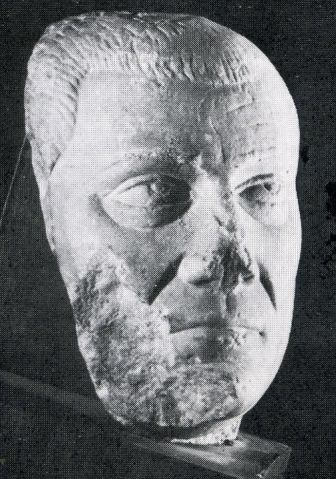
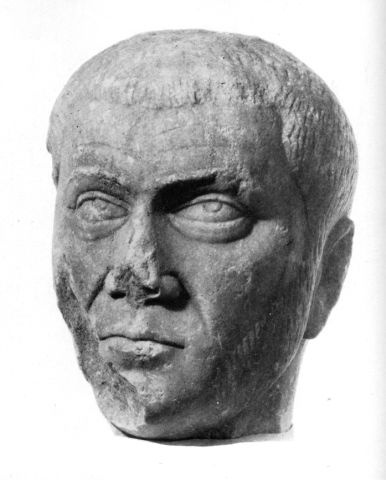
Portrait head of man with short hair. Emona (Noricum Mediterraneum). Earlier to mid fourth century
Record details
Photographs
Bibliography
- Jevtovic, J. (ed.), Antički portret u Jugoslaviji : Narodni muzej, Beograd, Muzeji Makedonije, Skopje, Arheološki muzej, Zagreb, Arheološki muzej, Split, Narodni muzej, Ljubljana , Belgrade 1987, 234, no. 223
Discussion
DESCRIPTION (Object)
Over life-size marble head broken at neck; H 28, W(of face) 14 cm. At the right side, the jawbone with a portion of the cheek and the back of the head with the ear are broken; the tip of the nose is chipped off.
The hair surrounds the skull like a tight-fitting cap; it is set off the flesh by a clear-cut line. Strands of hair are singled out by short, superficial chisel strokes; these are irregular on the skull but parallel and regular around the face. The beard is treated in the same technique, but is not lined out against the flesh.
The eyebrows are plastically rendered. The iris is not marked (and was probably indicated by paint), the pupil is circumscribed by an incised line.
The eyes are surrounded by a web of concentrically arranged lines. The brow is furrowed by four incised lines paralleling the flat arch of the eyebrows; above the nose there is a steep vertical fold. The lacrimal sacs are markedly set off the cheeks. Deep naso-labial folds are running down from the nostrils.
The proportions of the head are balanced, its traits are harmonized.
PROVENANCE AND CURRENT LOCATION
The head was found in Ljubljana, the area of ancient Emona. It is today in the National Museum of Ljubljana, inv. no. R 11649.
DESCRIPTION (Subject)
The depicted is a man of mature age. His hair is still full but starts receding above the temples. His beard is covering the cheeks, but not the chin, and he does not have a moustache. The furrows on his brow and around his mouth signal alertness and severness, the marked chin energy.
HONORAND AND DATE
The head was dated to the early 4th century by Jevtović 1987, and to the 4th century by the 1971 catalogue of the National Museum Ljubljana.
The hairstyle follows the fashion of the tetrarchic period; the technique by which the hair is set off the flesh, and the way it is arranged into a regular fringe around the face separate this head from portraits of the mid 3rd century which follow similar fashion styles and show similar stylistic values. This date is supported by the '4th-century' marking of the eyes. One would not associate the harmonized traits of the face with the disrupted physiognomies in the portraiture of the first tetrarchy in the late 3rd century. Tetrarchic hairstyles and beards, on the other hand, were still in use for non-imperial persons well into the Constantinian period. A marked change in hairstyle appears only in the late 4th century when the arrangement of the hair around the face becomes more sumptuous. The short hair and the energetic features characterize our portrayed as a man in the active life; it appears most plausible to think of either an emperor of the later tetrarchic period, or of a high ranking official of the earlier or mid 4th century.
Discussion references
- Narodni Muzej v Ljubljana in Skupnost Muzejev Slovenije, Argo. Leto X, Št. 1. Informativno Glasilo za Muzejsko Dajavnost. Informationsbulletin für Museumstätigkeit, Ljubljana 1971, p. 104
Cite: Last Statues of Antiquity, LSA-2396 (Ulrich Gehn).