
LSA-2397
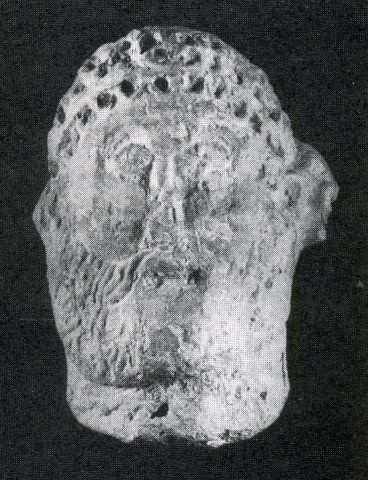
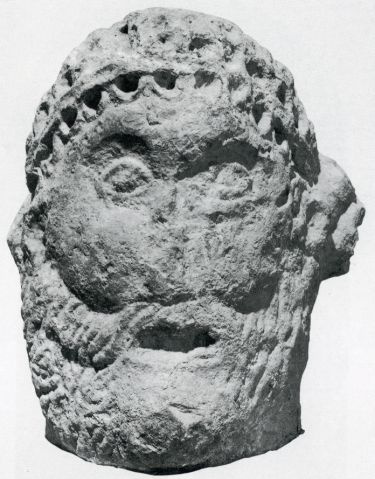
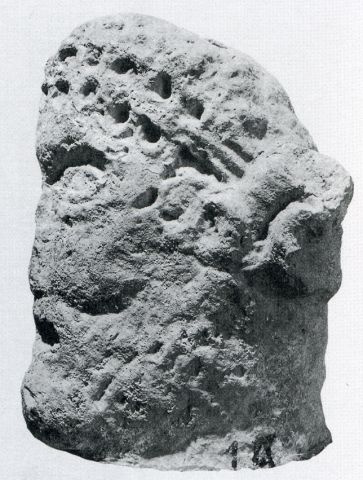
Head of bearded male with headgear, attributed by some to Julian, emperor. From Epidaurum (Dalmatia). Of uncertain date
Record details
Photographs
Bibliography
- Cambi, N., Imago Animi. Antički Portret u Hrvatskoj, Split 2000, 187, 422-3, no. 147, pls. 192-3
- Jevtovic, J. (ed.), Antički portret u Jugoslaviji : Narodni muzej, Beograd, Muzeji Makedonije, Skopje, Arheološki muzej, Zagreb, Arheološki muzej, Split, Narodni muzej, Ljubljana , Belgrade 1987, 236, no. 227
Discussion
DESCRIPTION (Object)
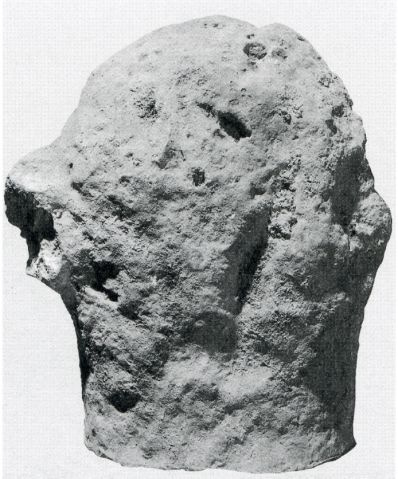
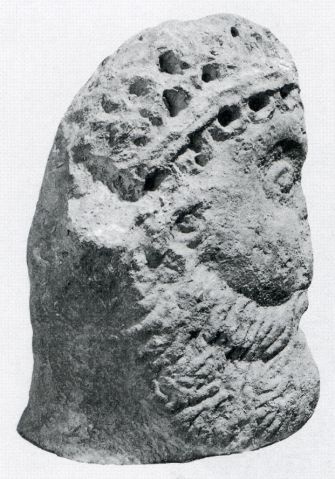
Head of local limestone, cut horizontally at neck, H (total) 36, H (head) 31 cm. The nose, the ears and the back of the skull are broken, the surface is worn.
The eyes are protruding, surrounded by bulgy lids; no markings of iris and pupil are visible.
The cheeks are without modellings. They are set off the beard by a deeply inscised line.
The beard is articulated by parallel incised lines.
The head is assessed as an unfinished piece by Cambi 2000. The break at the back head, on the other side, could indicate that it once formed part of a relief.
PROVENANCE AND CURRENT LOCATION
The head is from Cavtat, the area of ancient Epidaurum; it is today in the Municipal Museum in Dubrovnik, Collection Rupe, inv. no. 15.
DESCRIPTION (Subject)
The portrayed wears a full beard. He has small eyes and a robust chin; his mouth is opened. Above the brow there is a horizontal band of two grouts lined by two rows of round holes. Each hole has a bulgy rim. At the left ear there are two bulky protuberances.
HONORAND AND DATE
The head was assessed as a late antique imperial portrait by Jevtović 1987, and again by Cambi 2000, on base of the headgear which they interpreted as a diadem. This would provide a terminus post quem of 325, the year when Constantine I introduced this imperial insigne. If this is an imperial portrait, the terminus post quem must be raised to the mid 4th century, when Julian was the first emperor of the Constantinian dynasty to wear a beard. Both, Jevtovic 1987 and Cambi 2000 consider Julian the most probable honorand.
The iconography, the head type, and the style, however, do not fit any of the 4th or 5th century emperors. The headgear, moreover, does not match the diadems otherwise known. The 'pearl diadem' where two lines of pearls flank a band, has a flat band which is usually continued to the backside of the head, and its pearls are significantly smaller than on our head. Moreover, diadems of that type typically display a large stone or gem at the central brow (Delbrueck 1933,64-5 and plates 74-120); they become predominant in the later 4th century. All imperial diadems are set high above the brow leaving a portion of hair visible (which our head does not). The protuberances at the left ear can not be explained as part of an imperial diadem. The open mouth is inappropriate for an imperial portrait (sacer vultus) of the period.
On balance, we are certain that this is not a late-antique head, and stylistically it is so provincial that it could be of almost any date.
Discussion references
- Delbrueck, R., Spätantike Kaiserporträts. Von Constantinus Magnus bis zum Ende des Westreichs , Leipzig 1933
Cite: Last Statues of Antiquity, LSA-2397 (Ulrich Gehn).