
LSA-240
Base for statue of Flavius Anthemius Isidorus, governor. Hypaipa (Lydia). 405-410
Record details
Photographs

Inscription
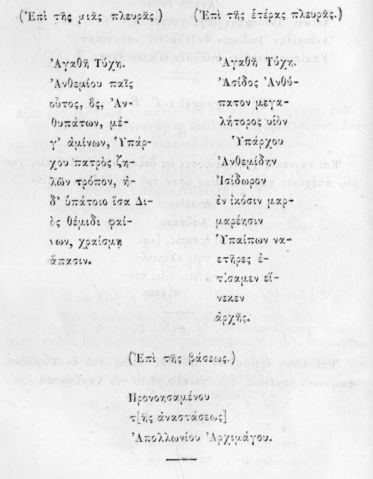
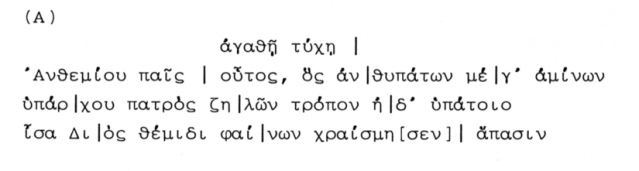
(A) Ἀγαθῇ τύχῃ. / Ἀνθεμίου παῖς / (3) οὗτος, ὃς άν/θυπάτων μέ/γ’ ἀμίνων ὑπάρ/χου πατρὸς ζη/λῶν τρόπον ἠ/δ’ ὑπάτοιο/ (9)ἶσα Δι/ὸς θέμιδι φαί/νων χραίσμη[σεν] / ἅπασιν.
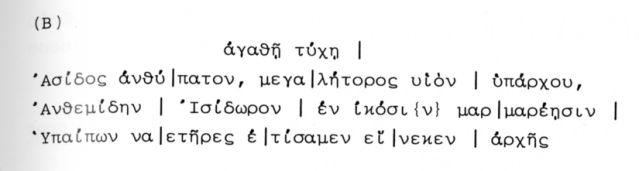
(B) Ἀγαθῇ τύχῃ. / Ἀσιδος ἀνθύ/πατον, μεγα/λήτορος υἱὸν / (5) ὑπάρχου, Ἀνθεμίδην / Ἰσίδωρον / έν ἰκόσιν (sic) μαρ/μαρέῃσιν / Υπαίων να/ετῆρες ἐτίσαμεν εἵνεκεν / ἀρχῆς.
(C) (cross) / προνοησαμένου / τ[ῆς ἁναστάσεως] / Ἀπολλωνίου ἀρχιμάγου.
Inscription translation
(A) To Good Fortune. This child of Anthemius, who, by far the best of the proconsuls, rivaled the ways of his father the prefect and consul, and, appearing equal to Zeus or Themis, warded off injury from everybody.
(B) To Good Fortune. We, the inhabitants of Hypaipa, have repaid in marble images the proconsul of Asia, son of the high-minded prefect, Isidorus the offspring of Anthemius, for his rule.
(C) The overseeing of the setting up was done by Apollonius, the archimagos.
Bibliography
- Meriç, R., R. Merkelbach, J. Nollé, and S. Şahin (eds.), Die Inschriften von Ephesos VII,2. Inschriften griechischer Städte aus Kleinasien, vol. 17,2, Bonn 1981, no. 3820
Discussion
INSCRIPTION
Two epigrams and a dedicatory formula, distributed over three sides of the base:
(A) Epigram in twelve lines:
Ἀγαθῇ τύχῃ. / Ἀνθεμίου παῖς / (3) οὗτος, ὃς άν/θυπάτων μέ/γ’ ἀμίνων ὑπάρ/χου πατρὸς ζη/λῶν τρόπον ἠ/δ’ ὑπάτοιο/ (9)ἶσα Δι/ὸς θέμιδι φαί/νων χραίσμη[σεν] / ἅπασιν.
'To Good Fortune. This child of Anthemius, who, by far the best of the proconsuls, rivaled the ways of his father the prefect and consul, and, appearing equal to Zeus or Themis, warded off injury from everybody.'
(B) Epigram in eleven lines:
Ἀγαθῇ τύχῃ. / Ἀσιδος ἀνθύ/πατον, μεγα/λήτορος υἱὸν / (5) ὑπάρχου, Ἀνθεμίδην / Ἰσίδωρον / έν ἰκόσιν (sic) μαρ/μαρέῃσιν / Υπαίων να/ετῆρες ἐτίσαμεν εἵνεκεν / ἀρχῆς.
'To Good Fortune. We, the inhabitants of Hypaipa, have repaid in marble images the proconsul of Asia, son of the high-minded prefect, Isidorus the offspring of Anthemius, for his rule.'
(C) Dedicatory formula, in three lines:
(cross) / προνοησαμένου / τ[ῆς ἁναστάσεως] / Ἀπολλωνίου ἀρχιμάγου.
'The overseeing of the setting up was done by Apollonius, the archimagos.'
Letter height not recorded.
Lines 6-8 of epigram (A) literally read '...while his father held the office of prefect (ὑπάρχου πατρὸς, which we take to be a genitive absolute), he (= the honorand) rivaled the ways of the consul...'. Since we know that both the prefect and the consul were the same man, Isidorus' father (see below, 'Honorand, Awarder and Date'), we have somewhat simplified this playful, but convoluted, phrase.
DESCRIPTION
Base, H 115, W 53 cm. Keil 1942, 197, quoting a 1885 report by a local newspaper from Izmir, states that the base has framed sunken fields on all four sides. The epigrams, (A) and (B), are carved on opposite faces of the base, whereas the dedicatory formula (C) is on the lower part of a third face (Kyriakides 1875), below a cross (Keil 1942, 197). There is no published image of the base.
The inscription explicitly states that the base bore a marble statue (epigram (B), lines 7-8).
PROVENANCE AND LOCATION
Found in 1874 in the city of Ödemiş (Kyriakides 1875). It was thought to be lost by Keil 1942, but recorded in the gymnasium (high school) of Ödemiş by Meriç, Nollé, Merkelbach & Şahin 1981.
HONORAND, AWARDER AND DATE
Isidorus, our honorand, was Flavius Anthemius Isidorus (Keil 1942; PLRE II, 631, Fl. Anthemius Isidorus 9). He is here honoured as governor (proconsul) of Asia, the office being mentioned explicitly in both epigrams: (A), lines 3-5; (B), lines 2-3. The terminus post quem for Isidorus' governorship of Asia, and for our base, is 405, when his father became praetorian prefect of the East and also held the consulship - both offices are mentioned in our epigrams: the prefecture in epigram (A), lines 5-6 ('ὑπάρχου πατρὸς') and (B), line 5; the consulship in epigram (A), line 8. The terminus ante quem is 410, when our Isidorus is known to have held a senior position, the prefecture of the city of Constantinople.
As our epigrams proclaim, Isidorus' father, Anthemius, was praetorian prefect of the East (405-14) and consul in 405 (Keil 1942; PLRE II, 93-5, Anthemius 1). His person is so prevalent in our inscriptions that he even overshadows the honorand proper, his son: Anthemius’ name opens epigram (A), and in epigram (B) Isidorus is styled ‘Anthemides’ – ‘offspring of Anthemius’; and his offices occupy more space than his son’s. Presumably Isidorus was young when he held the office of governor (Malcus 1967, 129), and our inscriptions are as much a compliment to his powerful father as they are to him. Later in life Isidorus even outclassed his father’s splendid career, becoming praetorian prefect of Illyricum in 424 and of the East in 435-6, and consul in 436. During his tenure as praetorian prefect, he was honoured with a statue in Hypaipa (our inscription) and two further statues in Ephesus (LSA-725 and LSA-729).
The inscription is dedicated by the inhabitants of Hypaipa (epigram (B), lines 9-10), and was overseen by the archimagus Apollonius. The archimagus was the priest of the Persian deity Anaitis, the city goddess of Hypaipa (Robert 1948, 19 n. 1). As Robert points out, it is extraordinary that, at this late date, a pagan priest was responsible for the erection of a statue dedicated by the whole city (see below, 'Further Discussion').
FURTHER DISCUSSION
The puzzling appearance of the pagan priest of a Persian deity as responsible for the dedication (in an inscription preceded by a cross) was explained by Keil 1942, 201-3 as a homage to the tolerance of Persia towards the Christian religion at this time. However, Robert (1948,19 n. 1; Robert 1976) proposed to read the dedicatory formula (C) as not belonging to the late antique dedication but as the remnant of an earlier dedication (on a re-used piece), though he does not explain the presence of the cross. Unfortunately, no photographs have been published so far of the base or its inscriptions, so no evidence is available to test Robert's hypothesis.
Zeus and Themis (a goddess of justice), cited in epigram (A) lines 9-10, are frequently alluded to as models of good governance and justice, well into Christian times.
Discussion references
- Keil, J., Anzeiger Akademie der Wissenschaften in Wien. Philosophisch-Historische Klasse 79, 1942
- Kyriakides, I., Mouseion kai Bibliotheke tes Evangelikes Scholes. Periodos prote, 1873-1875, 114-15, Izmir (Smyrne) 1875, pp. 114-15
- Malcus, B. 'Die Prokonsuln von Asien von Diokletian bis Theodosius II', Opuscula Atheniensa, 7 (1967) 91-154
- Martindale, J. R., The Prosopography of the Later Roman Empire. Vol. II A.D. 395-527, Cambridge 1980
- Robert, L., Epigrammes du Bas-Empire (Hellenica IV), Paris 1948, 18-19
- Robert, L.Types monétaires à Hypaipa, Revue Numismatique 1976, 25-48, p. 32 n. 30
Cite: Last Statues of Antiquity, LSA-240 (Ulrich Gehn).