
LSA-2400
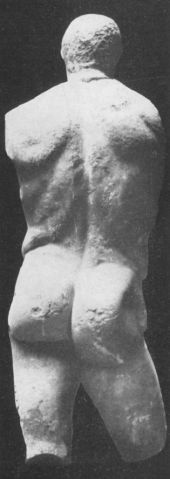
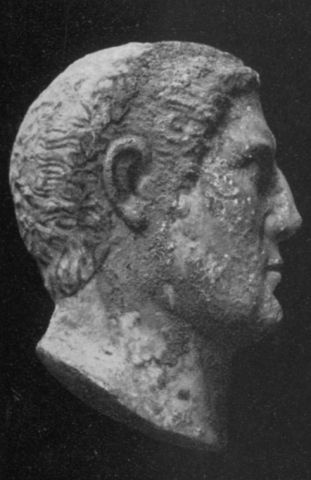
Nude statue of emperor with separately worked head. Aquae Domitianae (Viennensis). Later third or earlier fourth century
Record details
Photographs
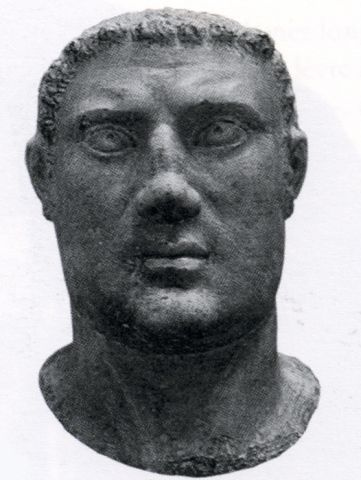
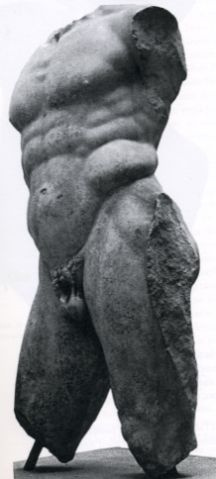
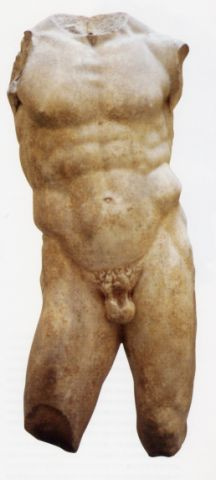
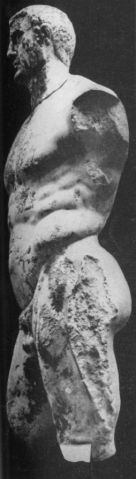
Bibliography
- Chauvel, A. and P. Wuilleumier, 'Les Thermes Romains d'Aix-les-Bains', Bulletin Monumental 95, Paris 1936, 83-100, at 98-100, pls. 3-4 (Constantine?)
- Rosso, E., L'Image de l'Empereur en Gaule Romaine. Portraits et Inscriptions, Paris 2006, 306-307, no. 96, figs. 73-4
Discussion
DESCRIPTION (Object)
Life-size head worked separately and attached to over life-size body. H (of extant body): 1.50 m. H (of head): 22 cm. Projected H (of statue): 2.40 m. White marble
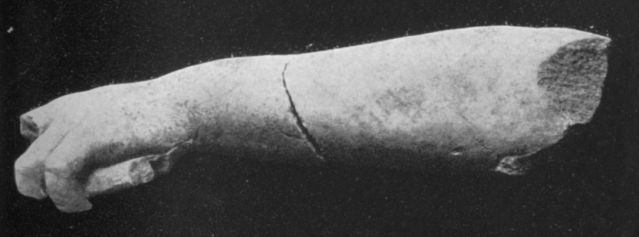
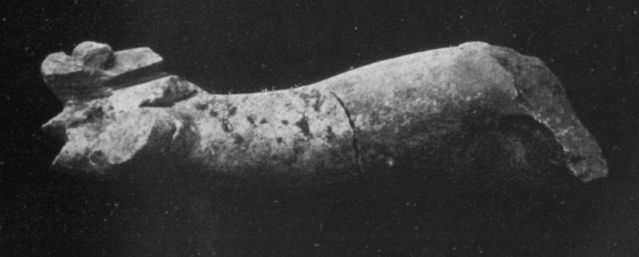
The head is fully-preserved. It was worked separately and was fit into a cavity made in the area at the base of the neck on the statue. The statue has broken at the knees and at the beginning of both arms. The left lower arm with part of the hand, holding a sword hilt, however, is preserved.
The head has been re-cut from an earlier portrait. The hair around the face has been removed, and the pupils have been marked with a drill. The eyes have an unusual shape; the inner corners are higher than the outer corners. The shape of the lower face might even indicate that a beard has been removed.
PROVENANCE
All three portions of the statue (head, body, and arm) were found in the bath complex at Aquae Domitianae. The torso was found in pool A by M. Formigé in 1923; the head and left arm were found by A. Chauvel and P. Wuilleumier in the excavations immediately after 1932.
Pool A was unheated and had paving, walls, and steps of marble. It was surrounded by a portico and apparently well-decorated. According to de Loche, Mem.Acad.Savoie 1899 at pp. 348-9, 353, 360, and 368, many statues were found there in the 18th and 19th century. These, write A. Chauvel and P. Wuilleumier, included a Hercules, a woman, an ephebe with raised arms, and a group of two children. In 1932 M. Pétriaux found a mutilated colossal head and a female statue in a Muse type with a socket for a separately-worked head. A head of Muse, which probably does not belong to that Muse statue, was found in the Chauvel and Wuilleumier campaign. It features deeply-drilled pupils which would seem to be late in date or later additions to an earlier head.
DESCRIPTION (Subject)
The head and body formed part of a statue monument of c. 2.4 m displayed in the Baths. The head shows a powerful man with short hair that is brushed forward; this is a hairstyle of a mortal man. He is clean-shaven. The body is a muscular nude with an assertive stance. The left hip, over the weight-bearing left leg, is thrown outwards, and the right leg is advanced. The head turns to its right. In the left arm he probably held a sword.
The head is too small for the body but was certainly placed on it. It moreover has been clearly re-cut.
HONORAND AND DATE
The head is intended as a portrait; the sword held in the hand supports this identification. Both the hairstyle and the sword make the identification of the honorand as Hercules difficult (Formigé and Mandersheid).
Kreikenbom suggested that the honorand was the emperor Otho who ruled for three months in AD 69. He believed that it corresponded to images on coins. This identification is not entirely convincing because of the short-lived nature of that honorand, the drilling in the eyes, and the volume and curl of the original hairstyle at the brow. Moreover, the original head may even have had a beard. Finally, it should be noted that the head of the Muse found in the same pool also has drilled eyes.
It therefore remains possible the statue was re-used to represent a Tetrarch or a fourth century emperor. The hairstyle corresponds essentially to the Constantinian look. This would be an example of a fourth-century emperor depicted in the nude, a routine choice in the high-imperial period which went out of fashion in late third century and disappeared in the fourth century. The only other secure examples of nude imperial statues are Tetrarchic in date and from Asia Minor (LSA-246 and LSA-368).
Discussion references
- Kreikenbom, D., Griechische und römische Kolossalporträts bis zum späten ersten Jahrhundert nach Christus, Berlin 1992, 98, fn. 787 (Otho?)
- Manderscheid, H., Die Skulpturenausstattung der kaiserzeitlichen Thermenanlagen, Berlin 1981
Cite: Last Statues of Antiquity, LSA-2400 (J. Lenaghan).