
LSA-2401
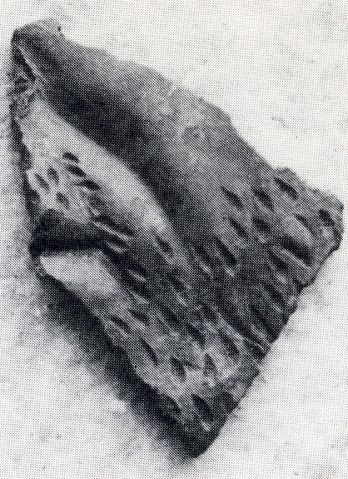
Fragment from bronze portrait head of bearded man. From Aguntum (Noricum Mediterraneum). Mid-third to early fourth century.
Record details
Photographs
Bibliography
- Heger, N., Die Rundskulpturen der Stadtgebiete von Aguntum und Brigantium. Corpus signorum imperii Romani. Österreich ; v.3, fasc.4 , Vienna 1987, 15-16, no. 2, pl. 1
Discussion
DESCRIPTION (Object)
Portion of the left cheek with the left corner of the mouth, H 8, W 5.5, D 0.4 cm. A deep fold running downwards from the left nostril separates the cheek from the mouth. A beard is indicated on cheek, chin and upper lip by irregular short strokes cut into the flesh.
PROVENANCE AND CURRENT LOCATION
The fragment was found in the village of Dölsach (Austria), that is the area of the ancient city of Aguntum. It is today in the Museum Auguntinum in Dölsach (without published inv. no.).
DESCRIPTION (Subject)
The portrayed was a man of mature age, as indicated by the deep fold, and a ‘man on campaign’, as the picked beard shows; a high ranking magistrate or military man, or an emperor.
HONORAND AND DATE
Earlier scholarship suggested the fragment to be from a portrait of the emperor Trebonianus Gallus (Augustus 251-3) (see Heger 1987 with references). This identification is beyond verifying; the irregular pickings directly into the flesh, without a clear line separating flesh from beard, however, is a technique common in the mid-3rd century (whereas late 3rd and 4th century portraits rather show beard and hair set off the flesh by a clear cut line). We fully agree to Hegler’s assessment that the technique most probably assigns a mid-3rd century date to the fragment, without being able to rule out a date in the late 3rd or even the early 4th century completely.
Cite: Last Statues of Antiquity, LSA-2401 (Ulrich Gehn).