
LSA-2405
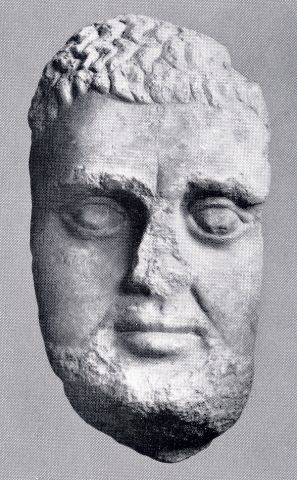
Portrait head of man with short hair and stubble beard, possibly from statue. From Loco Felicis (?) (Noricum Ripense). Mid third to earlier fourth century.
Record details
Photographs
Bibliography
- Eckhart, L., Die Rundskulpturen des Stadtgebietes von Lauriacum. Corpus signorum imperii Romani. Österreich ; v.3, fasc.2 , Vienna 1976, 49-50, no. 58, pl. 17
Discussion
DESCRIPTION (Object)
Portrait head of medium grained marble, H 26 cm. The nose is broken and the eyebrows are chipped. The ears have been cut off in order to adjust the backside into a cone shape. The context of the head is unknown but Eckahart 1976 suggests that it was possibly from a portrait statue.
The hair is arranged into short tresses by sharp chisel lines. The beard is set off the flesh and arranged into flat buckles.
The eyes are protruding. The iris is flat and the pupil not marked; both were probably indicated by paint.
The large areas of the face are scarsely modelled; a deep vertical fold is incised between the eyebrows, and a naso labial fold runs down from the left nostril.
PROVENANCE AND MOST RECENTLY RECORDED LOCATION
The head was found after 1787 between the village of Mauer an der Url and the town of Amstetten on the Danubian boarder in Noricum (today Oberösterreich). This is the area of the ancient location of Loco Felicis, on the road between the cities/ military camps of Lauriacum and Arelape. It was recorded by Eckhart 1976 in the Archaeological Collection of the monastery of Seitenstetten (without published inv. no.).
DESCRIPTION (Subject)
The depicted is a full faced man of mature age, with short hair and trimmed beard. The hair forms a convex line above the brow. The vertical fold above the nose indicates alertness, the marked chin energy.
HONORAND AND DATE
The head was dated to the 2nd quarter of the third century by Eckhart 1976.
In our view, the stylistic and technical features indicate a date in the tetrarchic or Constantinian period in the late 3rd or earlier 4th century. Particularly the treatment of the hair which is set off the flesh by a clear cut line and which is schematically articulated without lending plastic volume to the single locks is a feature of this later date; the same is true for the trimmed beard which is treated in a similar technique.
Its bulky structure assigns the head to what can be called the 'tetrarchic type'; the facial features, however, where the large areas of the face (cheeks, mouth, brow) are plain and separated from each other by few yet marked modellings, are a stylistic feature of the Constantinian period. The hairstyle with the short wavy strands and the trimmed beard would well fit such a date. Similar features reappear in the same area on funerary reliefs dated to the late 3rd or early 4th century; notably a three-figured relief from Lauriacum (Eckhart 1976 no. 51) dated to the early 4th century offers a striking parallel.
Discussion references
- Ruprechtsberger, E.M. 'Ein römischer Grabstein aus Lentia/Linz. Spätantike Porträts des 4. Jahrhunderts aus der Austria Romana', Jahrbuch für Antiken und Christentum 23, Münster 1980, 135-7, pl. 4c (tetrarchic)
Cite: Last Statues of Antiquity, LSA-2405 (Ulrich Gehn).