
LSA-2406
Base for statue of 'Fortuna Victrix'. From Calama (Africa Proconsularis). 293-294
Record details
Photographs
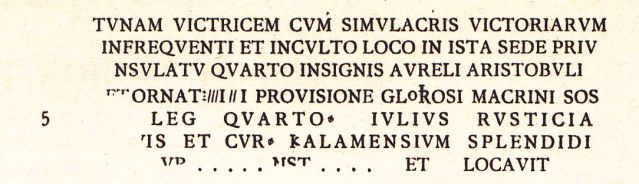
Inscription
[For]tunam victricem, cum simulacris Victoriarum, / [ex] infrequenti et inculto loco in ista sede, priv[ato?] / [sumptu?, proco]nsulato quarto insignis Aureli Aristobuli, [viri clarissimi] / et ornat[iss]i[m]i, provisione gloriosi Macrini Sos[siani, viri clarissimi], / leg(ati) quarto. Iulius Rusticia[nus], / [ci]vis et cur(ator) Kalamensium splendidi[ssimae coloniae], / [---]VP[--- tran]st[ulit ---] et locavit [---].
Inscription translation
The [statue of the] Victorious Fortune, with the statues of victories, [was moved] from an abandoned and neglected place, into this place, with (private funds?), in the fourth (year of the) governorship (proconsulatu) of the distinguished Aurelius Aristobulus, of clarissimus rank and most distinguished, through the foresight of the glorious Macrinus Sossianus, of clarissimus rank, legate for the fourth time. Iulius Rusticianus, citizen and curator of the splendid colony of Kalama (…) moved and placed (…).
Bibliography
- Corpus Inscriptionum Latinarum; , VIII, 2590
- Gsell, S., Inscriptions latines de l’Algérie, vol. I, Paris 1922 (Rome 1965), 179
- Lepelley, C., Les cités de l'Afrique romaine au Bas-Empire, t. 2, Notices d'histoire municipale, Paris 1981, 91-2 no. 2
Discussion
INSCRIPTION
Partly preserved in seven lines:
[For]tunam victricem, cum simulacris Victoriarum, / [ex] infrequenti et inculto loco in ista sede, priv[ato?] / [sumptu?, proco]nsulato quarto insignis Aureli Aristobuli, [viri clarissimi] / et ornat[iss]i[m]i, provisione gloriosi Macrini Sos[siani, viri clarissimi], /(5) leg(ati) quarto. Iulius Rusticia[nus], / [ci]vis et cur(ator) Kalamensium splendidi[ssimae coloniae], / [---]VP[--- tran]st[ulit ---] et locavit [---].
‘The [statue of the] Victorious Fortune, with the statues of victories, [was moved] from an abandoned and neglected place, into this place, with (private funds?), in the fourth (year of the) governorship (proconsulatu) of the distinguished Aurelius Aristobulus, of clarissimus rank and most distinguished, through the foresight of the glorious Macrinus Sossianus, of clarissimus rank, legate for the fourth time. Iulius Rusticianus, citizen and curator of the splendid colony of Kalama (…) moved and placed (…)'.
Letter height 2.5 cm.
DESCRIPTION (from Gsell 1965)
Rectangular marble base, H 35, W 82 cm. The base is broken at both sides and a t bottom, but line 7 appears to be the last line of the inscription. There is no published image.
PROVENANCE AND CURRENT LOCATION
The base was found built into the byzantine walls of Guelma (ancient Calama). It is now in the Musée du Louvre, Paris, inv. no. 2033.
HONORAND, AWARDER AND DATE
The base carried a statue of Fortuna Victrix, the ‘victorious Fortuna’. It was transferred, as the inscription informs us, ‘from an abandoned and neglected place’ ([ex] infrequenti et inculto loco, line 2) to a more central place of the city.
The initiative for the transfer was taken by Macrinus Sossianus (PLRE I, 849 C. Macrinius Sossianus 2), legate of the provincial governor (proconsul) of Africa Aurelius Aristobulus (see below, next paragraph). It was executed by Iulius Rusticianus, a local man who held the office of curator rei publicae in Calama (see below, ‘Further Discussion’); he is styled ‘citizen and curator’ (civis et curator, line 6) of Calama in our inscription.
The proconsul Aurelius Aristobulus held the governorship in the province 290-4 (PLRE I, 106 T. Cl. Aurelius Aristobulus). Our inscription states that the transfer of the statue was executed in the fourth year of his governorship, that is 293/4 (proconsulato quarto, line 3).
FURTHER DISCUSSION
Along with the statue of Fortuna Victrix, further statues of Victories were transferred to the new location; the monument which was transferred was probably a little shrine of Fortuna Victrix.
The office of curator rei publicae is not a civic office in the strict sense. It it is first testified to in the early 2nd century; curators were men charged by the imperial administration with overseeing the finance of a city (curatores dati ab imperatore) and were usually not natives of the city where they held office. By the time of Diocletian more aspects of civic life had come under the competence of the curators. The office holders continued to report to the imperial administration in the 4th century; however, they were usually taken from the local aristocracies by that time (Lepelley I, 168-9).
As Lepelley points out, our inscription is from a time when it had not yet become the rule to charge local men with the office of curator and therefore highlights that Iulius Rusticianus is a local citizen.
Discussion references
- Jones, A. H. M. et al., The Prosopography of the Later Roman Empire. Vol. I 260-395, Cambridge et al. 1971 (1975)
Cite: Last Statues of Antiquity, LSA-2406 (Ulrich Gehn).