
LSA-2407
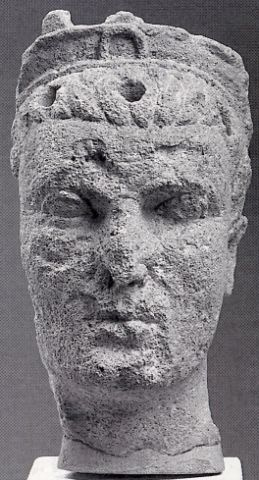
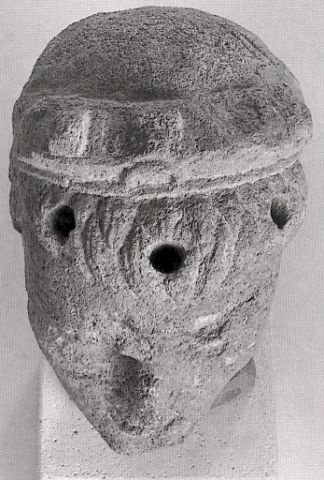
Portrait head of Constantine, with diadem and radiate crown. Augusta Treverorum (Belgica II). Early fourth century.
Record details
Photographs
Bibliography
- Faust, S. ‘Ein “neues” Konstantinporträt im Rheinischen Landesmuseum Trier’, Trierer Zeitschrift 54, Trier 1991, 233-7, figs. 2-5 and 7
Discussion
DESCRIPTION (Object)
Life-size head. H: 31 cm. Local limestone.
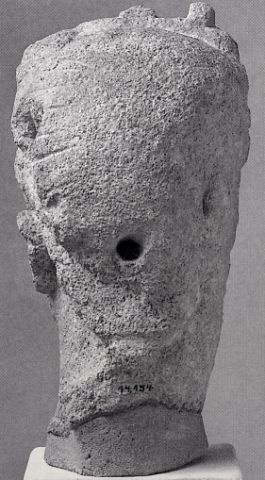
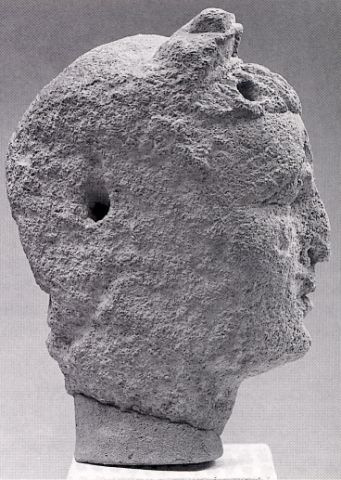
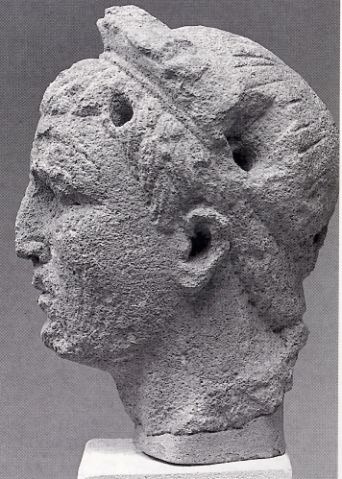
The surface of the head is worn. The right side of the face lacks depth and is mainly abraded. The nose is missing. Six deep holes are located around the head above the ears. These were for metal insertions.
The portrait has been re-worked from a female head wearing a diadem. The original hair motif, the gathering of long hair at the nape, is still visible in the back view. The hair of the current portrait is rendered with a flat chisel, and the eyes are unmarked.
PROVENANCE
The head entered the museum in 1914 with the information that it was found in the area of the Cloisters of the Franciscan Nuns on Paulinstrasse.
DESCRIPTION (Subject)
The portrait depicts a clean-shaven man without any indication of age. He has short hair which is brushed forward and curves inwards in C-shaped locks over the brow. He wears a diadem which is decorated with a central crescent in relief and projections on the top edge and on top of that wore probably a radiate crown. The face is long, with pronounced cheekbones, a curving nose, and a rounded chin.
IDENTIFICATION AND DATE
Both the arrangement of the hair and the features of the face correspond to the identified portraits of Constantine. A radiate crown, which connects the honorand with Sol, is also appropriate for Constantine (see the statue of Constantine in the guise of Sol mounted on a column in Istanbul). Faust would date the head between 310, when Constantine takes Sol Invictus as his patron divinity, and 326, after which point this pagan motif ceases to appear on the coinage of Constantine.
COMMENT ON RE-WORKING
Faust argues that the original portrait was of Sabina or a contemporary of hers. In either case, she believes that the woman wore the crown of Aphrodite. She also believes that the head originally was part of a high relief ( in A. Demandt and J. Engemann, (eds.), Konstantin der Grosse). To this author there seems no reason to exclude a Julio-Claudian woman or even a classicizing divinity; the original hair is collected in a pony tail at the nape. Furthermore it would be an unusual choice to turn a relief head into a portrait in the round. More probably the right side of the face was damaged.
Discussion references
- Demandt, A. and J. Engemann, (eds.), Konstantin der Grosse, Mainz 2007
, no. I.13.102 (S. Faust)
Cite: Last Statues of Antiquity, LSA-2407 (J. Lenaghan).