
LSA-2411
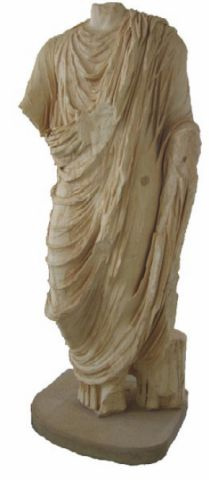
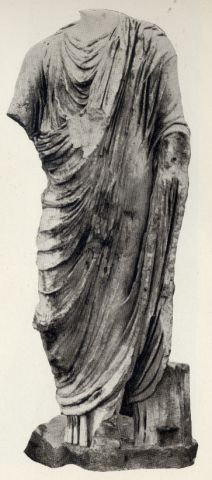
Statue possibly of Flavius Victor Calpurnius (see LSA 2181). Lepcis Magna (Tripolitania). 340-350
Record details
Photographs
Bibliography
- Bartoccini, R. 'Museo Leptitano', Notiziario Archeologico. Ministero delle Colonie 3, Rome 1922, 80, fig. 4
- Faulx-Briole Rocher, A. ‘Du remploi dans la statuaire: autour d’un portrait masculin retravaillé du Musée de Lepcis Magna’, Le passé et son héritage. Modalités et enjeux dans le sociétés du monde romaine et de l'Antiquité tardive, Paris 2011, 63-4, fig. 20, fn. 32
Discussion
DESCRIPTION (Object)
Over life-size statue. H: 202 cm. Of the same marble as the base (Bartoncini), ergo Pentelic marble.
The head, which was worked in one piece with the statue, has broken off at the top of the neck. One imagines that it was re-worked. The left arm hand, which was separately worked and attached by a dowel, is missing. Most of both feet, the right forearm, and the umbo of the toga are all missing.
PROVENANCE
Old Forum, near the Severan aedicula. According to Bartoncini in 1922 and re-stated by Faulx-Briole Rocher, the statue was found next to the base for Flavius Victor Calpurnius, LSA-2181. There were of course many bases and many statues found in the area.
DESCRIPTION (Subject)
The statue shows a man wearing a traditional Roman toga which features a lacinia, a sinus that touches the right knee, and an umbo over the middle of the abdomen. He stands with his weight over the left leg, and the left arm rests by his side. The lower right leg is withdrawn, and the heel of the right foot was raised. The right arm is bent, and the forearm would have extended away from the body. Along the left lower leg is a box for tablets which serves as a statue support.
DATE
The original statue dates to the high imperial period, probably to the second or third century AD. Bartoncini published it in 1922 without any further proof as found in front of its base, also originally belonging to the second or third century but re-used in the fourth century. This statue might well then represent Flavius Calpurnius Victor, a governor of Tripolitana in the 340s-350s; see LSA-2181.
The re-use of high-imperial togate statues is typical of the fourth century AD in all parts of the Empire; for prominent examples, see LSA-903,LSA-1130, LSA-196 and LSA-46.
Cite: Last Statues of Antiquity, LSA-2411 (J. Lenaghan).