
LSA-2415
Base for statue of emperor, possibly Licinius. Lambaesis (Numidia). Fourth century
Record details
Photographs
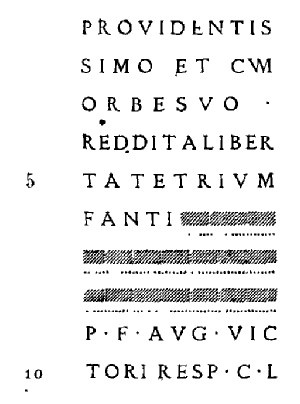
Inscription
Providentis/simo et [cum] / orbe suo / (4) reddita liber/tate trium/fanti, [[[d(omino) n(ostro), perp(etuo)]]] / [[[Imp(eratori), ---]]] / [[[--- invicto]]], / (9) pio, felici Aug(usto), vic/tori; res p(ublica) c(oloniae) L(ambaesitanae).
Inscription translation
To the most prudent one, triumphant with his whole world at the return of freedom, our lord, perpetual Emperor, ... unconquered, pious, fortunate Augustus, victor; the community (res publica) of the colony of Lambaesis [set this up].
Bibliography
- L'Année épigraphique, Paris, 1916, no. 11
- Lepelley, C., Les cités de l'Afrique romaine au Bas-Empire, t. 2, Notices d'histoire municipale, Paris 1981, p. 423, no. 9
Discussion
INSCRIPTION
In ten lines:
Providentis/simo et [cum] / orbe suo / (4) reddita liber/tate trium/fanti, [[[d(omino) n(ostro), perp(etuo)]]] / [[[imp(eratori), ---]]] / [[[--- invicto]]], / (9) pio, felici Aug(usto), vic/tori; res p(ublica) c(oloniae) L(ambaesitanae).
'To the most prudent one, triumphant with his whole world at the return of freedom, our lord, perpetual Emperor, ... unconquered, pious, fortunate Augustus, victor; the community (res publica) of the colony of Lambaesis [set this up].'
Letter height: 5 - 6 cm.
Lines 6-8, with the name of the emperor, have been deliberately erased. Parts of the erasure can be completed, on the basis of the similar formula used in three other dedications in Lambaesis (see below, 'Honorand, Awarder and Date').
DESCRIPTION (from Carcopino)
Rectangular base of limestone, with plinth and crown : H 102, W 53, D 48 cm.
PROVENANCE AND CURRENT LOCATION
Found in 1914 by Decori, probably in the monumental center of Lambaesis. Last recorded, in 1919 by Carcopino, in Tazoult museum ('musée de Lambèse').
HONORAND, AWARDER AND DATE
Our base is dedicated to an Augustus who later suffered damnatio memoriae. Lepelley plausibly argued that he was Licinius, Augustus from 308 to 324, whose name was frequently removed from monuments after his definitive split with Constantine I (and fall) in 324. Lepelley pointed out the similarity in formula and size between our base and one dedicated to Constantine (LSA-2263), and suggested that the two were set up as a pair. If this is correct, Licinius, co-emperor with Constantine between 312 and 324, is the likely honorand of our base.
The awarder was the city of Lambaesis, proudly proclaiming its status as a colony. The city is last recorded as a municipium in 247-8 (see CIL VIII no. 2611), and was probably made a colonia under Philip the Arab or Trajan Decius.
Our base is certainly 4th century, when its opening formula, 'Providentissimo et cum orbe suo reddita libertate triumfanti', was frequently used in Lambaesis (LSA-2262 to Galerius, LSA-2263 to Constantine, and LSA-2414 to Julian).
Discussion references
- Compte-rendus des séances de la Commission de l'Afrique du Nord, Bulletin archéologique du Comité des Travaux Historiques et Scientifiques, Paris, 1919, p. ccvi
Cite: Last Statues of Antiquity, LSA-2415 (Gabriel de Bruyn).