
LSA-2416
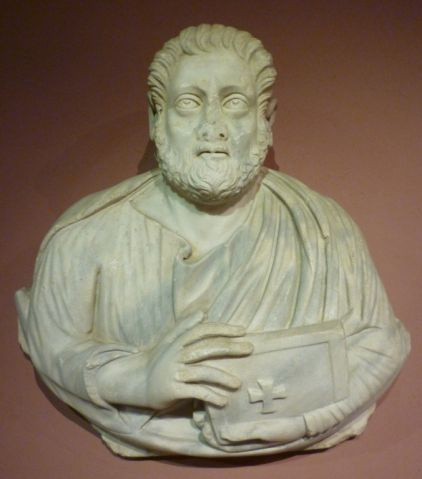
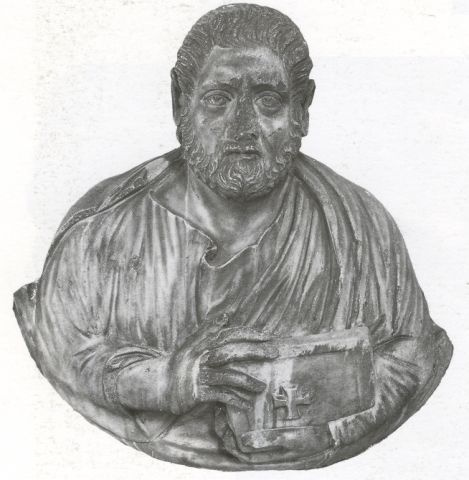
Tondo portrait of evangelist or apostle. Constantinople. Later fourth to fifth century.
Record details
Photographs
Bibliography
- Fıratlı, N., La sculpture byzantine figurée au Musée archéologique d'Istanbul, Paris 1990, 19 no. 36 pl. 16
- Grabar, A., Sculptures byzantines de Constantinople (IVe - Xe siècle), Paris 1963, 9-16
- Mendel, G., Musées impériaux ottomans. Catalogue des sculptures grecques, romaines et byzantines, Istanbul 1912-1914, 444-5, no. 661
Discussion
DESCRIPTION (Object)
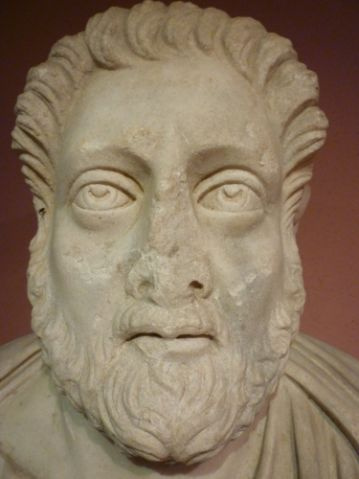
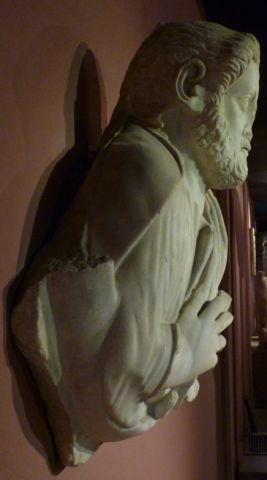
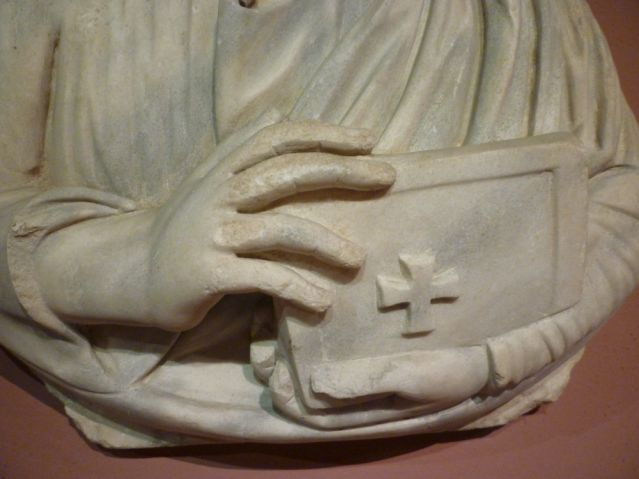
White marble, H (total) 69, (of head) 25 cm; W 65 cm. The bust was set in a circular frame which in turn was placed onto an octagonal plate. The circular frame and the corners of the underlying octagonal plate are preserved only at the bottom of the bust. The nose is broken, the fingers are chipped, and the fringe of the sleeve is broken at the the right arm; the bust is otherwise completely preserved.
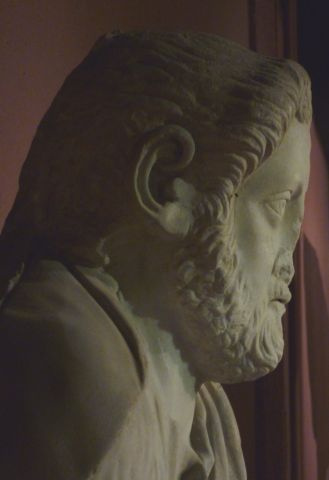
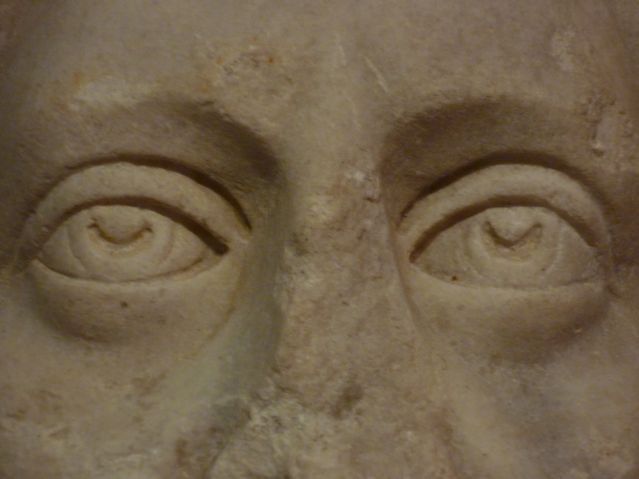
The folds of the garment are realistically rendered. The eyes are large; the pupils are indicated by a crescent shape drill line, and the iris is marked by an incised line. The upper lids are separated from the orbitals by drilled lines. The hair is indicated with a chisel on the skull; around the face, the strands are singled out by drill lines. The beard is worked with a chisel; the lips are separated by a deep drill line, touching each other only in the centre. No wrinkles are indicated.
The eyebrows are regularly arching, the arching line is repeated by the outline of the upper lids. The symmetrical arrangement of the beard, the pointed centre of the lips, and the long nose stress the vertical axis. The symmetrical build up and the smooth surface create a ‘classicising’ impression.
PROVENANCE AND CURRENT LOCATION
The bust is from Istanbul; however, there is no published information on the find spot. There is no recorded date of entry into the Istanbul Museum; it was first recorded by Strzygowski 1892 in the then imperial Ottoman Museum (Tschinili-Kiosk Museum) where the author saw it in 1889. It is today in the Istanbul Archaological Museum, inv. no. 930.
DESCRIPTION (Subject)
The portrait shows a mature man with full beard. His hair is combed forward in long lank strands; it forms a small ‘fork’ above the right temple and is brushed to the left above the brow. The hair forms a small coil around the face; the ears are free. The hairstyle is similar to non-imperiasl portraits in the late 4th and earlier 5th century (e. g. LSA-67, LSA-69, LSA-72, LSA-81, LSA-101, LSA-117, LSA-150, LSA-169, LSA-176, LSA-181, LSA-182, LSA-389, LSA-1093, LSA-1709). The beard is arranged into long strands around the mouth, and trimmed under the chin and at the jawbones. The man is wearing a tunic with wide sleeves and a cloak (himation). The cloak covers the left side of the body and is tightly wrapped around the left forearm. In his hands he is holding a codex decorated with a cross and a frame.
The tondo portrait takes up an antique tradition of honouring cultural heroes in this form which is still alive in Late Antiquity (LSA-206, LSA-207, LSA-208, LSA-209, LSA-210, LSA-211, LSA-212,LSA-213,LSA-214, LSA-236, LSA-238, LSA-442, LSA-483, LSA-602, LSA-603, LSA-604, LSA-2109, LSA-2287, LSA-2360, LSA-2440, LSA-2441, LSA-2511, LSA-2533, LSA-2537, LSA-2663). However, it is conspicuous that it was transformed here into a Christian context which is demonstratively visualized by the presentation of the codex with the cross (see also below, ‘Further Discussion’).
Strzygowski 1892, 586 suggested that the portrayed was an evangelist (Strzygowski thought it was most probably St Mark; Grabar 1963, 12: St Luke or St Mark); this was widely accepted in later scholarship (see also below, ‘Further Discussion‘).
DATE
The hairstyle resembles non-imperial portraits of the Theodosian period and suggests a date not earlier than the late 4th century. The feature of the cross enters massively into the imperial iconography in the earlier 5th century, under Theodosius II; its appearance on the tondo portraits is possibly in connection with this development. The stylistic features of the portrait, with the ‘naturalistic’ treatment of the garment, and the ‘classicising’ appearance of the face support, so I think, a date in the earlier 5th century.
FURTHER DISCUSSION
Fragments of three tondo portraits similar in size, style, iconography and technique, are preserved in the Istanbul Museum (LSA-2417, LSA-2418, LSA-2419). It is possible that they once formed a group, possibly of the four evangelists (see above, ‘Description (Subject)’).
Nothing is known about the late antique display of the tondi. Strzygowski 1892, 588 suggested that the four octagonal medaillons in the Istanbul Museum once decorated the pendentives of a church. Grabar 1963, 9 doubted this and justly pointed out that they were more probably embedded into an architectural setting. Relief panels from St Polyeuktos showing Christ, the Virgin and apostles and/or evangelists adopt the iconography of our tondo portraits (Harrison and Fıratlı 1966, 235 and figs. 33-8; Harrison, Fıratlı and Hayes 1968, 199 and fig. 10); they were possibly parts of a sanctuary screen.
Discussion references
- Harrison, R. M. and N. Fıratlı, Excavations at Saraçhane ın Istanbul: Second and Third Preliminary Reports, Dumbarton Oaks Papers 20, 222-38, 1966, 235 nos. 1-6 and figs. 33-8
- Harrison, R. M., Fıratlı, N. and J. W. Hayes, Excavations at Saraçhane ın Istanbul: Fifth Preliminary Report, with a Contribution on ASeventh-Century Pottery Group, Dumbarton Oaks Papers 22, 195-216, 1968, 199 and figs. 10-12
- Strzygowski, J., Die altbyzantinische Plastik der Blütezeit, Byzantinische Zeitschrift 1, 575-90, 1892, 585-90 pl. III
Cite: Last Statues of Antiquity, LSA-2416 (Ulrich Gehn).