
LSA-2417
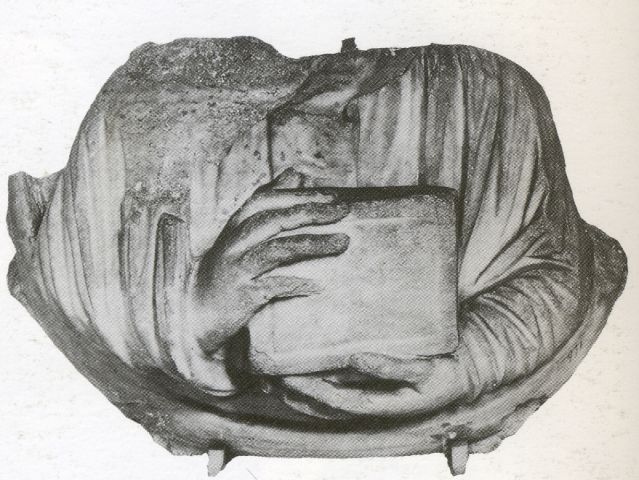
Headless tondo portrait of evangelist or apostle. Constantinople. Fourth to fifth century.
Record details
Photographs
Bibliography
- Fıratlı, N., La sculpture byzantine figurée au Musée archéologique d'Istanbul, Paris 1990, 19 no. 37 pl. 16
- Grabar, A., Sculptures byzantines de Constantinople (IVe - Xe siècle), Paris 1963, 9-16
- Mendel, G., Musées impériaux ottomans. Catalogue des sculptures grecques, romaines et byzantines, Istanbul 1912-1914, 446, no. 662
Discussion
DESCRIPTION (Object)
Coarse grained white marble, H 41, W 67 cm. The head and the upper portion of the shoulders are broken with the upper part of the frame. The bust was placed in a circular frame which in turn was set on an octagonal panel; this technique reoccurs on three other medaillons in the Istanbul Museum which are also iconographically related (LSA-2416, LSA-2418, LSA-2419). The circular frame and the underlying octagonal panel are preserved at the bottom from elbow to elbow.
The cross which once decorated the front face of the codex is now chiselled out (Strzygowski 1892, 585; Fıratlı 1990).
PROVENANCE AND CURRENT LOCATION
The bust is from Istanbul; however, there is no published information on the find spot. It was first recorded by Strzygowski 1892, 585 in the then imperial Ottoman Museum (Tschinili-Kiosk Museum) where the author saw it in 1889. According to Fıratlı 1990 it entered the Istanbul Archaeological Museum in 1894. It is today in the Istanbul Archaological Museum, inv. no. 931.
DESCRIPTION (Subject)
The portrayed is a man dressed in a tunic and a cloak (himation). The cloak is laid over both shoulders and is tightly wrapped around the left forearm. The man is holding a book between his hands in front of the body. The book is decorated by an elevated frame, similar to those displayed by the related tondi LSA-2416 and LSA-2418. Like these, the book was once decorated with a cross (see above, ‘Description (Object)‘).
Strzygowski 1892, 586 suggested that the four similar tondi in Istanbul represented the four evangelists; this was widely accepted in later scholarship (see the more detailed discussion in LSA-2416, ‘Description (Subject)’ and ‘Further Discussion‘).
DATE
The style of the garment is similar to that of the better preserved tondo LSA-2416. Our tondo is similar in size, style, iconography and technique and is probably contemporary (see LSA-2416, ‘Date’).
Discussion references
- Strzygowski, J., Die altbyzantinische Plastik der Blütezeit, Byzantinische Zeitschrift 1, 575-90, 1892, 585
Cite: Last Statues of Antiquity, LSA-2417 (Ulrich Gehn).