
LSA-2418
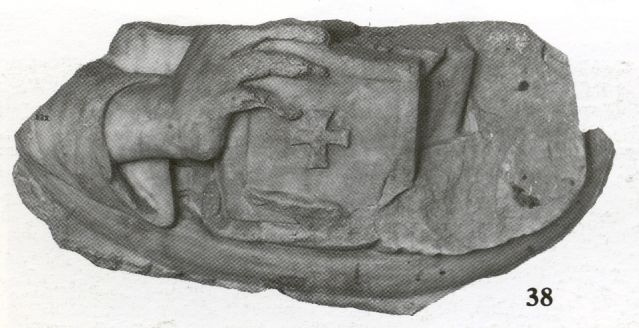
Lower edge of tondo portrait of evangelist or apostle. Constantinople. Fourth to fifth century.
Record details
Photographs
Bibliography
- Fıratlı, N., La sculpture byzantine figurée au Musée archéologique d'Istanbul, Paris 1990, 20 no. 38 pl. 17
- Grabar, A., Sculptures byzantines de Constantinople (IVe - Xe siècle), Paris 1963, 9-16
- Mendel, G., Musées impériaux ottomans. Catalogue des sculptures grecques, romaines et byzantines, Istanbul 1912-1914, 446, no. 662
Discussion
DESCRIPTION (Object)
Coarse grained white marble, H 32, W 59 cm. What is preserved identifies this fragment as part of a medaillon similar to LSA-2416, and LSA-2417. The upper portion with breast, shoulders and head is broken off. The right arm is chipped off, but its shape is still visible. Preserved are the right forearm and hand with three fingers, the codex, the bottom of the circular frame, and bits of the underlying octagonal panel.
PROVENANCE AND CURRENT LOCATION
There is no published information on the find spot of the bust. It was first recorded by Strzygowski 1892, 585 in the then imperial Ottoman Museum (Tschinili-Kiosk Museum) where the author saw it in 1889. It is today in the Istanbul Archaological Museum, inv. no. 931. According to Fıratlı 1990 there is no recorded date of entry into the Istanbul Museum.
DESCRIPTION (Subject)
The portrait is of a male dressed in a tunic; the wide sleeve of the garment covers the right forearm almost down to the wrist. The man is holding a codex in front of him in a gesture similar to LSA-2416, and LSA-2417. Like these, the book is decorated with a frame and a cross in relief.
Strzygowski 1892, 586 suggested that the four similar tondi in Istanbul LSA-2416, LSA-2417, LSA-2419 and our tondo, represented the four evangelists; this was widely accepted in later scholarship (see the more detailed discussion in LSA-2416, ‘Description (Subject)’ and ‘Further Discussion‘).
DATE
The tondo will be contemporary with LSA-2416 (see discussion there).
Discussion references
- Strzygowski, J., Die altbyzantinische Plastik der Blütezeit, Byzantinische Zeitschrift 1, 575-90, 1892, 585
Cite: Last Statues of Antiquity, LSA-2418 (Ulrich Gehn).