
LSA-242
Milestone, or just possibly statue base, for Licinius and Licinius II (in the nominative). On road between Ephesus and Magnesia. 317-324
Record details
Photographs
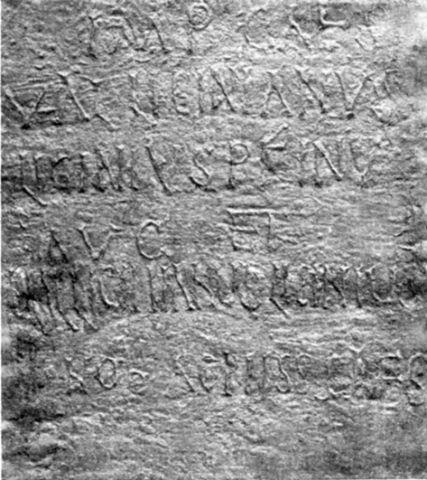
Inscription
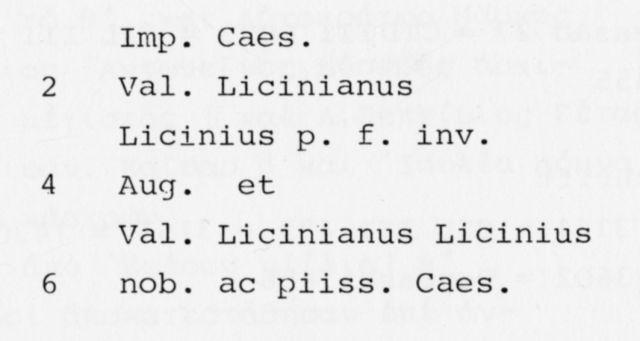
Imp(erator) Caes(ar) / Val(erius) Licinianus / Licinius, p(ius), f(elix), inv(ictus) / Aug(ustus), et / (5) Val(erius) Licinianus Licinius, / nob(ilissimus) ac piiss(imus) Caes(ar).
Inscription translation
Emperor Caesar Val(erius) Licinianus Licinius, pious, fortunate, unconquered Augustus, and Val(erius) Licinianus Licinius, most noble and most pious Caesar.
Bibliography
- Wankel, H. et al. (eds.), Die Inschriften von Ephesos VII,1. Inschriften griechischer Städte aus Kleinasien, vol. 17,1, Bonn 1981, no. 3158
Discussion
INSCRIPTION
In six lines:
Imp(erator) Caes(ar) / Val(erius) Licinianus / Licinius, p(ius), f(elix), inv(ictus) / Aug(ustus), et / (5) Val(erius) Licinianus Licinius, / nob(ilissimus) ac piiss(imus) Caes(ar).
'Emperor Caesar Val(erius) Licinianus Licinius, pious, fortunate, unconquered Augustus, and Val(erius) Licinianus Licinius, most noble and most pious Caesar.'
Letter height 4-5 cm.
The inscription with the honorands in the nominative, and no awarder named, does not apply the usual formula of Latin statue base inscriptions. It would, on the other hand fit a milestone, even if no mileage is indicated here.
DESCRIPTION (from Keil 1910)
Large rectangular block of white marble, with mouldings at top and bottom, H 109, W48, D 53 cm. The inscription is carved over an erased earlier inscription of undeterminable date. Keil 1910, the first editor, was not able to see the top face and investigate whether there are traces of the fixings for a statue (see below, 'Provenance and Location'). No more detailed description has been published since, and a squeeze of the inscription remains the only published image.
PROVENANCE AND CURRENT LOCATION
The inscription was first recorded by Keil 1910 who saw it in the village of Naibili on the road from Ephesus to Magnesia on the Menandros. It was sticking upside down in the soil at that time, leaving the top face invisible (Keil 1910, 79-80 n. 5).
There is no recent record of the inscription’s location.
HONORAND AND DATE
Licinius, the first honorand (full name Valerius Licinianus Licinius) was Augustus 308-24. His son Licinius II, the second honorand (full name Valerius Licinianus Licinius) was Caesar 317-24.
FURTHER DISCUSSION
The form and material of the block (marble, rectangular and with mouldings) would suit a statue base; but the wording of the inscription (with the emperors in the nominative, and without a named awarder), as well as the rural findspot, point rather to a milestone (Keil 1910, 80 with the same assessment). As Keil 1910, 79-80 n. 5 points out, base-shaped milestones are often without mileages, which presumably were written on a pedestal below the base.
We agree with Keil that this was almost certainly a milestone when used under the Licinii, though it may have had a previous life as a statue base. If it was a Licinian statue base, it must have been accompanied by a second base to the second emperor.
Discussion references
- Keil, J., Neue Inschriften aus dem Gebiet von Magnesia a. M., Jahreshefte des Österreichischen Archäologischen Instituts in Wien, vol. XIII, 1910, Beiblatt, pp. 75-80, pp. 79-80 no. 2
Cite: Last Statues of Antiquity, LSA-242 (Ulrich Gehn).