
LSA-2420
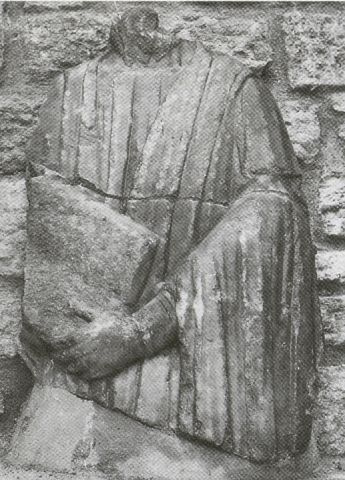
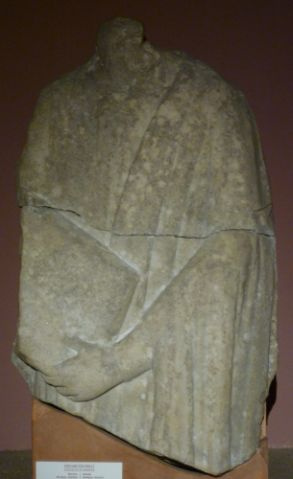
Headless torso of Apostle (?). Constantinople. Fifth to sixth century?
Record details
Photographs
Bibliography
- Fıratlı, N., La sculpture byzantine figurée au Musée archéologique d'Istanbul, Paris 1990, 20, no. 40, pl. 17
Discussion
DESCRIPTION (Object)
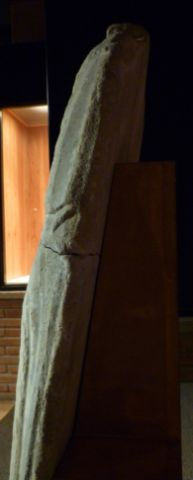
Proconnesian marble, H 84, W 48, D (at head) 7 cm. The statue is broken at bottom at the waist, and the head is missing; some strands of a beard are preserved. The torso has a horizontal break line at the breast. The surface of the book which the statue holds in its hand is worn. The back face is smooth. Although it is very flat, there is no indication that the torso was connected to a relief; it wass possibly standing in front of a wall.
The folds of the garment are rendered in a flat and schematic way.
PROVENANCE AND CURRENT LOCATION
The statue was found at the Ahırkapı in Istanbul, in the area south of Topkapı palace, and entered the Istanbul Museum in 1936. It is now in the Istanbul Archaeological Museum, inv. no. 4649.
DESCRIPTION (Subject)
The statue is of a bearded male. He is wearing a sleeved tunic (tunica manicata) of which the tight cuff is visible at the left wrist. The left upper arm is covered by a layer of cloth which is different from the vertical falling cloak over the left shoulder. This layer resembles the short arms of the upper tunics (colobia) worn by late antique togati (cf. e. g. LSA-1033). From the left shoulder the folds of a cloak, possibly a himation, are falling; they cross the strictly vertical folds of the tunic at the breast, and the cloak is also draped over the left forearm. In its hands the statue is holding an open book.
Fıratlı 1990, the only publisher of the statue, very cautiously suggested that it could be the statue of an Apostle (or Evangelist). A codex presented by the figure indeed occurs on the tondo portraits LSA-2416, LSA-2417, LSA-2418 (here clearly marked with a cross), and also on some relief figures from St Polyeuctus (Fıratlı 1990 no. 485, 487 pl. 123; no 488, 489, 491 pl. 124), and the codex (as opposed to a papyrus roll) was specifically associated with Christianity . Our figure is unique in that it holds an open book.
DATE
Fıratlı 1990 suggests a date in the 5th century.
The schematic style of the statue is different from the tondo portraits LSA-2416, LSA-2417, LSA-2418 and LSA-2419; it resembles the style of the relief figures from St Polyeuctus, built 524/7 (see above, ‘Description (Subject)‘; comparable are in particular Fıratlı 1990 no. 485, 486, 488, 492). I would suggest a date in the late 5th or 6th century for this unparalleled monument.
Cite: Last Statues of Antiquity, LSA-2420 (Ulrich Gehn).